



Dynamic effect of Qingre Sanjie Recipe on acne based on a DID model
-
摘要:
目的 寻常痤疮(瘀热互结证)是皮肤科常见炎症性疾病,影响患者形象,现有治疗效果局限。本研究应用(difference-in-differences,DID)模型分析清热散结方的动态效果,以期为建立基于证候分型的痤疮中西医结合诊疗方案提供循证依据。 方法 纳入2023年9月—2024年9月绍兴市中医院收治的92例寻常痤疮(瘀热互结证)患者,采用随机数字表法分为对照组(n=46)和观察组(n=46)。对照组给予多西环素胶囊联合夫西地酸乳膏治疗,观察组在对照组的基础上给予清热散结方治疗。比较2组患者临床疗效、中医证候评分、炎症-氧化情况及不良反应。 结果 观察组临床总有效率显著高于对照组[95.65%(44/46) vs. 82.61%(38/46),χ2=4.039,P=0.044]。清热散结方与寻常痤疮患者中医证候评分降低显著相关(P < 0.05)。治疗后,2组患者肿瘤坏死因子-α(TNF-α)、白细胞介素-17(IL-17)均下降,超氧化物歧化酶(SOD)均上升,且观察组患者TNF-α、IL-17低于对照组,SOD高于对照组(P<0.05)。对照组与观察组不良反应发生率比较差异无统计学意义[6.52%(3/46) vs. 13.04%(6/46),χ2=0.493,P=0.483]。 结论 清热散结方用于寻常痤疮(瘀热互结证)患者,临床疗效显著,可调节炎症-氧化因子水平,降低中医证候评分,并具有一定的安全性。 Abstract:Objective Acne vulgaris (stagnation of blood-heat syndrome) is a common inflammatory dermatological condition that affects patients ' appearance, and the efficacy of current treatments is limited. This study applied a difference-in-differences (DID) model to analyze the dynamic effect of the Qingre Sanjie Recipe, aiming to provide evidence-based basis for an integrated traditional Chinese and western medicine diagnosis and treatment of acne based on syndrome classification. Methods A total of 92 patients with acne vulgaris (stagnation of blood-heat syndrome) admitted to our hospital from September 2023 to September 2024 were randomly divided into a control group (n=46) and an observation group (n=46). The control group received doxycycline capsules combined with fusidic acid cream, while the observation group was supplemented with Qingre Sanjie Recipe on the basis of the control group. The clinical efficacy, traditional Chinese medicine (TCM) syndrome score, inflammation-oxidation, and adverse reactions were compared between the two groups. Results The total clinical effective rate in the observation group was significantly higher than that in the control group [95.65% (44/46) vs. 82.61% (38/46), χ2=4.039, P=0.044]. Qingre Sanjie Recipe was significantly related to the decrease of TCM syndrome score of acne vulgaris patients (P < 0.05). After treatment, the levels of tumor necrosis factor-α (TNF-α) and interleukin-17 (IL-17) decreased, while the levels of superoxide dismutase (SOD) increased. The levels of TNF-α and IL-17 in the observation group were lower than those in the control group, while the levels of SOD were higher than those in the control group (P < 0.05). There was no significant difference in the incidence of adverse reactions between the control group and the observation group [6.52% (3/46) vs. 13.04% (6/46), χ2=0.493, P=0.483]. Conclusion The Qingre Sanjie Recipe is effective in treating acne vulgaris (stagnation of blood-heat syndrome), and it can regulate inflammatory-oxidative factors, reduce the score of TCM syndromes, and demonstrates safety. -
Key words:
- Acne /
- Difference-in-differences /
- Qingre Sanjie Recipe /
- Stasis-heat syndrome /
- Superoxide dismutase
-

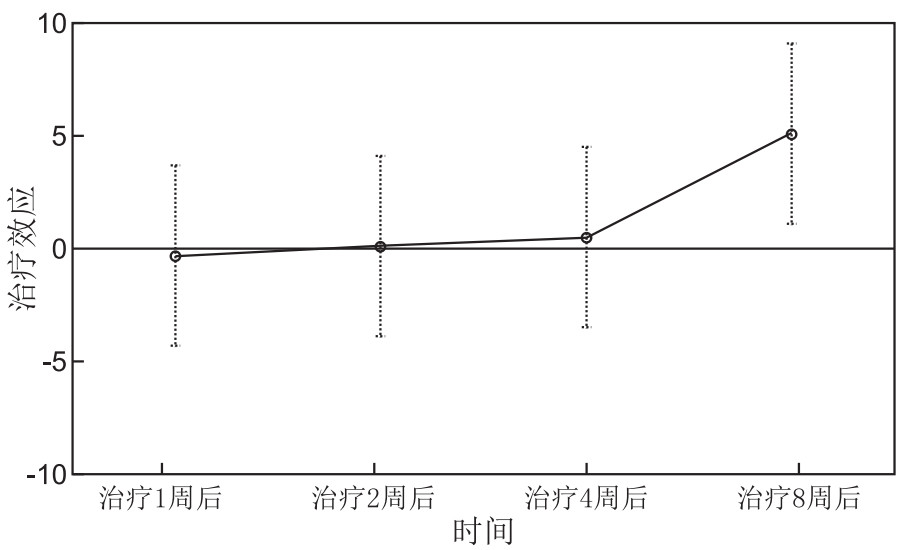
图 1 清热散结方治疗影响中医证候评分的平衡趋势
Figure 1. Parallel trends in the effect of Qingre Sanjie recipe treatment on TCM syndrome scores
表 1 2组寻常痤疮(瘀热互结证)患者总有效率比较[例(%)]
Table 1. Comparison of overall clinical efficacy between the two groups of patients with acne vulgaris (blood-heat stagnation syndrome)[cases(%)]
组别 例数 治愈 显效 有效 无效 总有效 对照组 46 5(10.87) 16(34.78) 17(36.96) 8(17.39) 38(82.61) 观察组 46 14(30.43) 19(41.30) 11(23.91) 2(4.35) 44(95.65) 注:2组总有效率比较,χ2=4.039,P=0.044。  下载: 导出CSV
表 2 患者中医证候评分比较(x±s,分)
Table 2. Comparison of TCM syndrome scores between the two groups of patients with acne vulgaris (blood-heat stagnation syndrome)(x±s, points)
组别 例数 治疗前 治疗1周 治疗2周 治疗4周 治疗8周 对照组 46 10.51±2.87 10.20±2.83 9.56±2.74 8.94±2.41ab 7.95±2.01abcd 观察组 46 11.02±2.95 10.25±2.90 9.15±2.67a 7.50±2.34abc 4.58±1.63abcd F值 0.840 0.084 0.727 2.907 8.832 P值 0.403 0.933 0.469 0.005 <0.001 注:与同组治疗前比较,aP<0.05;与同组治疗后1周比较,bP < 0.05;与同组治疗后2周比较,cP < 0.05;与同组治疗后4周比较,dP < 0.05。
下载: 导出CSV
表 3 清热散结方治疗影响寻常痤疮(瘀热互结证)患者中医证候评分的结果
Table 3. Results of the effect of Qingre Sanjie recipe on TCM syndrome scores in patients with acne vulgaris (blood-heat stagnation syndrome)
变量 β SE t值 P值 95% CI 时间 -0.320 0.050 -6.400 <0.001 -0.420~-0.220 治疗 0.510 0.200 2.550 0.012 0.110~0.910 交互作用 0.485 0.150 3.230 0.072 -0.190~1.160
下载: 导出CSV
表 4 2组寻常痤疮(瘀热互结证)患者治疗前后炎症-氧化情况比较(x±s)
Table 4. Comparison of inflammation oxidation status before and after treatment between the two groups of patients with acne vulgaris (blood-heat stagnation syndrome, x±s)
组别 例数 TNF-α(ng/L) IL-17(ng/L) SOD(U/mL) 治疗前 治疗后 治疗前 治疗后 治疗前 治疗后 对照组 46 42.15±4.86 34.22±4.40b 33.85±3.39 23.57±2.64b 38.76±4.58 52.33±2.50b 观察组 46 42.78±4.94 28.05±3.96b 33.94±3.26 19.46±2.63b 38.65±5.04 66.74±4.68b 统计量 0.617a 7.069c 0.130a 7.480c 0.110a 18.420c P值 0.539 <0.001 0.897 <0.001 0.913 <0.001 注:a为t值,c为F值; 与同组治疗前比较,bP<0.05。
下载: 导出CSV
-
[1] 陈姣, 李建伟, 陈绍斐, 等. 基于体质学说分析"湿热"表象下的痤疮[J]. 中国中医基础医学杂志, 2023, 29(8): 1272-1274.CHEN J, LI J W, CHEN S F, et al. Analysis of acne under appearance of"Dampness Heat"based on constitution theory[J]. Journal Of Basic Chinese Medicine, 2023, 29(8): 1272-1274. [2] LAYTON A M, RAVENSCROFT J. Adolescent acne vulgaris: current and emerging treatments[J]. Lancet Child Adolesc Health, 2023, 7(2): 136-144. doi: 10.1016/S2352-4642(22)00314-5 [3] 郭琼, 任虎, 钟婷婷, 等. 中重度痤疮患者心理健康状况及影响因素[J]. 四川精神卫生, 2024, 37(4): 335-340.GUO Q, REN H, ZHONG T T, et al. Mental health status and influencing factors in patients with moderate to severe acne[J]. Sichuan Mental Health, 2024, 37(4): 335-340. [4] DESSINIOTI C, KATSAMBAS A. Antibiotics and antimicrobial resistance in acne: epidemiological trends and clinical practice considerations[J]. Yale J Biol Med, 2022, 95(4): 429-443. [5] 李涛, 王芳, 韦朵, 等. 浅析孙虹教授治疗寻常痤疮热瘀互结证用药规律[J]. 皮肤病与性病, 2021, 43(4): 512-514.LI T, WANG F, WEI D, et al. Brief analysis of Professor SUN Hong' s medication rules in treating acne vulgaris with heat-stasis interbinding syndrome[J]. Journal of Dermatology and Venereology, 2021, 43(4): 512-514. [6] 章誉耀, 孟易禹, 吴珏婷. 清热散结胶囊联合开喉剑喷雾剂治疗反流性咽喉炎的价值[J]. 辽宁中医杂志, 2024, 51(9): 102-104.ZHANG Y Y, MENG Y Y, WU J T. Value of Qingre Sanjie Capsules combined with Kaihoujian Spray in the treatment of reflux pharyngitis[J]. Liaoning Journal of Traditional Chinese Medicine, 2024, 51(9): 102-104. [7] 赵辨. 中国临床皮肤病学[M]. 南京: 江苏科学技术出版社, 2010: 1165.ZHAO B. Clinical Dermatology of China[M]. Nanjing: Jiangsu Science and Technology Press, 2010: 1165. [8] 赵统秀, 王煜, 王自立. 王自立从肺治疗痤疮经验拾萃[J]. 四川中医, 2014, 32(3): 46-47.ZHAO T X, WANG Y, WANG Z L. Summary of WANG Zili' s experience in treating acne from the lung[J]. Sichuan Journal of Traditional Chinese Medicine, 2014, 32(3): 46-47. [9] 陈琴, 陈晓雯, 贾其军. 陈晓雯治疗痤疮经验[J]. 实用中医药杂志, 2014, 30(8): 755-756.CHEN Q, CHEN X W, JIA Q J. CHEN Xiaowen' s experience in treating acne[J]. Journal of Practical Traditional Chinese Medicine, 2014, 30(8): 755-756. [10] 丁娟, 张建青, 陈宏. 清热散结片联合异维A酸软胶囊、克拉霉素缓释片治疗寻常型痤疮的临床效果及对血清IL-17的影响[J]. 中华中医药学刊, 2021, 39(5): 67-69.DING J, ZHANG J Q, CHEN H. Clinical effect of Qingre Sanjie Tablets combined with Isotretinoin Soft Capsules and Clarithromycin Sustained-release Tablets in the treatment of acne vulgaris and its influence on serum IL-17[J]. Chinese Archives of Traditional Chinese Medicine, 2021, 39(5): 67-69. [11] 张小芳, 高军, 姜慧, 等. 严重程度痤疮患者血清25羟维生素D水平及其与IL-8 TNF-α TLR2的相关性[J]. 河北医学, 2023, 29(4): 578-582.ZHANG X F, GAO J, JIANG H, et al. Level of serum 25-hydroxyvitamin D and its correlation with IL-8 TNF-αand TLR2 in patients with different severity of acne[J]. Hebei Medicine, 2023, 29(4): 578-582. [12] 鞠强, 郑志忠. 兼顾临床经验与循证证据助推中国痤疮诊治水平稳步提升: 《中国痤疮治疗指南(2019修订版)》解读[J]. 中华医学信息导报, 2019, 34(24): 22.JU Q, ZHENG Z Z. Promoting the steady improvement of acne diagnosis and treatment level in China by integrating clinical experience and evidence-based evidence: Interpretation of "Chinese Guidelines for the Treatment of Acne (2019 Revised Edition)"[J]. Chinese Medical Information Bulletin, 2019, 34(24): 22. [13] 马丽华, 杨茂芹. 夫西地酸乳膏联合阿达帕林凝胶治疗寻常痤疮的临床疗效及安全性分析[J]. 药店周刊, 2021, 30(48): 36-37.MA L H, YANG M Q. Analysis of clinical efficacy and safety of Fusidic Acid Cream combined with Adapalene Gel in the treatment of acne vulgaris[J]. Pharmacy Weekly, 2021, 30(48): 36-37. [14] MÅRDH O, PLACHOURAS D. Using doxycycline for prophylaxis of bacterial sexually transmitted infections: considerations for the European Union and European Economic Area[J]. Euro Surveill, 2023, 28(46): 2300621. DOI: 10.2807/1560-7917.ES.2023.28.46.2300621. [15] 李坤杰, 黄煌, 林松发, 等. 羟氯喹联合多西环素序贯Elos光电协同技术治疗毛细血管扩张型玫瑰痤疮疗效观察[J]. 中国皮肤性病学杂志, 2021, 35(11): 1244-1248.LI K J, HUANG H, LIN S F, et al. Observation on the efficacy of hydroxychloroquine combined with doxycycline sequential Elos photoelectric synergistic technology in the treatment of telangiectatic rosacea[J]. Chinese Journal of Dermatology and Venereology, 2021, 35(11): 1244-1248. [16] 鲍丙溪, 刘健, 黄旦, 等. 刘健中医药治疗皮肌炎用药规律数据挖掘研究[J]. 中医药临床杂志, 2022, 34(12): 2317-2323.BAO B X, LIU J, HUANG D, et al. Data mining study on the medication rules of LIU Jian' s traditional Chinese medicine in treating dermatomyositis[J]. Clinical Journal of Traditional Chinese Medicine, 2022, 34(12): 2317-2323. [17] 朱若维, 李雪菲, 牛露娜, 等. 基于数据挖掘探讨国医大师治疗胸痹心痛痰瘀互结证用药规律及经验[J]. 西部中医药, 2024, 37(3): 28-31.ZHU R W, LI X F, NIU L N, et al. Exploring the medication rules and experience of national medical masters in treating chest impediment and heartache with phlegm-stasis interbinding syndrome based on data mining[J]. Western Journal of Traditional Chinese Medicine, 2024, 37(3): 28-31. [18] 陈志良, 刘聪, 廖自文, 等. 紫花地丁总黄酮的提取工艺及抗炎作用研究[J]. 中国畜牧兽医, 2024, 51(11): 5051-5063.CHEN Z L, LIU C, LIAO Z W, et al. Study on extraction process and anti-inflammatory effect of total flavonoids from Viola philippica[J]. Chinese Journal of Animal Husbandry and Veterinary Medicine, 2024, 51(11): 5051-5063. [19] 胡冰洁. 清热散结方治疗寻常痤疮瘀热互结证临床疗效观察及其对血清SOD水平的影响[D]. 济南: 山东中医药大学, 2020.HU B J. Clinical observation on the efficacy of Qingre Sanjie Recipe in treating acne vulgaris with stasis-heat syndrome and its influence on serum SOD level[D]. Jinan: Shandong University of Traditional Chinese Medicine, 2020. [20] 方静, 王莉文, 王静, 等. 外周血IL-17A水平与寻常痤疮的相关性研究及对痤疮瘢痕的预测价值[J]. 中华全科医学, 2024, 22(9): 1483-1486. doi: 10.16766/j.cnki.issn.1674-4152.003664FANG J, WANG L W, WANG J, et al. Relationship between peripheral blood IL-17A levels and severity of acne vulgaris and its predictive value for acute acne scars[J]. Chinese Journal of General Practice, 2024, 22(9): 1483-1486. doi: 10.16766/j.cnki.issn.1674-4152.003664 [21] HOU Y C, ALSHARAWY A. Applying difference-in-differences design in quality improvement and health systems research[J]. J Am Geriatr Soc, 2025, 73(1): 8-11. doi: 10.1111/jgs.19180 -

 点击查看大图
计量
- 文章访问数: 5
- HTML全文浏览量: 4
- PDF下载量: 0
- 被引次数: 0
