



Clinical practice protocol for home-based pulmonary rehabilitation in patients with stable chronic obstructive pulmonary disease
-
摘要: 慢性阻塞性肺疾病(chronic obstructive pulmonary disease,COPD)是严重危害我国居民健康的重大慢病之一,在2024年已成为继高血压病、2型糖尿病后第3个被纳入国家基本公共卫生服务项目的慢性病。肺康复(又称呼吸康复)被认为是慢性呼吸道疾病患者康复的核心组成部分,是COPD患者非药物治疗的核心手段。然而,传统中心化的肺康复因受限于时间、空间、交通条件、成本等多重因素,其普及性与依从性均面临严峻挑战。居家肺康复模式以其便捷、可及的优势,成为突破这一困境的有效途径。本文旨在系统阐述COPD稳定期患者居家肺康复的临床规范,从其定义、适用对象、介入时机、持续时间、评估方法、运动及呼吸处方、安全性监测、注意事项、总结与展望等关键环节进行全面论述,以期为各级医疗机构医护人员提供清晰、实用的实践指导,最终达到减轻症状、延缓疾病进展、提升患者生活质量的综合管理目标。Abstract: Chronic obstructive pulmonary disease (COPD) is one of the major chronic diseases that poses a serious threat to population health in China. In 2024, it was incorporated into the National Basic Public Health Service Program as the third targeted chronic disease, following hypertension and type 2 diabetes. Pulmonary rehabilitation (also known as respiratory rehabilitation) is recognized as a core component of rehabilitation for patients with chronic respiratory diseases and represents a cornerstone of non-pharmacological treatment for COPD patients. However, the widespread implementation of traditional center-based pulmonary rehabilitation is limited by multiple barriers, including time constraints, geographical distance, transportation difficulties, and financial cost, resulting in suboptimal participation and adherence. The home-based pulmonary rehabilitation model, with its advantages of convenience and accessibility, has emerged as an effective solution to overcome these difficulties. This article aims to systematically outline a clinical protocol for home-based pulmonary rehabilitation in patients with stable COPD. It comprehensively discusses key aspects, including definition, target population, optimal timing and duration of intervention, assessment methods, exercise and breathing prescriptions, safety monitoring, precautions, as well as a summary of future prospective. The goal is to provide clear and practical guidance for healthcare professionals across different levels of medical institutions, ultimately supporting comprehensive disease management aimed at symptom relief, delayed disease progression, and improved quality of life in patients with COPD.
-

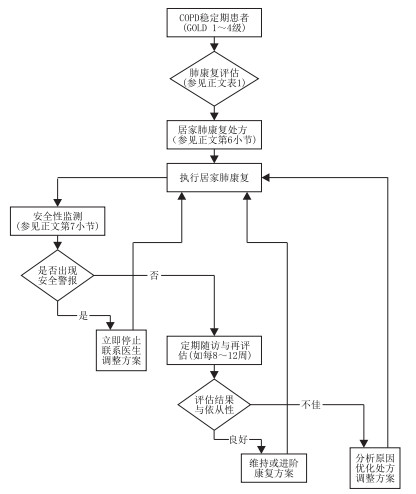
图 1 居家肺康复实施流程图
Figure 1. Flowchart for the implementation of home-based pulmonary rehabilitation
分类 内容及方法 应用场景与说明 临床评估 现病史;既往史;共患病;体格检查 核心安全筛查,尤其在急性加重出院后启动康复前至关重要,用于排除禁忌证,评估康复风险。稳定期患者初期评估时亦需完成 检查评估 化验检查;影像学检查;心电图;超声心动图;电子支气管镜检查 安全性及鉴别诊断依据,主要用于急性加重后或存在可疑心血管等合并症的患者,为确保运动安全提供客观依据。稳定期患者根据临床需要选择 功能评估 肺功能;咳嗽峰流速;最大吸气压(maximal inspiratory pressure, MIP);最大呼气压(maximal expiratory pressure, MEP);跨膈压;膈肌超声;心肺运动试验(cardiopulmonary exercise testing, CPET);6分钟步行试验;1分钟坐-站试验;徒手肌力检查;等长测力计;等张肌力检查;吞咽功能评估 康复处方制定与效果评价的核心。是稳定期患者评估的重点,用于客观量化受损程度,为制定个体化运动处方提供基准,并精确评估康复疗效 问卷评估 圣乔治呼吸问卷(St.George's respiratory questionnaire, SGRQ);慢性呼吸系统疾病问卷(chronic respiratory disease questionnaire, CRQ);慢性阻塞性肺疾病评估测试(COPD assessment test, CAT);视觉模拟评分(visual analogue scale, VAS);改良巴氏指数;工具性日常生活活动能力量表(instrumental activities of daily living scale, IADL);改良呼吸困难指数(modified medical research council dyspnea scale, mMRC);Borg量表;医院焦虑抑郁量表;匹兹堡睡眠质量指数(Pittsburgh sleep quality index, PSQI);营养筛查(nutritional risk screening 2002, NRS 2002) 贯穿全程,侧重患者主观体验与生活质量。稳定期用于全面了解症状负担、心理状态和生活质量,是评价康复综合获益的关键。急性加重后可用于快速筛查焦虑、抑郁、营养风险等影响预后的因素  下载: 导出CSV
表 2 不同指南对COPD患者的运动建议总结
Table 2. Summary of exercise recommendations for COPD patients in different guidelines
运动要素 ACSM ATS/ERS AACVPR 耐力运动 方式 步行和/或骑自行车 骑自行车或步行(地面或跑步机) 步行(跑步机、跑道、助行器或轮椅支撑步行)、骑自行车、固定自行车、臂力测功计、台阶练习、划船、水中运动、改良有氧舞蹈,坐位有氧运动等 频率 3~5次/周(最少) 3~5次/周 3~5次/周 强度 低强度:30%~40%峰值功率;高强度:60%~80%峰值功率;替代标准:Borg CR10量表气促评分4~6分 >60%最大功率 高强度:60%~80%峰值功率 持续时间 无单次训练总时长的具体建议。时长建议基于COPD严重程度;中重度患者在训练初期可能仅能耐受特定强度数分钟,最初可能需要间歇性训练 20~60 min/次 20~60 min/次(持续4~12周) 进阶 基于健康和体能状况个体化制定。可参考适用于老年人的通用指南。初期:前4~6周内,每1~2周增加5~10 min,然后逐渐增加时长、频率和/或强度 按Borg量表滴定至症状4~6分或按主观努力评定(rating of perceived exertion,RPE)量表滴定至症状12~14分 选项包括滴定至选定的RPE水平、呼吸困难水平或预定的代谢当量水平 注解 在个体能够忍受较长时间的运动之前,最初可采用间歇性训练。据报道,高强度的短时间、间歇性训练可降低症状评分 对因症状限制而无法忍受持续训练的个体,应考虑间歇性训练 对于无法维持长时间连续高强度运动的个人,应考虑进行间歇性训练。强调运动前的热身和运动后的放松 抗阻运动 注意:ACSM指南不包括针对COPD患者抗阻训练和柔韧性练习的具体建议,但参考了针对老年人和健康成年人的建议。以下陈述反映了这些建议 抗阻运动应遵循与健康和/或老年人运动处方相同的FITT原则 未说明 方式 强调功能性活动(如爬楼梯);自由举重、器械抗阻、弹力带 重复提举相对较重的负荷 举重:手部和踝部重量、自由重量、器械重量、弹力带阻力、利用自身体重(爬楼梯、深蹲) 频率 ≥2次/周 2~3次/周 未作说明 强度 低强度:1次重复最大值的40%~50%;中等强度:1次重复最大值的60%~70% 1次重复最大值的60%~70%,或8~12次重复最大值的100% 从较低重量/阻力和较高重复次数开始,以增加肌肉耐力。在个体化基础上,可采用较大重量和较少重复次数促进力量发展 持续时间 1~4套;8~10个练习;重复10~15次,以提高肌肉力量和耐力 未作说明 未作说明 进阶 逐渐增加阻力和/或重复次数和/或频率 增加重量、每组重复次数、每次训练的组数,或者当个人可以在连续2次训练中完成超过所需次数的1 ~2次重复时减少休息时间 监测RPE及肌肉/关节疲劳、酸痛和疼痛 注解 组间休息2~3 min;每次练习都使用适当的技巧;在整个运动范围内移动;使用正确的呼吸技巧;使用多关节和单关节练习来锻炼每个主要肌肉群 耐力训练是肺康复的主要内容。然而,阻力运动将带来更大的肌肉质量和肌肉力量增益,并减少呼吸困难 对于骨质疏松症,注意脊柱屈曲/旋转和大重量训练;对于肺动脉高压:低阻力训练和有节奏的呼吸,有氧训练是可以接受的
下载: 导出CSV
-
[1] CELLI B R, CHRISTENSON S, RABE K F, et al. Current smoker: a clinical COPD phenotype affecting disease progression and response to therapy[J]. Am J Respir Crit Care Med, 2025, 211(5): 729-736. doi: 10.1164/rccm.202407-1379CI [2] DE OCA M M, PEREZ-PADILLA R, CELLI B, et al. The global burden of COPD: epidemiology and effect of prevention strategies[J]. Lancet Respir Med, 2025, 13(8): 709-724. doi: 10.1016/S2213-2600(24)00339-4 [3] BOERS E, BARRETT M, SU J G, et al. Global burden of chronic obstructive pulmonary disease through 2050[J]. JAMA Netw Open, 2023, 6(12): e2346598. DOI: 10.1001/jamanetworkopen.2023.46598. [4] SINGH D, HAN M K, HAWKINS N M, et al. Implications of cardiopulmonary risk for the management of COPD: a narrative review[J]. Adv Ther, 2024, 41(6): 2151-2167. doi: 10.1007/s12325-024-02855-4 [5] ADELOYE D, SONG P, ZHU Y, et al. Global, regional, and national prevalence of, and risk factors for, chronic obstructive pulmonary disease (COPD) in 2019: a systematic review and modelling analysis[J]. Lancet Respir Med, 2022, 10(5): 447-458. doi: 10.1016/S2213-2600(21)00511-7 [6] DOBRIC A, DE LUCA S N, SPENCER S J, et al. Novel pharmacological strategies to treat cognitive dysfunction in chronic obstructive pulmonary disease[J]. Pharmacol Ther, 2021, 233: 108017. DOI: 10.1016/j.pharmthera.2021.108017. [7] 王妍, 闫巍. 关注肺健康, 实现COPD防治关口前移[J]. 中华全科医学, 2025, 23(2): 194-197, 214. doi: 10.16766/j.cnki.issn.1674-4152.003865WANG Y, YAN W. Prioritizing lung health: Achieving effective prevention and treatment of chronic obstructive pulmonary disease[J]. Chinese Journal of General Practice, 2025, 23(2): 194-197, 214. doi: 10.16766/j.cnki.issn.1674-4152.003865 [8] ROCHESTER C L, ALISON J A, CARLIN B, et al. Pulmonary rehabilitation for adults with chronic respiratory disease: an official American thoracic society clinical practice guideline[J]. Am J Respir Crit Care Med, 2023, 208(4): e7-e26. DOI: 10.1164/rccm.202306-1066ST. [9] CHUNG C, LEE W J, LEE S W, et al. Clinical efficacy of mobile app-based, self-directed pulmonary rehabilitation for patients with chronic obstructive pulmonary disease: systematic review and meta-analysis[J]. JMIR Mhealth Uhealth, 2024, 12: e41753. DOI: 10.2196/41753. [10] WEN J, MILNE S, SIN D D. Pulmonary rehabilitation in a postcoronavirus disease 2019 world: feasibility, challenges, and solutions[J]. Curr Opin Pulm Med, 2022, 28(2): 152-161. doi: 10.1097/MCP.0000000000000832 [11] STEFAN M S, PEKOW P S, PRIYA A, et al. Association between initiation of pulmonary rehabilitation and rehospitalizations in patients hospitalized with chronic obstructive pulmonary disease[J]. Am J Respir Crit Care Med, 2021, 204(9): 1015-1023. doi: 10.1164/rccm.202012-4389OC [12] COX N S, MCDONALD C F, MAHAL A, et al. Telerehabilitation for chronic respiratory disease: a randomised controlled equivalence trial[J]. Thorax, 2022, 77(7): 643-651. doi: 10.1136/thoraxjnl-2021-216934 [13] COX N S, DAL CORSO S, HANSEN H, et al. Telerehabilitation for chronic respiratory disease[J]. Cochrane Database Syst Rev, 2021, 1(1): CD013040. DOI: 10.1002/14651858.CD013040. [14] BENZO R, HOULT J, MCEVOY C, et al. Promoting chronic obstructive pulmonary disease wellness through remote monitoring and health coaching: a clinical trial[J]. Ann Am Thorac Soc, 2022, 19(11): 1808-1817. doi: 10.1513/AnnalsATS.202203-214OC [15] UZZAMAN M N, AGARWAL D, CHAN S C, et al. Effectiveness of home-based pulmonary rehabilitation: systematic review and meta-analysis[J]. Eur Respir Rev, 2022, 31(165): 220076. DOI: 10.1183/16000617.0076-2022. [16] COX N S, MCDONALD C, BURGE A T, et al. Comparison of clinically meaningful improvements after center-based and home-based telerehabilitation in people with COPD[J]. Chest, 2025, 167(4): 1003-1011. doi: 10.1016/j.chest.2024.11.001 [17] ZANABONI P, DINESEN B, HOAAS H, et al. Long-term telerehabilitation or unsupervised training at home for patients with chronic obstructive pulmonary disease: a randomized controlled trial[J]. Am J Respir Crit Care Med, 2023, 207(7): 865-875. doi: 10.1164/rccm.202204-0643OC [18] SPRUIT M A, SINGH S J, GARVEY C, et al. An official American thoracic society/European respiratory society statement: key concepts and advances in pulmonary rehabilitation[J]. Am J Respir Crit Care Med, 2013, 188(8): e13-64. DOI: 10.1164/rccm.201309-1634ST. [19] 盛蕾益. 基于移动医疗的慢阻肺居家运动康复方法研究与应用[D]. 杭州: 浙江大学, 2021.SHENG L Y. Research and application of home-based pulmonary rehabilitation method for chronic obstructive pulmonary disease delivered via mHealth[D]. Hangzhou: Zhejiang University, 2021. [20] SPIELMANNS M, SCHULZE S T, GUENES E, et al. Clinical effects of pulmonary rehabilitation in very old patients with COPD[J]. J Clin Med, 2023, 12(7): 2513. DOI: 10.3390/jcm12072513. [21] DOWMAN L, HILL C J, MAY A, et al. Pulmonary rehabilitation for interstitial lung disease[J]. Cochrane Database Syst Rev, 2021, 2(2): CD006322. DOI: 10.1002/14651858.CD006322. [22] 中国医师协会呼吸医师分会, 中华医学会呼吸病学分会, 中国康复医学会呼吸康复专业委员会, 《中华健康管理学杂志》编辑委员会. 中国慢性呼吸道疾病呼吸康复管理指南(2021年)[J]. 中华健康管理学杂志, 2021, 15(6): 521-538.Chinese Association of Chest Physicians, Chinese Thoracic Society, Respiratory Rehabilitation Committee of Chinese Association of Rehabilitation Medicine, Chinese Journal of Health Management. Guidelines for respiratory rehabilitation management of chronic respiratory diseases in China (2021)[J]. Chinese Journal of Health Management, 2021, 15(6): 521-538. [23] RYRSØ C K, GODTFREDSEN N S, KOFOD L M, et al. Lower mortality after early supervised pulmonary rehabilitation following COPD-exacerbations: a systematic review and meta-analysis[J]. BMC Pulm Med, 2018, 18(1): 154. DOI: 10.1186/s12890-018-0718-1. [24] CHUATRAKOON B, UTHAIKHUP S, NGAI S P, et al. The effectiveness of home-based balance and pulmonary rehabilitation program in individuals with chronic obstructive pulmonary disease: a randomized controlled trial[J]. Eur J Phys Rehabil Med, 2022, 58(3): 478-486. [25] BISHOP J A, SPENCER L M, DWYER T J, et al. Effect of pulmonary rehabilitation duration on exercise capacity and health-related quality of life in people with chronic obstructive pulmonary disease (pure duration trial): a randomized controlled equivalence trial[J]. Respirology, 2025, 30(1): 41-50. doi: 10.1111/resp.14820 [26] PITTA F, TROOSTERS T, PROBST V S, et al. Are patients with COPD more active after pulmonary rehabilitation?[J]. Chest, 2008, 134(2): 273-280. doi: 10.1378/chest.07-2655 [27] REJBI I B C, TRABELSI Y, CHOUCHENE A, et al. Changes in six-minute walking distance during pulmonary rehabilitation in patients with COPD and in healthy subjects[J]. Int J Chron Obstruct Pulmon Dis, 2010, 5: 209-215. [28] CINDY NG L W, MACKNEY J, JENKINS S, et al. Does exercise training change physical activity in people with COPD? A systematic review and meta-analysis[J]. Chron Respir Dis, 2012, 9(1): 17-26. doi: 10.1177/1479972311430335 [29] MALAGUTI C, DAL CORSO S, JANJUA S, et al. Supervised maintenance programmes following pulmonary rehabilitation compared to usual care for chronic obstructive pulmonary disease[J]. Cochrane Database Syst Rev, 2021, 8(8): CD013569. DOI: 10.1002/14651858.CD013569. [30] CHEN X R, XU L, LI S Q, et al. Efficacy of respiratory support therapies during pulmonary rehabilitation exercise training in chronic obstructive pulmonary disease patients: a systematic review and network meta-analysis[J]. BMC Med, 2024, 22(1): 389. DOI: 10.1186/s12916-024-03605-7. [31] PASSERIEUX E, DESPLANCHE E, ALBURQUERQUE L, et al. Altered skeletal muscle function and beneficial effects of exercise training in a rat model of induced pulmonary emphysema[J]. Acta Physiol (Oxf), 2024, 240(7): e14165. DOI: 10.1111/apha.14165. [32] HEYNE E, ZEEB S, JUNKER C, et al. Exercise training differentially affects skeletal muscle mitochondria in rats with inherited high or low exercise capacity[J]. Cells, 2024, 13(5): 393. DOI: 10.3390/cells13050393. [33] HAN L H, LI P J, HE Q L, et al. Revisiting skeletal muscle dysfunction and exercise in chronic obstructive pulmonary disease: emerging significance of myokines[J]. Aging Dis, 2023, 15(6): 2453-2469. [34] HILL K, DOLMAGE T E, WOON L, et al. Comparing peak and submaximal cardiorespiratory responses during field walking tests with incremental cycle ergometry in COPD[J]. Respirology, 2012, 17(2): 278-284. doi: 10.1111/j.1440-1843.2011.02089.x [35] 李键, 周福健, 余娟, 等. 中国传统运动在慢性阻塞性肺疾病康复中的应用: 近20年文献计量学分析[J]. 华西医学, 2024, 39(6): 899-905.LI J, ZHOU F J, YU J, et al. Application of traditional Chinese exercise in the rehabilitation of chronic obstructive pulmonary disease: a bibliometric analysis of the past 20 years[J]. West China Medical Journal, 2024, 39(6): 899-905. [36] BARTZIOKAS K, PAPAPORFYRIOU A, HILLAS G, et al. Global initiative for chronic obstructive lung disease (gold) recommendations: strengths and concerns for future needs[J]. Postgrad Med, 2023, 135(4): 327-333. doi: 10.1080/00325481.2022.2135893 [37] CAI Y Y, REN X H, WANG J Y, et al. Effects of breathing exercises in patients with chronic obstructive pulmonary disease: a network meta-analysis[J]. Arch Phys Med Rehabil, 2024, 105(3): 558-570. doi: 10.1016/j.apmr.2023.04.014 [38] 吴蕾, 许银姬, 林琳. 慢性阻塞性肺疾病中医肺康复临床应用指南[J]. 中医杂志, 2021, 62(22): 2018-2024.WU L, XU Y J, LIN L. Clinical Application Guideline of Traditional Chinese Medicine Pulmonary Rehabilitation Therapy for Chronic Obstructive Pulmonary Disease[J]. Journal of Traditional Chinese Medicine, 2021, 62(22): 2018-2024. [39] NGAI S P C, JONES A Y M, TAM W W S. Tai Chi for chronic obstructive pulmonary disease (COPD)[J]. Cochrane Database Syst Rev, 2016, 2016(6): CD009953. DOI: 10.1002/14651858.CD009953. [40] ZHU S C, SHI K, YAN J, et al. A modified 6-form tai chi for patients with COPD[J]. Complement Ther Med, 2018, 39: 36-42. doi: 10.1016/j.ctim.2018.05.007 [41] 潘怡, 王振兴, 闵婕, 等. 24式简化太极拳在慢性阻塞性肺疾病稳定期肺康复中的疗效评价[J]. 中国康复医学杂志, 2018, 33(6): 681-686.PAN Y, WANG Z X, MIN J, et al. The effect of 24 simplified Taichi on pulmonary rehabilitation in patients with stable chronic obstructive pulmonary disease[J]. Chinese Journal of Rehabilitation Medicine, 2018, 33(6): 681-686. [42] 张妤, 刘敦煌. 二十四式太极拳结合呼吸康复训练对慢性阻塞性肺疾病患者肺功能及生活质量的影响[J]. 实用中医药杂志, 2019, 35(3): 350-351.ZHANG Y, LIU D H. Effect of 24-style Tai Chi combined with respiratory rehabilitation training on pulmonary function and quality of life in patients with chronic obstructive pulmonary disease[J]. Journal of Practical Traditional Chinese Medicine, 2019, 35(3): 350-351. [43] POLKEY M I, QIU Z H, ZHOU L, et al. Tai chi and pulmonary rehabilitation compared for treatment-naive patients with COPD: a randomized controlled trial[J]. Chest, 2018, 153(5): 1116-1124. doi: 10.1016/j.chest.2018.01.053 [44] NG B H P, TSANG H W H, JONES A Y M, et al. Functional and psychosocial effects of health Qigong in patients with COPD: a randomized controlled trial[J]. J Altern Complement Med, 2011, 17(3): 243-251. doi: 10.1089/acm.2010.0215 [45] 张丽秀, 王檀, 仕丽, 等. 八段锦"调宗气"对慢性阻塞性肺疾病患者营养状况及心肺康复评定的影响[J]. 长春中医药大学学报, 2017, 33(6): 954-956.ZHANG L X, WANG T, SHI L, et al. Effect of Eight-section brocade on therapeutics nutrition status and evaluation of cardiopul monary function of chronic obstructive pulomonary disease rehabilitation by adjusting pectoral qi[J]. Journal of Changchun University of Chinese Medicine, 2017, 33(6): 954-956. [46] 黄宝驹, 姚青平, 朱益敏. 健身气功八段锦辅助治疗慢性阻塞性肺疾病稳定期肺脾两虚型的疗效观察[J]. 湖北中医杂志, 2017, 39(1): 4-6.HUANG B J, YAO Q P, ZHU Y M. Clinical Observation of Health Qigong Ba Duan Jin on Stable Chronic Obstructive Pulmonary Disease with Lung and Spleen Deficiency[J]. Hubei Journal of Traditional Chinese Medicine, 2017, 39(1): 4-6. [47] 潘梅英, 罗健华, 杨三春. 站势八段锦康复锻炼对慢性阻塞性肺疾病稳定期患者疗效的观察[J]. 成都中医药大学学报, 2016, 39(3): 49-52.PAN M Y, LUO J H, YANG S C. Observation on Rehabilitation Exercise Eight-section Brocade in Community Patients with Early Metaphase Chronic Obstructive Pulmonary Disease[J]. Journal of Chengdu University of Traditional Chinese Medicine, 2016, 39(3): 49-52. [48] 薛广伟, 冯淬灵, 姚小芹, 等. 健身气功八段锦在慢性阻塞性肺疾病稳定期肺康复中的疗效评价[J]. 北京中医药大学学报, 2015, 38(2): 139-144.XUE G W, FENG C L, YAO X Q, et al. Efficacy of fitness qigong Ba Duan Jin in pulmonary rehabilitation of patients with chronic obstructive pulmonary disease at stable stage[J]. Journal of Beijing University of Traditional Chinese Medicine, 2015, 38(2): 139-144. [49] 张杨, 王思吉, 易秀彪. 基于互联网平台下五禽戏推广策略研究[J]. 体育世界, 2025(4): 64-66.ZHANG Y, WANG S J, YI X B. Research on promotion strategies of Wuqinxi based on Internet platforms[J]. Sports World, 2025(4): 64-66. [50] 张洁心, 魏玉龙. 气功对人体呼吸作用的探讨[C]//中国医学气功学会2016年学术年会论文集, 郑州, 2016: 112-115.ZHANG J X, WEI Y L. Discussion on the effect of qigong on human respiration[C]//Proceedings of the 2016 Annual Conference of the China Medical Qigong Association, Zhengzhou, 2016: 112-115. [51] 程玉峰, 魏姗姗, 何蕊. 传统华佗五禽戏对慢性阻塞性肺疾病稳定期患者临床疗效观察[J]. 中医药临床杂志, 2015, 27(5): 683-685.CHENG Y F, WEI S S, HE R. To Observe the Clinical Curative Effect of the Traditional Hua Tuo Style Stable Patients with Chronic Obstructive Pulmonary Disease[J]. Clinical Journal of Traditional Chinese Medicine, 2015, 27(5): 683-685. [52] 赵桥梁. 五禽戏防治社区稳定期慢性阻塞性肺疾病临床研究[J]. 中医学报, 2015, 30(6): 801-803.ZHAO Q L. Clinical Research on the Prevention and Cure Stable Phase Chronic Obstructive Pulmonary Disease in Community by Five-animal Exercises[J]. Acta Chinese Medicine, 2015, 30(6): 801-803. [53] 高艳芳, 区燕云, 陈妙媛. 五禽戏锻炼对出院过渡期慢性阻塞性肺疾病患者肺功能及运动耐量的影响[J]. 临床与病理杂志, 2017, 37(5): 975-980.GAO Y F, OU Y Y, CHEN M Y. Effect of five-animal exercises on the lung function and exercise tolerance of chronic obstructive pulmonary disease patients during discharge transition period[J]. Journal of Clinical and Pathological Research, 2017, 37(5): 975-980. [54] XIAO C M, ZHUANG Y C. Efficacy of Liuzijue Qigong in individuals with chronic obstructive pulmonary disease in remission[J]. J Am Geriatr Soc, 2015, 63(7): 1420-1425. doi: 10.1111/jgs.13478 [55] 方英, 方群, 王世强, 等. 简化"六字诀"联合体外膈肌起搏对COPD稳定期患者肺康复的疗效评价[J]. 中华全科医学, 2021, 19(10): 1680-1684. doi: 10.16766/j.cnki.issn.1674-4152.002131FANG Y, FANG Q, WANG S Q, et al. Efficacy evaluation of simplified ' six-word formula ' combined with extracorporeal phrenic pace-making in pulmonary rehabilitation of patients with COPD stable period[J]. Chinese Journal of General Practice, 2021, 19(10): 1680-1684. doi: 10.16766/j.cnki.issn.1674-4152.002131 [56] WU W B, LIU X D, LIU J X, et al. Effectiveness of water-based Liuzijue exercise on respiratory muscle strength and peripheral skeletal muscle function in patients with COPD[J]. Int J Chron Obstruct Pulmon Dis, 2018, 13: 1713-1726. doi: 10.2147/COPD.S165593 [57] 李俊, 冷虎. 呼吸康复临床研究进展[J]. 齐齐哈尔医学院学报, 2018, 39(20): 2435-2437.LI J, LENG H. Progress in clinical research of respiratory rehabilitation[J]. Journal of Qiqihar Medical University, 2018, 39(20): 2435-2437. [58] CATTEAU M, PASSERIEUX E, BLERVAQUE L, et al. Response to electrostimulation is impaired in muscle cells from patients with chronic obstructive pulmonary disease[J]. Cells, 2021, 10(11): 3002. DOI: 10.3390/cells10113002. [59] HUANG W Y, LEE C T, CHIEN J Y, et al. Effects of inspiratory muscle training in patients with chronic obstructive pulmonary disease exacerbations: a randomized controlled trial[J]. Am J Phys Med Rehabil, 2025, 104(5): 458-464. doi: 10.1097/PHM.0000000000002654 [60] NICI L, DONNER C, WOUTERS E, et al. American thoracic society/european respiratory society statement on pulmonary rehabilitation[J]. Am J Respir Crit Care Med, 2006, 173(12): 1390-1413. doi: 10.1164/rccm.200508-1211ST [61] AMMOUS O, FEKI W, LOTFI T, et al. Inspiratory muscle training, with or without concomitant pulmonary rehabilitation, for chronic obstructive pulmonary disease (COPD)[J]. Cochrane Database Syst Rev, 2023, 1(1): CD013778. DOI: 10.1002/14651858.CD013778. [62] ZENG P P, LIN Y P, CHEN Y Q, et al. Effects of incentive spirometry respiratory trainer device on lung recruitment in non-intubated mechanical ventilation moderate ards patients: a retrospective study[J]. Heliyon, 2023, 9(5): e16073. DOI: 10.1016/j.heliyon.2023.e16073. [63] 龚邢洁, 王雨婷, 冯扣兰. 三球式呼吸训练器结合中医特色护理在老年慢性阻塞性肺疾病患者中的应用[J]. 中西医结合护理(中英文), 2023, 9(12): 57-60.GONG X J, WANG Y T, FENG K L. Application of three-ball breathing trainer combined with traditional Chinese medicine characteristic nursing in elderly patients with chronic obstructive pulmonary disease[J]. Journal of Clinical Nursing in Practice, 2023, 9(12): 57-60. [64] 李娜, 赵水平, 张艳莎, 等. 呼吸训练器辅助康复训练在慢阻肺稳定期患者中的应用价值[J]. 中国康复, 2024, 39(11): 682-685.LI N, ZHAO S P, ZHANG Y S, et al. Application value of respiratory trainer-assisted rehabilitation training in patients with stable COPD[J]. Chinese Journal of Rehabilitation, 2024, 39(11): 682-685. [65] 杨昕, 唐哲, 蒋继宗, 等. 三球式呼吸训练器主导的呼吸康复锻炼在放射性肺损伤患者中的疗效[J]. 中国康复, 2023, 38(10): 595-599.YANG X, TANG Z, JIANG J Z, et al. Effectiveness of respiratory rehabilitation exercise dominated by three-ball breathing trainers on patients with radiation-induced lung injury[J]. Chinese Journal of Rehabilitation, 2023, 38(10): 595-599. [66] TONELLA R M, RATTI L D S R, DELAZARI L E B, et al. Inspiratory muscle training in the intensive care unit: a new perspective[J]. J Clin Med Res, 2017, 9(11): 929-934. doi: 10.14740/jocmr3169w [67] 张亚平, 姬泽萱. 居家肺康复在COPD稳定期患者中的应用效果分析: 评《慢阻肺患者呼吸康复手册》[J]. 世界中医药, 2024, 19(6): 919.ZHANG Y P, JI Z X. Analysis of the effect of home-based pulmonary rehabilitation in patients with stable COPD: a review of Handbook of Respiratory Rehabilitation for COPD Patients[J]. World Chinese Medicine, 2024, 19(6): 919. -

 点击查看大图
图(1) / 表(2)
计量
- 文章访问数: 23
- HTML全文浏览量: 12
- PDF下载量: 15
- 被引次数: 0
