



A prediction model for postoperative residual low back and leg pain in patients with postmenopausal osteoporosis complicated with lumbar disc herniation was constructed based on machine learning algorithms
-
摘要:
目的 本研究旨在通过机器学习算法构建预测模型,为绝经后骨质疏松症(OP)合并腰椎间盘突出症(LDH)患者术后残留腰腿痛的识别提供预测工具。 方法 回顾性选取2023年1月—2025年1月温州医科大学附属第二医院疼痛科和脊柱外科收治的200例绝经后OP合并LDH患者,按分层随机抽样法以7∶3比例分为训练集(140例)和验证集(60例)。采用LASSO回归方法筛选绝经后OP合并LDH患者术后残留腰腿痛相关特征变量,基于机器学习算法构建预测模型。采用验证集数据对模型效能进行验证。 结果 绝经后OP合并LDH患者术后残留腰腿痛发生率为48.50%(97例)。绝经后OP合并LDH患者术后残留腰腿痛的影响因素包括年龄、糖尿病、腰椎骨密度、疼痛表现、Pfirrmann分级、术前ODI。基于LASSO筛选变量构建随机森林模型,训练集、验证集预测绝经后OP合并LDH患者术后残留腰腿痛的AUC分别为0.799、0.790。糖尿病、疼痛表现、年龄、Pfirrmann分级对绝经后OP合并LDH患者术后残留腰腿痛呈正向贡献,腰椎骨密度对绝经后OP合并LDH患者术后残留腰腿痛呈反向贡献。 结论 基于随机森林算法构建的预测模型可有效预测绝经后OP合并LDH患者术后残留腰腿痛风险,有利于及早识别术后残留腰腿痛高风险患者,为临床干预提供指导。 Abstract:Objective This study aims to provide a predictive tool for the identification of postoperative residual low back and leg pain in postmenopausal patients with osteoporosis (OP) combined with lumbar disc herniation (LDH) by constructing a predictive model based on machine learning algorithms. Methods A retrospective study was conducted on 200 postmenopausal patients with osteoporosis and lumbar disc herniation who were admitted to the Department of Pain Medicine and Department of Spinal Surgery at the Second Affiliated Hospital of Wenzhou Medical University from January 2023 to January 2025. Using stratified random sampling, the patients were divided into a training set (n=140) and a validation set (n=60) in a 7∶3 ratio. LASSO regression was used to screen the characteristic variables related to residual low back and leg pain after surgery in postmenopausal patients with OP combined with LDH. The random forest algorithm was used as the basic algorithm for machine learning analysis to construct the prediction model. The model performance was verified using the validation set data. Results The incidence of residual lumbago and leg pain after surgery in postmenopausal patients with osteoporosis and lumbar disc herniation was 48.50% (97 cases). Factors influencing postoperative residual pain in these patients include age, diabetes, lumbar bone mineral density, pain manifestations, Pfirrmann grade, and preoperative Oswestry disability index (ODI). Based on the variables selected via LASSO, a random forest model was constructed, achieving AUC values of 0.799 and 0.790 in the training and validation sets, respectively, for predicting postoperative residual lumbago and leg pain. Pfirrmann classification contributed positively to the residual low back and leg pain after surgery in postmenopausal patients with OP combined with LDH, while lumbar bone mineral density contributed negatively to the residual low back and leg pain after surgery in postmenopausal patients with OP combined with LDH. Conclusion The prediction model constructed based on the random forest algorithm can effectively predict the risk of postoperative residual low back and leg pain in postmenopausal patients with OP combined with LDH, which is conducive to the early identification of high-risk patients with postoperative residual low back and leg pain and provides guidance for clinical management. -

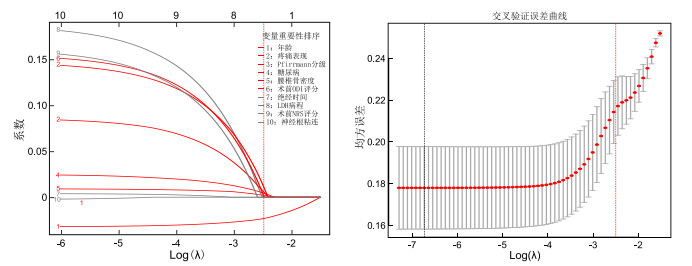
图 1 LASSO回归筛选绝经后OP合并LDH患者术后残留腰腿痛相关变量
Figure 1. Screening of variables related to postoperative residual lumbocrural pain in postmenopausal patients with OP complicated by LDH using LASSO regression

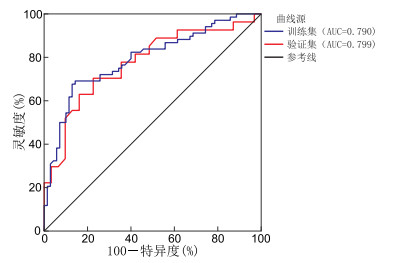
图 2 随机森林模型预测绝经后OP合并LDH患者术后残留腰腿痛的ROC曲线
Figure 2. ROC curve of the random forest model for predicting postoperative residual lumbocrural pain in postmenopausal patients with OP complicated by LDH

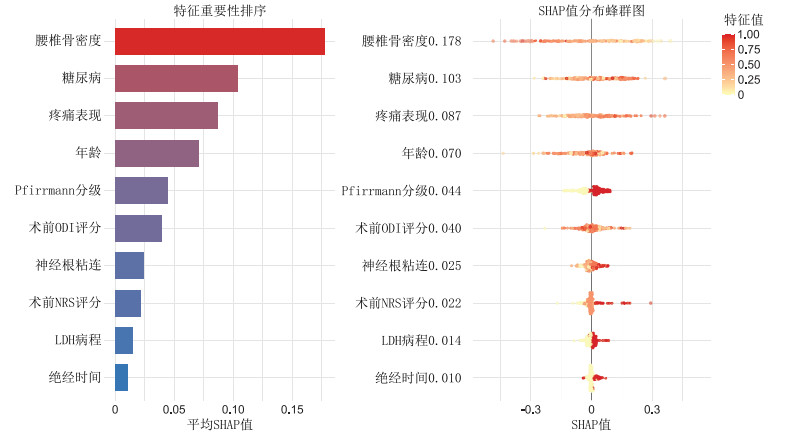
图 3 基于SHAP的随机森林模型可解释性分析
Figure 3. Interpretability analysis of the random forest model based on SHAP
表 1 2组绝经后OP合并LDH患者临床资料比较
Table 1. Comparison of clinical data between two groups of postmenopausal patients with osteoporosis and lumbar disc herniation
组别 例数 年龄(x±s, 岁) BMI (x±s) 绝经时间(x±s,年) 工作情况(例) 合并基础疾病(例) LDH病程(x±s,月) 腰椎骨密度(x±s,g/m3) LDH类型(例) 在职 退休或无业 高血压 糖尿病 高脂血症 脱出型 突出型 观察组 97 63.06±6.77 24.02±2.05 18.06±6.71 20 77 30 27 25 10.06±3.62 58.85±5.26 40 57 对照组 103 60.88±6.40 24.19±2.10 15.29±6.44 23 80 29 12 26 8.91±2.97 64.02±5.39 39 64 统计量 2.341a 0.579a 2.979a 0.087b 0.185b 8.336b 0.007b 2.462a 6.859a 0.238b P值 0.020 0.563 0.003 0.768 0.667 0.004 0.931 0.015 <0.001 0.626 组别 例数 责任节段(例) 疼痛表现(例) Pfirrmann分级(例) 黄韧带增厚(例) 神经根粘连(例) 纤维环破裂(例) Modic改变(例) 术前NRS评分(x±s, 分) 术前ODI (x±s, %) L3~4 L4~5 L5~S1 腰痛或腿痛 腰腿痛 Ⅱ级 Ⅲ级 Ⅳ级 Ⅴ级 观察组 97 12 56 29 40 57 20 21 40 16 32 66 40 28 7.05±0.51 68.13±6.75 对照组 103 14 55 34 63 40 30 33 35 5 37 53 31 30 6.88±0.47 65.34±6.81 统计量 0.380b 7.943b 0.003c 0.190b 5.702b 2.708b 0.002b 2.453a 2.908a P值 0.827 0.005 0.006 0.663 0.017 0.100 0.968 0.015 0.004 注:a为t值,b为χ2值,c为Z值。责任节段是指在脊柱退变性疾病或多节段病变中导致患者主要症状的特定节段。  下载: 导出CSV
表 2 随机森林模型对绝经后OP合并LDH患者术后残留腰腿痛的预测效能
Table 2. Predictive performance of the random forest model for postoperative residual lumbocrural pain in postmenopausal patients with OP complicated by LDH
数据集 AUC (95% CI) 灵敏度(%) 特异度(%) 准确度(%) 精确度(%) F1值 训练集 0.799(0.725~0.873) 69.57 71.43 70.51 70.30 0.700 验证集 0.790(0.672~0.907) 85.92 78.12 81.76 77.46 0.838
下载: 导出CSV
-
[1] SHAH F I, AKRAM F, SHEHZADI S. Repercussions of gastrointestinal microbiota in postmenopausal osteoporosis[J]. Womens Health (Lond), 2025, 21(1): 17455057251363684. DOI: 10.1177/17455057251363684. [2] 盛静馨, 梁冰, 王涛, 等. FRQ与MFS在绝经后骨质疏松症人群中的应用[J]. 中华全科医学, 2024, 22(5): 776-780. doi: 10.16766/j.cnki.issn.1674-4152.003501SHENG J X, LIANG B, WANG T, et al. Application of the FRQ and MFS in assessing the fall risk in postmenopausal osteoporosis[J]. Chinese Journal of General Practice, 2024, 22(5): 776-780. doi: 10.16766/j.cnki.issn.1674-4152.003501 [3] FAN W, ZHANG C, ZHANG D X, et al. Biomechanical responses of the human lumbar spine to vertical whole-body vibration in normal and osteoporotic conditions[J]. Clin Biomech (Bristol), 2023, 102(1): 105872. DOI: 10.1016/j.clinbiomech.2023.105872. [4] ZHANG Y, CHEN X, YANG X, et al. Hysterectomy-a possible risk factor for operative intervention in female patients for degenerative lumbar spine conditions: a case control and cohort study[J]. Spine J, 2024, 24(11): 2066-2077. doi: 10.1016/j.spinee.2024.06.019 [5] XU X, SONG J, ZHOU G, et al. Comparison and evaluation of percutaneous transforaminal endoscopic discectomy treatment efficacy in patients with lumbar disc herniation of different age groups[J]. Front Surg, 2025, 12(1): 1587857. DOI: 10.3389/fsurg.2025.1587857. [6] 李晓林, 解桐, 赵英杰, 等. 单侧双通道脊柱内镜技术与经皮椎间孔镜下椎间盘切除术治疗单节段腰椎间盘突出症的早期效果比较[J]. 中华实用诊断与治疗杂志, 2024, 38(12): 1223-1230.LI X L, XIE T, ZHAO Y J, et al. Comparison of early efficacy of unilateral biportal endoscopy and percutaneous transforaminal endoscopic discectomy on single-level lumbar disc herniation[J]. Journal of Chinese Practical Diagnosis and Therapy, 2024, 38(12): 1223-1230. [7] YUAN J, FU J. Develop and validate a machine learning model to predict the risk of persistent pain after percutaneous transforaminal endoscopic discectomy[J]. Front Surg, 2025, 12(1): 1631651. DOI: 10.3389/fsurg.2025.1631651. [8] 中华医学会骨质疏松和骨矿盐疾病分会. 原发性骨质疏松症诊疗指南(2022)[J]. 中国全科医学, 2023, 26(14): 1671-1691.Osteoporosis and Bone Mineral Salt Diseases Branch of the Chinese Medical Association. Guidelines for the Diagnosis and Treatment of Primary Osteoporosis(2022)[J]. Chinese General Practice, 2023, 26(14): 1671-1691. [9] 中华医学会骨科学分会脊柱外科学组, 中华医学会骨科学分会骨科康复学组. 腰椎间盘突出症诊疗指南[J]. 中华骨科杂志, 2020, 40(8): 477-487.Spine Surgery Group of the Orthopaedic Branch, Chinese Medical Association & Orthopaedic Rehabilitation Group of the Orthopaedic Branch, Chinese Medical Association. Clinical practice guideline for diagnosis and treatment of lumbar disc herniation[J]. Chinese Journal of Orthopaedics, 2020, 40(8): 477-487. [10] 杨坤, 陈子龙, 陈衍熙, 等. 腰椎间盘突出症经椎间孔镜治疗术后残留腰腿痛的分子机制研究[J]. 中国骨伤, 2024, 37(2): 159-165.YANG K, CHEN Z L, CHEN Y X, et al. Molecular Mechanism Study on Postoperative Residual Lumbocrural Pain After Transforaminal Endoscopic Treatment for Lumbar Disc Herniation[J]. China Journal of Orthopaedics and Traumatology, 2024, 37(2): 159-165. [11] SHAFSHAK T S, ELNEMR R. The visual analogue scale versus numerical rating scale in measuring pain severity and predicting disability in low back pain[J]. J Clin Rheumatol, 2021, 27(7): 282-285. doi: 10.1097/RHU.0000000000001320 [12] SINGH A. Analysis of the clinical outcome of microlumbar decompression in degenerative grade-1 spondylolisthesis versus stable lumbar canal stenosis[J]. Rev Bras Ortop (Sao Paulo), 2025, 60(3): 1-7. [13] 张陇豫, 康晓乐, 任敬佩, 等. 影响腰椎间盘突出症患者经皮椎间孔镜下椎间盘切除术治疗效果的相关因素分析[J]. 中国内镜杂志, 2024, 30(4): 1-6.ZHANG L Y, KANG X L, REN J P, et al. Associated factors affecting the therapeutic effect of percutaneous transforaminal endoscopic discectomy in patients with lumbar disc herniation[J]. China Journal of Endoscopy, 2024, 30(4): 1-6. [14] 赵玉果, 叶向阳, 程省. 腰椎间盘突出症患者行经皮椎间孔镜髓核摘除术术后复发的列线图模型构建[J]. 中华实用诊断与治疗杂志, 2024, 38(10): 1034-1039.ZHAO Y G, YE X Y, CHENG S. Construction of a nomogram model for predicting recurrence after percutaneous transforaminal endoscopic discectomy in patients with lumbar disc herniation[J]. Journal of Chinese Practical Diagnosis and Therapy, 2024, 38(10): 1034-1039. [15] 应永干, 楼颖颖, 李珊珊. 骨质疏松对经皮椎间孔镜下髓核摘除术治疗腰椎间盘突出症效果的影响[J]. 浙江医学, 2025, 47(12): 1259-1262, 1271.YING Y G, LOU Y Y, LI S S. Influence of osteoporosis on the treatment of lumbar disc herniation by percutaneous endoscopic lumbar discectomy[J]. Zhejiang Medical Journal, 2025, 47(12): 1259-1262, 1271. [16] ZHU F, JIA D, ZHANG Y, et al. Development and validation of a nomogram to predict the risk of residual low back pain after tubular microdiskectomy of lumbar disk herniation[J]. Eur Spine J, 2024, 33(6): 2179-2189. doi: 10.1007/s00586-024-08255-0 [17] ZHONG D, KE Z Y, CHEN Q, et al. A clinical nomogram for predicting the residual low back pain after percutaneous endoscopic surgery for lumbar disc herniation[J]. Int Orthop, 2023, 47(3): 819-830. doi: 10.1007/s00264-022-05658-w [18] LIN M, WEN X, HUANG Z, et al. A nomogram for predicting residual low back pain after percutaneous kyphoplasty in osteoporotic vertebral compression fractures[J]. Osteoporos Int, 2023, 34(4): 749-762. doi: 10.1007/s00198-023-06681-2 [19] LI X, PAN B, CHENG L, et al. Development and validation of a prognostic model for the risk of recurrent lumbar disc herniation after percutaneous endoscopic transforaminal discectomy[J]. Pain Physician, 2023, 26(1): 81-90. doi: 10.36076/ppj.2023.26.81 [20] 许燕昕, 黄丽珊, 陈静, 等. 基于随机森林算法的腰椎间盘突出症保守治疗慢性疼痛患者恐动症影响因素分析[J]. 中国实用护理杂志, 2025, 41(7): 506-514.XU Y X, HUANG L S, CHEN J, et al. Analysis of factors influencing kinesiophobia in patients with conservative treatment of chronic pain caused by lumbar disc herniation based on random forest algorithm[J]. Chinese Journal of Practical Nursing, 2025, 41(7): 506-514. -

 点击查看大图
计量
- 文章访问数: 11
- HTML全文浏览量: 6
- PDF下载量: 0
- 被引次数: 0
