



Study on the influencing factors of functional constipation in children and its correlation with dietary habits/intestinal flora
-
摘要:
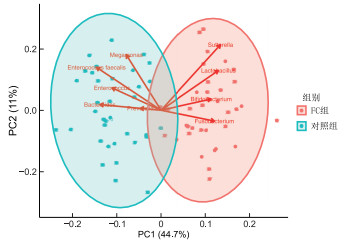
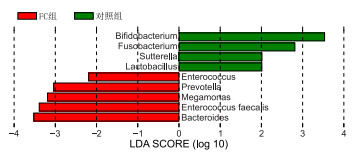
目的 分析影响温州地区儿童功能性便秘(FC)的因素,探讨FC发生与饮食习惯和肠道菌群的相关性。 方法 选取2020年12月—2022年12月于温州市中西医结合医院儿科就诊的FC患儿35例为FC组,选取同期健康儿童35例为对照组。对所有儿童和其监护人进行问卷调查。比较2组儿童的临床资料、肠道菌群特征等情况。应用多因素logistic回归分析研究影响儿童FC发生的相关因素,采用Pearson相关性分析研究相关指标与FC发生的相关性。 结果 FC组蔬菜水果摄入频率、运动频次和饮水量均少于对照组(P>0.05)。FC组Chao1指数、ACE指数和Shannon指数均低于对照组(P<0.05),而Simpson指数高于对照组(P<0.05)。蔬菜水果摄入频次高(OR=0.768)、运动频次高(OR=0.494)、饮水量多(OR=0.206)和菌群Chao1指数高(OR=0.931)均是影响儿童FC发生的保护性因素。2组儿童肠道菌群分布存在差异,FC组肠道菌群中以普氏菌属、巨单胞菌属等占主要优势,对照组以双歧杆菌、乳酸杆菌等占主要优势(LDA>4log10)。 结论 蔬菜水果摄入频次高、运动频次高、饮水量多和菌群Chao1指数高是儿童FC发生的保护性因素。肠道菌群中普氏菌属、巨单胞菌属、拟杆菌属和粪肠球菌都可能与FC发生有关。 Abstract:Objective To analyze the factors affecting functional constipation (FC) in children in Wenzhou area, and explore the correlation between FC occurrence and dietary habits and intestinal flora. Methods A total of 35 children with FC who were treated in the Department of Pediatrics of Wenzhou Hospital of Integrated Traditional and Western Medicine from December 2020 to December 2022 were selected as the FC group, and then 35 healthy children in the same period were selected as the control group. Questionnaires were conducted for all children and their guardians. The clinical data and intestinal flora characteristics of the two groups were compared. Multifactorial logistic regression was used to analyze the related factors affecting the incidence of FC in children, and Pearson correlation was used to analyze the correlation between correlation indicators and FC occurrence. Results Chao1 index, ACE index, and Shannon index in the FC group were lower than those in the control group (P < 0.05), while Simpson index was higher than those in the control group (P < 0.05). High frequency of vegetable and fruit intake (OR=0.768), high frequency of exercise (OR=0.494), high water intake (OR=0.206), and High flora Chao1 index (OR=0.931) were all protective factors affecting the incidence of FC in children. There were differences in the distribution of intestinal flora between the two groups. In the FC group, Prevotella and macroomonas were dominant, while in the control group, bifidobacterium and Lactobacillus were dominant (LDA>4log10). Conclusion High frequency of vegetable and fruit intake, high frequency of exercise, high water intake, and Chao1 index of bacterial flora were protective factors for the incidence of FC in children. The Prevotella, macroomonas, Bacteroides, and Enterococcus faecalis in intestinal flora may be related to the development of FC. -
Key words:
- Functional constipation /
- Eating habits /
- Intestinal flora
-

图 1 2组儿童粪便菌群LDA值分布
Figure 1. Distribution of LDA values of fecal microbiota in two groups of children

图 2 2组儿童粪便菌群PCA分布
Figure 2. PCA distribution of fecal microbiota in two groups of children
表 1 2组儿童一般资料比较
Table 1. Comparison of general information of two groups of children
项目 FC组(n=35) 对照组(n=35) 统计量 P值 年龄(x±s,岁) 2.18±0.72 2.23±0.69 0.297 0.768 性别[例(%)] 0.516 0.473 男 18(51.43) 15(42.86) 女 17(48.57) 20(57.14) FC家族史[例(%)] 8(22.86) 6(17.14) 0.357 0.550 身高(x±s,cm) 88.76±5.27 89.18±5.31 0.332 0.741 体重(x±s,kg) 12.27±2.04 11.92±1.98 0.728 0.469 BMI(x±s) 22.21±1.12 21.89±1.20 1.153 0.253 是否有医保[例(%)] 0.583 0.445 是 22(62.86) 25(71.43) 否 13(37.14) 10(28.57) 家庭年收入[例(%)] 0.057 0.811 ≤7万 19(54.29) 18(51.43) >7万 16(45.71) 17(48.57) 监护人文化水平[例(%)] 0.240 0.887 高中以下 8(22.86) 7(20.00) 高中和专科 14(40.00) 16(45.71) 本科及以上 13(37.14) 12(34.29) 分娩方式[例(%)] 0.238 0.626 顺产 20(57.14) 22(62.86) 剖宫产 15(42.86) 13(37.14) 喂养方式[例(%)] 0.284 0.868 母乳 13(37.14) 15(42.86) 奶粉 5(14.29) 4(11.43) 母乳+奶粉 17(48.57) 16(45.71) 蔬菜水果摄入频率(x±s,次/周) 13.38±3.39 17.04±4.07 4.088 <0.001 肉类摄入频率(x±s,次/周) 13.29±1.17 12.78±1.02 1.944 0.056 甜食摄入频率(x±s,次/周) 8.17±1.38 7.55±1.41 1.859 0.067 辛辣食物摄入频率(x±s,次/周) 3.14±0.44 2.96±0.38 1.832 0.071 运动频次(x±s,次/周) 5.08±1.82 6.91±1.97 4.037 <0.001 饮水量(x±s,L/d) 1.45±0.41 1.95±0.58 4.165 <0.001 育儿方式[例(%)] 0.530 0.467 作息规律 19(54.29) 22(62.86) 作息不规律 16(45.71) 13(37.14) 注:a为t值,b为χ2值。  下载: 导出CSV
表 2 2组儿童粪便菌群α多样性比较(x±s)
Table 2. Comparison of α diversity of fecal microbiota between the two groups of children
组别 例数 菌群丰度 菌群多样性 Chao1指数 ACE指数 Shannon指数 Simpson指数 FC组 35 199.04±28.65 185.59±25.28 2.48±0.72 1.13±0.18 对照组 35 246.42±34.66 199.33±29.17 2.89±0.93 0.95±0.12 t值 6.233 2.106 2.062 4.922 P值 <0.001 0.039 0.043 <0.001
下载: 导出CSV
表 3 变量赋值情况
Table 3. Variable Assignment
变量 赋值方法 功能性便秘 有=1,无=0 蔬菜水果摄入频次 以实际值赋值 运动频次 以实际值赋值 饮水量 以实际值赋值 菌群Chao1指数 以实际值赋值
下载: 导出CSV
表 4 影响儿童FC发生的多因素logistic回归分析
Table 4. Multivariate Logistic regression analysis of factors influencing fc in children
变量 B SE Waldχ2 P值 OR值 95% CI 蔬菜水果摄入频次 -0.264 0.129 4.226 0.040 0.768 0.597~0.988 运动频次 -0.705 0.294 5.773 0.016 0.494 0.278~0.878 饮水量 -1.581 0.963 2.694 0.049 0.206 0.031~1.359 菌群Chao1指数 -0.071 0.022 10.281 0.001 0.931 0.892~0.973
下载: 导出CSV
-
[1] 白铂亮, 曲书强. 儿童功能性便秘的研究现状[J]. 中华实用儿科临床杂志, 2017, 32(7): 554-556.BAI B L, QU S Q. Research status of childhood functional constipation[J]. Chinese Journal of Applied Clinical Pediatrics, 2017, 32(7): 554-556. [2] 林菲菲, 何春风, 林德. 儿童功能性便秘患者肠道菌群及血清脑肠肽水平的变化[J]. 中国微生态学杂志, 2020, 32(6): 692-694, 699.LIN F F, HE C F, LIN D. Changes of intestinal flora and brain-gut peptides in children with functional constipation[J]. Chinese Journal of Microecology, 2020, 32(6): 692-694, 699. [3] 张伟, 郭宏伟, 王宝西. 肠道菌群与儿童功能性便秘研究进展[J]. 中华实用儿科临床杂志, 2020, 35(16): 1277-1280.ZHANG W, GUO H W, WANG B X. Study progress of gut microbiota and functional constipation in children[J]. Chinese Journal of Applied Clinical Pediatrics, 2020, 35(16): 1277-1280. [4] ARMAN-ASL H, MOHAMMADPOUR A H, HAMEDI A, et al. Evaluation of the anti-constipation effects of abdominal application of olive oil ointment in children 1-4 years old: a pilot placebo-controlled, double-blind, randomized clinical trial[J]. Adv Exp Med Biol, 2021, 1328(3): 411-419. [5] BONILLA S, NURKO S, RODRIGUEZ L. Long-term use of bisacodyl in pediatric functional constipation refractory to conventional therapy[J]. Pediatr Gastroenterol Nutr, 2020, 69(3): 288-291. [6] YU G, GAO J, GU J L, et al. Efficacy of honey suppositories in treating paediatric functional constipation: a comparative study[J]. J Paediatr Child Health, 2025, 61(1): 100-105. doi: 10.1111/jpc.16722 [7] RUSSO M, STRISCIUGLIO C, SCARPATO E, et al. Functional chronic constipation: Rome Ⅲ criteria versus Rome Ⅳ criteria[J]. J Neurogastroenterol Motil, 2019, 25(1): 123-128. doi: 10.5056/jnm18035 [8] 程伟伟, 陈科, 周丽, 等. 儿童功能性便秘症状复现率调查及其风险因素分析[J]. 中国实用儿科杂志, 2023, 38(2): 114-118, 124.CHENG W W, CHEN K, ZHOU L, et al. Recurrence rate and risk factors of functional constipation in children[J]. Chinese Journal of Practical Pediatrics, 2023, 38(2): 114-118, 124. [9] 陆艳, 潘国琴, 金笑天, 等. 婴儿功能性便秘与母亲孕期因素间的相关性分析[J]. 中华全科医学, 2019, 17(6): 987-989, 1024. doi: 10.16766/j.cnki.issn.1674-4152.000843LU Y, PANG G Q, JING X T, et al. Correlation analysis between functional constipation of infant and maternal factors during pregnancy[J]. Chinese Journal of General Practice, 2019, 17(6): 987-989, 1024. doi: 10.16766/j.cnki.issn.1674-4152.000843 [10] 鲍文婷, 李在玲, 张华, 等. 2~7岁儿童功能性便秘影响因素分析[J]. 中华实用儿科临床杂志, 2020, 35(12): 917-921.BAO W T, LI Z L, ZHANG H, et al. Analysis of influencing factors of functional constipation in children aged 2~7 years[J]. Chinese Journal of Practical Pediatrics, 2020, 35(12): 917-921. [11] SIAJUNBORIBOON S, TANPOWPONG P, EMPREMSILAPA S, et al. Prevalence of functional abdominal pain disorders and functional constipation in adolescents[J]. J Paediatr Child Health, 2022, 58(7): 1209-1214. doi: 10.1111/jpc.15950 [12] 张爱华, 代金明, 顾秀明, 等. 乳双歧杆菌联合乳果糖对功能性便秘儿童的疗效及其对肠道菌群的影响分析[J]. 安徽医学, 2023, 44(3): 298-302.ZHANG A H, DAI J M, GU X M, et al. Analysis of the efficacy of Lactobacillus bifidus combined with lactulose in children with functional constipation and its impact on the intestinal flora[J]. Anhui Medical Journal, 2023, 44(3): 298-302. [13] NIU Y, LIU T, RAN N, et al. Relationship between family-related factors and functional constipation among Chinese preschoolers: a case-control study[J]. BMC Pediatr, 2022, 22(1): 460. DOI: 10.1186/s12887-022-03521-w. [14] OSATAKUL S, BENNINGA M A, THAPAR N, et al. The magnitude and management of functional constipation at pediatric gastroenterology clinics: a survey study of various countries[J]. J Gastroenterol Hepatol, 2022, 37(1): 89-96. doi: 10.1111/jgh.15671 [15] 刘四香, 黄永坤, 王明英, 等. 功能性便秘患儿的肠道菌群分析及治疗干预[J]. 昆明医科大学学报, 2022, 43(3): 123-127.LIU S X, HUANG Y K, WANG M Y, et al. Analysis of intestinal flora and therapeutic intervention in children with functional constipation[J]. Journal of Kunming Medical University, 2022, 43(3): 123-127. [16] DE OLIVEIRA M B B, JARDIM-BOTELHO A, DE MORAIS M B, et al. Impact of infant milk-type and childhood eating behaviors on functional constipation in preschool children[J]. J Pediatr Gastroenterol Nutr, 2021, 73(3): 50-56. [17] 王树茂, 王俊敏, 荣光宏. 学龄期儿童功能性便秘的发病因素[J]. 山东医药, 2024, 64(18): 58-61.WANG S M, WANG J M, RONG G H. The causes of functional constipation in school-age children[J]. Shandong Medical Journal, 2024, 64(18): 58-61. [18] 董可欣, 冯文烨, 吴蔚. 基于"肺与大肠相表里"理论和"整体观念"探讨慢性肺系病合并功能性便秘的诊治思路[J]. 中国中医基础医学杂志, 2024, 30(2): 204-208.DOND K X, FENG W Y, WU W. Exploration of the Diagnosis and Treatment of Chronic Pulmonary Disease Complicated with Functional Constipation Based on the Theory of"Lung and Large Intestine Connected Externally and Internally"and"Overall Concept"[J]. Chinese Journal of Basic Medicine in Traditional Chinese Medicine, 2024, 30(2): 204-208. -

 点击查看大图
计量
- 文章访问数: 10
- HTML全文浏览量: 5
- PDF下载量: 0
- 被引次数: 0
