



The trajectory of depression and its influencing factors among retired middle-aged and elderly individuals in China
-
摘要:
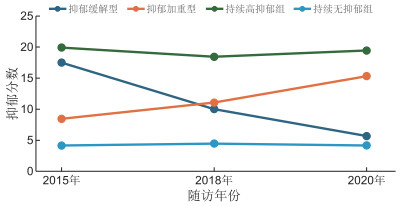
目的 分析退休中老年人群的抑郁症状发展轨迹,识别其潜在的预测因素,为中老年人心理健康干预提供科学依据。 方法 采用2015—2020年中国健康与养老追踪调查的数据,共选取4 435名退休中老年人作为研究对象。利用潜变量增长混合模型对退休中老年人群的抑郁症状发展轨迹进行分类,并进一步探讨影响发展轨迹的预测因素。 结果 退休中老年人群抑郁症状发展轨迹可分为4种类别:抑郁缓解型(9.85%)、抑郁加重型(18.85%)、持续高抑郁型(9.50%)和持续无抑郁型(61.80%)。Logistic回归分析发现,性别、年龄、教育程度、婚姻状况、居住地、自评健康、失能情况、住院情况、家庭子女数目、是否为城镇职工、听力能力、认知障碍、社会参与程度以及慢性病患病状况等均为退休中老年人群抑郁症状发展轨迹的影响因素。 结论 本研究强调了退休中老年人群抑郁症状发展轨迹的多样性和群体间的异质性。医务人员可以根据这些不同的轨迹特征,实施针对性的健康管理策略。通过识别抑郁症状的不同发展轨迹,可以更精确地理解抑郁症状的动态变化过程,并为开发有效的预防和干预措施提供科学依据。 Abstract:Objective To analyze the developmental trajectories of depressive symptoms in retired middle-aged and elderly individuals, to identify potential predictors, and to provide a scientific basis for mental health interventions. Methods This research utilized data from the China Health and Retirement Longitudinal Study spanning the period from 2015 to 2020. The study population comprised of 4 435 retired middle-aged and elderly individuals who were selected as participants. A latent variable growth mixture model was employed in order to classify the developmental trajectories of depressive symptoms in this population. Further analysis was conducted in order to identify the predictors influencing these trajectories. Results The developmental trajectories of depressive symptoms in retired middle-aged and elderly individuals were classified into four categories: depressive remission (9.85%); depressive worsening (18.85%); persistently high depressive symptoms (9.50%); and persistently non-depressive (61.80%). Logistic regression analysis revealed that factors such as gender, age, education level, marital status, place of residence, self-rated health, disability status, history of hospitalization, number of children in the family, employment as urban workers, hearing ability, cognitive impairment, level of social participation, and chronic disease status were influencing factors of depressive symptom trajectories. Conclusion This study underscores the heterogeneity of developmental trajectories of depressive symptoms and the diversity among groups within the retired middle-aged and elderly population. Healthcare providers can utilize these distinct trajectory characteristics to implement targeted health management strategies. By identifying the various developmental trajectories of depressive symptoms, a more nuanced understanding of the dynamic changes in these symptoms can be achieved. This, in turn, offers a scientific foundation for the development of effective prevention and intervention strategies. -
Key words:
- Middle-aged /
- Retirement /
- Depression /
- Trajectory /
- Longitudinal study
-

图 1 退休中老年人抑郁症状发展轨迹
Figure 1. The trajectory of depressive symptoms in retired middle-aged and older adults
表 1 潜变量增长混合模型指标拟合结果
Table 1. Fitting results of the Latent variable growth mixed model (LGMM)
类别 k AIC BIC aBIC Entropy LMR BLRT 类别概率 1 5 88 817.958 88 849.944 88 834.056 2 8 85 514.874 85 566.052 85 540.631 0.837 <0.001 <0.001 0.771 76/0.228 24 3 11 85 098.723 85 169.093 85 134.139 0.753 <0.001 <0.001 0.643 52/0.089 84/0.266 64 4 14 84 522.771 84 612.333 84 567.846 0.810 <0.001 <0.001 0.105 33/0.193 19/0.094 16/0.607 32 5 17 84 415.278 84 524.032 84 470.012 0.780 <0.05 <0.001 0.546 35/0.214 76/0.095 12/0.088 42/0.055 35 注:k为自由估计参数数目,AIC为赤池信息准则,BIC为贝叶斯信息准则;aBIC为校正样本的贝叶斯信息准则;Entropy为信息熵;LMR为似然比检验;BLRT为基于Bootstrap的似然比检验。  下载: 导出CSV
表 2 各抑郁症状潜在类别退休中老年人基本特征比较
Table 2. Comparison of the basic characteristics of each potential category of depressive symptoms in retired middle-aged and elderly adults
项目 抑郁缓解型(n=437) 抑郁加重型(n=836) 持续高抑郁型(n=421) 持续无抑郁型(n=2 741) 统计量 P值 项目 抑郁缓解型(n=437) 抑郁加重型(n=836) 持续高抑郁型(n=421) 持续无抑郁型(n=2 741) 统计量 P值 年龄(岁) 30.706a <0.001 住院情况 41.770b <0.001 45~59 121 260 146 804 有 119 175 126 430 60~74 244 473 244 1 385 无 318 661 295 2 311 ≥75 72 103 31 552 家庭子女数目 30.365a <0.001 性别 54.615b <0.001 无 4 9 5 16 男性 129 241 95 1 118 1个 48 81 33 457 女性 308 595 326 1 623 2个 126 280 128 860 教育程度 121.836a <0.001 3个及以上 259 466 255 1 408 小学及以下 355 631 341 1 738 城镇职工 77.447b <0.001 初中 57 134 51 574 是 40 133 32 661 高中及以上 25 71 29 429 否 397 703 389 2 080 婚姻状况 11.945b <0.001 听力能力 44.744b <0.001 在婚 302 628 305 2 117 好 95 238 90 973 不在婚 135 208 116 624 不好 342 598 331 1 768 居住地 16.213b <0.001 认知障碍 30.221b <0.001 农村 232 434 294 1 274 有 409 777 393 2 402 城市 205 402 127 1 467 无 28 59 28 339 自评健康 717.813a <0.001 社会参与 21.148b <0.001 好 33 102 17 886 有 195 423 187 1 516 一般 180 440 130 1 441 无 242 413 234 1 225 不好 224 294 274 414 慢性病 60.196b <0.001 失能 208.644b <0.001 有 393 757 402 2 226 有 199 267 240 497 无 44 79 19 515 无 238 569 181 2 244 注:a为H值,b为χ2值。
下载: 导出CSV
表 3 退休中老年人抑郁症状变化轨迹潜在类别影响因素的logistic回归分析
Table 3. Logistic regression analysis of the influencing factors of depressive symptoms in retired middle-aged and elderly adults
因变量 自变量 分类 B SE Waldχ2 P值 OR值 95% CI 抑郁缓解型a 年龄 45~59岁 0.692 0.197 12.308 <0.001 1.997 1.357~2.938 60~74岁 0.653 0.162 16.277 <0.001 1.921 1.399~2.637 性别 男性 -0.326 0.125 6.855 0.009 0.722 0.565~0.921 教育程度 小学及以下 0.619 0.237 6.817 0.009 1.857 1.167~2.957 婚姻状况 在婚 -0.407 0.128 10.063 0.002 0.665 0.517~0.856 自评健康 好 -2.343 0.205 130.036 <0.001 0.096 0.064~0.144 一般 -1.175 0.123 91.026 <0.001 0.309 0.243~0.393 失能情况 有 0.815 0.119 47.093 <0.001 2.259 1.790~2.851 住院情况 无 -0.319 0.131 5.899 0.015 0.727 0.562~0.940 城镇职工 否 0.688 0.191 13.040 <0.001 1.990 1.370~2.892 听力能力 好 -0.327 0.131 6.195 0.013 0.721 0.557~0.933 认知障碍 有 0.453 0.218 4.322 0.038 1.573 1.026~2.412 社会参与 有 -0.240 0.112 4.545 0.033 0.787 0.631~0.981 抑郁加重型a 年龄 45~59岁 0.918 0.156 34.823 <0.001 2.504 1.846~3.396 60~74岁 0.796 0.132 36.572 <0.001 2.217 1.713~2.870 性别 男性 -0.391 0.094 17.303 <0.001 0.676 0.562~0.813 教育程度 小学及以下 0.447 0.155 8.312 0.004 1.563 1.154~2.117 自评健康 好 -1.574 0.138 129.832 <0.001 0.207 0.158~0.272 一般 -0.675 0.100 45.473 <0.001 0.509 0.419~0.620 失能情况 有 0.430 0.97 19.486 <0.001 1.538 1.270~1.862 家庭孩子数目 1个 -0.469 0.151 9.645 0.002 0.625 0.465~0.841 认知障碍 有 0.529 0.155 11.631 0.001 1.698 1.252~2.301 慢性病 有 0.411 0.136 9.131 0.003 1.509 1.155~1.970 持续高抑郁型a 年龄 45~59岁 1.884 0.244 59.400 <0.001 6.577 4.074~10.618 60~74岁 1.499 0.218 47.338 <0.001 4.479 2.922~6.866 性别 男性 -0.653 0.141 21.285 <0.001 0.521 0.395~0.687 婚姻 在婚 -0.338 0.141 5.768 0.016 0.713 0.541~0.940 居住地 农村 0.831 0.124 44.610 <0.001 2.296 1.799~2.931 自评健康 好 -2.906 0.268 117.915 <0.001 0.055 0.032~0.092 一般 -1.603 0.132 147.639 <0.001 0.201 0.155~0.261 失能情况 有 1.190 0.125 90.566 <0.001 3.288 2.573~4.201 住院情况 无 -0.295 0.139 4.527 0.033 0.745 0.568~0.977 城镇职工 否 0.763 0.216 12.438 <0.001 2.146 1.404~3.280 家庭孩子数目 1个 -0.536 0.227 5.578 0.018 0.585 0.375~0.913 2个 -0.282 0.141 3.993 0.046 0.754 0.572~0.995 听力能力 好 -0.321 0.141 5.194 0.023 0.725 0.550~0.956 慢性病 有 0.715 0.258 7.688 0.006 2.044 1.233~3.387 注: a以“持续无抑郁型”为参照。年龄以≥75岁为参照, 教育程度以高中及以上为参照,家庭子女数目以3个及以上为参照,自评健康以不好为参照。各变量赋值方法如下, 年龄(45~59岁=1, 60~74岁=2, ≥75岁=3)、性别(女性=0, 男性=1)、教育程度(小学及以下=1, 初中=2, 高中及以上=3)、婚姻状况(不在婚=0, 在婚=1)、家庭子女数目(无=0,1个=1,2个=2,3个及以上=3)、居住地(城市=0, 农村=0)、城镇职工(否=0, 是=1)、住院情况(无=0, 有=1)、失能(无=0, 有=1)、慢性病(无=0, 有=1)、自评健康(好=1, 一般=2, 不好=3)、认知障碍(无=0, 有=1)、听力能力(不好=0, 好=1)以及社会参与(无=0, 有=1)。
下载: 导出CSV
-
[1] JIANG Z, LIU H, DENG J, et al. Influence of intergenerational support on the mental health of older people in China[J]. PLoS One, 2024, 19(4): e0299986. DOI: 10.1371/journal.pone.0299986. [2] FAN X, GUO X, REN Z, et al. The prevalence of depressive symptoms and associated factors in middle-aged and elderly chinese people[J]. J Affect Disord, 2021, 293: 222-228. doi: 10.1016/j.jad.2021.06.044 [3] LI W, YE X, ZHU D, et al. The longitudinal association between retirement and depression: a systematic review and meta-analysis[J]. Am J Epidemiol, 2021, 190(10): 2220-2230. doi: 10.1093/aje/kwab125 [4] 郑吉锋, 冯彩琴. 晚发性抑郁症患者抑郁程度与多导睡眠参数及疲劳水平的相关性[J]. 中华全科医学, 2024, 22(8): 1347-1349. doi: 10.16766/j.cnki.issn.1674-4152.2016.06.035ZHENG J F, FENG C Q. The correlation between the degree of depression and polysomnography parameters and fatigue level in patients with late-onset depression[J]. Chinese Journal of General Practice, 2024, 22(8): 1347-1349. doi: 10.16766/j.cnki.issn.1674-4152.2016.06.035 [5] ZHAO Y, HU Y, SMITH J P, et al. Cohort profile: the China health and retirement longitudinal study (CHARLS)[J]. Int J Epidemiol, 2014, 43(1): 61-68. doi: 10.1093/ije/dys203 [6] ANDRESEN E M, MALMGREN J A, CARTER W B, et al. Screening for depression in well older adults: evaluation of a short form of the CES-D (center for epidemiologic studies depression scale)[J]. Am J Prev Med, 1994, 10(2): 77-84. doi: 10.1016/S0749-3797(18)30622-6 [7] 杨璐, 宗占红, 易莹莹. 中国农村中老年女性抑郁状况及影响因素研究[J]. 中国全科医学, 2023, 26(25): 3091-3095.YANG L, ZONG Z H, YI Y Y. Current status and influencing factors of depression among rural middle-aged and elderly women in China[J]. Chinese General Practice, 2023, 26(25): 3091-3095. [8] HERLE M, MICALI N, ABDULKADIR M, et al. Identifying typical trajectories in longitudinal data: modelling strategies and interpretations[J]. Eur J Epidemiol, 2020, 35(3): 205-222. doi: 10.1007/s10654-020-00615-6 [9] MARA C A, CARLE A C. Understanding variation in longitudinal data using latent growth mixture modeling[J]. J Pediatr Psychol, 2021, 46(2): 179-188. doi: 10.1093/jpepsy/jsab010 [10] 余千千, 陈晓东, 何凌骁. 中老年人抑郁症状发展轨迹与跌倒及跌伤的关联性分析[J]. 伤害医学(电子版), 2024, 13(1): 7-14.YU Q Q, CHEN X D, HE L X. Association between trajectories of depressive symptoms with falls and fall-related injuries in China[J]. Injury Medicine(Electronic Edition), 2024, 13(1): 7-14. [11] DANG L, ANANTHASUBRAMANIAM A, MEZUK B. Spotlight on the challenges of depression following retirement and opportunities for interventions[J]. Clin Interv Aging, 2022, 17: 1037-1056. doi: 10.2147/CIA.S336301 [12] WANG J. The longitudinal relationship between leisure activities and depressive symptoms among older Chinese adults: an autoregressive cross-lagged analysis approach[J]. BMC Public Health, 2024, 24(1): 763. DOI: 10.1186/s12889-024-18293-4. [13] BREIJ D S, HUISMAN M, BOOT C R L, et al. Sex and gender differences in depressive symptoms in older workers: the role of working conditions[J]. BMC Public Health, 2022, 22(1): 1023. DOI: 10.1186/s12889-022-13416-1. [14] 高静, 蒋良华, 倪爽, 等. 基于IMB结构方程模型的功能社区职业女性抑郁影响因素及对策研究[J]. 中华全科医学, 2023, 21(12): 2093-2096. doi: 10.16766/j.cnki.issn.1674-4152.2016.07.037GAO J, JIANG L H, NI S, et al. Research on the influencing factors and countermeasures of depression among occupational women in functional communities based on IMB structural equation model[J]. Chinese Journal of General Practice, 2023, 21(12): 2093-2096. doi: 10.16766/j.cnki.issn.1674-4152.2016.07.037 [15] 吴双赢, 谢子恒, 庄严. 2 888名老年人抑郁症状发展轨迹及影响因素研究[J]. 护理学报, 2024, 31(14): 6-12.WU S Y, XIE Z H, ZHUANG Y. Development trajectory and influencing factors of depressive symptoms in 2, 888 elderly individuals[J]. Journal of Nursing(China), 2024, 31(14): 6-12. [16] 陈洁瑶, 方亚, 曾雁冰. 多元社会参与及家庭支持对中国老年人心理健康的影响研究[J]. 中国卫生政策研究, 2021, 14(10): 45-51.CHEN J Y, FANG Y, ZENG Y B. A Study on the impact of diversified social involvement and family support on the mental health of elderly people in China[J]. Chinese Journal of Health Policy, 2021, 14(10): 45-51. [17] 和红, 闫辰聿, 王鑫, 等. 社会参与对中国老年人抑郁水平的影响研究[J]. 中国卫生政策研究, 2023, 16(2): 1-8.HE H, YAN C Y, WANG X, et al. A study on the effects of social participation on the level of depression among Chinese elderly[J]. Chinese Journal of Health Policy, 2023, 16(2): 1-8. [18] 李强, 董隽含, 张欣. 子女数量和子女质量对父母自评幸福度的影响[J]. 华东师范大学学报(哲学社会科学版), 2021, 53(4): 150-165.LI Q, DONG J H, ZHANG X. The effect of the number and quality of children on parents ' self-rated happiness[J]. Journal of East China Normal University(Humanities and Social Sciences), 2021, 53(4): 150-165. [19] 吴念韦, 杨帆, 夏静, 等. 我国中老年人抑郁现况及其影响因素分析[J]. 四川大学学报(医学版), 2021, 52(5): 767-771.WU N W, YANG F, XIA J, et al. Analysis of the Status of Depression and the Influencing Factors in Middle-Aged and Older Adults in China[J]. Journal of Sichuan University (Medical Sciences), 2021, 52(5): 767-771. [20] 叶静, 张戌凡. 老年人心理韧性与幸福感的关系: 一项元分析[J]. 心理科学进展, 2021, 29(2): 202-217.YE J, ZHANG X F. The relationship between resilience and well-being in older adults: a meta-analysis[J]. Advances in Psychological Science, 2021, 29(2): 202-217. [21] FENG M, BI Y, WANG H, et al. Influence of chronic diseases on the occurrence of depression: a 13-year follow-up study from the survey of health, ageing and retirement in Europe[J]. Psychiat Res, 2023, 326: 115268. DOI: 10.1016/j.psychres.2023.115268. [22] WU C. Bidirectional association between depression and hearing loss: evidence from the china health and retirement longitudinal study[J]. J Appl Gerontol, 2022, 41(4): 971-981. doi: 10.1177/07334648211042370 [23] LV R, YANG L, LI J, et al. Relationship between social participation and life satisfaction in community-dwelling older adults: multiple mediating roles of depression and cognitive function[J]. Arch Gerontol Geriat, 2024, 117: 105233. DOI: 10.1016/j.archger.2023.105233. -

 点击查看大图
计量
- 文章访问数: 8
- HTML全文浏览量: 4
- PDF下载量: 0
- 被引次数: 0
