



Association of paternal dietary patterns with birth weight of assisted reproduction offspring
-
摘要:
目的 探索父亲膳食模式与辅助生殖(assisted reproductive technology, ART)子代出生体重之间的关联性,分析影响子代体重的相关膳食因素,为ART子代健康发育提供依据。 方法 选取2017年1月1日—2021年12月31日在中国国家出生队列辅助生殖技术子代胚胎源性疾病队列研究(China National Birth Cohort, CNBC)项目招募的904组父亲及ART子代为研究对象,使用半定量食物频率问卷收集膳食摄入情况,主成分分析法提取膳食模式,利用限制性立方函数及多因素logistic回归分析父亲膳食模式和ART子代出生体重的关联。 结果 通过主成分分析法归纳出“果蔬”模式、“高嘌呤”模式、“植物性主食”模式、“优质动物蛋白”模式以及“糖脂”模式5种膳食模式。按膳食模式得分四分位数分组,调整协变量后,与父亲处于“优质动物蛋白”模式Q1(最低)组相比,处于Q4组(最高)的ART子代发生小于胎龄儿(small for gestational age, SGA)的风险更低(OR=0.257,95% CI: 0.079~0.712),且随分值增加SGA风险降低(P-trend=0.007)。 结论 父亲采取“优质动物蛋白”的膳食模式可能降低ART子代罹患SGA的风险。父亲应在备孕期间增加优质蛋白摄入,保障胎儿的正常生长发育,降低不良出生结局的风险。 Abstract:Objective To explore the correlation between the father ' s dietary pattern and the birth weight of assisted reproductive technology (ART) offspring, and analyze the relevant dietary factors influencing the weight of offspring, and provide a basis for promoting the healthy development of ART offspring. Methods A total of 904 groups of fathers and ART offspring recruited in the China National Birth Cohort (CNBC) project from January 1, 2017 to December 31, 2021 were selected as the research subjects. The dietary intake was collected using the semi-quantitative food frequency questionnaire, the dietary patterns were extracted by principal component analysis, and the association between the father ' s dietary patterns and the birth weight of ART offspring was analyzed using the restricted cube function and multivariate logistic regression. Results Five dietary patterns were summarized through principal component analysis: the "fruit and vegetable" model, the "high purine" model, the "plant-based staple food" model, the "high-quality animal protein" model, and the "sugar-lipid" model. Grouped by quartiles of dietary pattern scores and after adjusting for covariates, compared with the group where the father was in the "high-quality animal protein" pattern Q1 (lowest), the ART offspring in the Q4 group (highest) had a lower risk of small for gestational age (SGA, OR=0.257, 95% CI: 0.079-0.712), and the SGA risk decreased with the increase of the score (P-trend=0.007). Conclusion A dietary pattern of "high-quality animal protein" adopted by fathers may reduce the risk of SGA in the offspring of ART. Fathers should increase their intake of high-quality protein during the preconception period to ensure the normal growth and development of the fetus and reduce the risk of adverse birth outcomes. -
Key words:
- Father /
- Dietary patterns /
- Assisted reproduction /
- Birth weight /
- Offspring
-

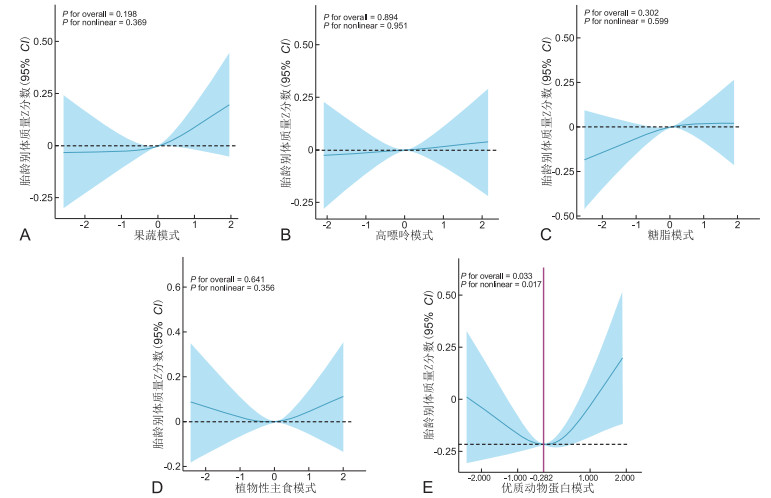
图 1 父亲膳食模式得分与胎龄别体质量Z评分的限制立方函数分析
注:果蔬模式(A),高嘌呤模式(B),糖脂模式(C),植物性主食模式(D),优质动物蛋白模式(E)。调整协变量为父亲年龄、受教育时间、BMI、吸烟、饮酒、运动、睡眠、家庭年收入、母亲年龄、孕前BMI、孕期二手烟暴露、子代性别、总能量。
Figure 1. Analysis of the restricted cube function of the father ' s dietary pattern score and the Z-score of gestational age and body weight
表 1 按子代出生体重分组的父亲人口学及生活方式比较
Table 1. Comparison of father ' s demographics and lifestyle based on the birth weight of the offspring
项目 总数(n=904) AGA(n=699) SGA(n=35) LGA(n=170) 统计量 P值 年龄(x±s, 岁) 33.93±4.62 33.94±4.66 35.23±3.99 33.64±4.54 1.723a 0.179 BMI(x±s) 24.61±3.28 24.55±3.23 24.39±3.30 24.87±3.45 492.600a < 0.001 总能量(x±s, kcal) 1 791.11±616.95 1 784.35±612.58 1 703.57±583.73 1 836.96±641.46 0.736a 0.391 蛋白质(x±s, g) 81.02±30.64 80.82±29.88 78.11±35.36 82.44±32.77 0.276a 0.600 脂肪(x±s, g) 65.33±27.30 65.35±26.76 62.82±28.99 65.81±29.21 0.013a 0.911 碳水化合物(x±s, g) 224.23±76.23 222.68±77.29 211.02±58.81 233.36±74.51 2.149a 0.143 受教育时间[例(%)] 1.079b 0.583 < 12年 75(8.30) 58(8.30) 4(11.43) 13(7.65) 12~16年 669(74.00) 514(73.53) 24(68.57) 131(77.06) >16年 160(17.70) 127(18.17) 7(20.00) 26(15.29) 家庭年收入[例(%)] 3.109b 0.211 < 20万元 358(39.60) 270(38.63) 17(48.57) 71(41.76) 20万元~30万元 250(27.65) 189(27.04) 11(31.43) 50(29.41) >30万元 296(32.74) 240(34.33) 7(20.00) 49(28.82) 居住地区[例(%)] 55.300b < 0.001 城市 844(93.36) 652(93.28) 31(88.57) 161(94.71) 乡镇农村 60(6.64) 47(6.72) 4(11.43) 9(5.29) 吸烟[例(%)] 278.820b < 0.001 有 320(35.40) 243(34.76) 8(22.86) 69(40.59) 无 584(64.60) 456(65.24) 27(77.14) 101(59.41) 饮酒[例(%)] 138.580b < 0.001 有 165(18.25) 124(17.74) 5(14.29) 36(21.18) 无 739(81.75) 575(82.26) 30(85.71) 134(78.82) 运动[例(%)] 307.080b < 0.001 有 334(36.95) 258(36.91) 7(20.00) 69(40.59) 无 570(63.05) 441(63.09) 28(80.00) 101(59.41) 睡眠时长[例(%)] 261.610b < 0.001 < 8 h 636(70.35) 487(69.67) 27(77.14) 122(71.76) ≥8 h 268(29.65) 212(30.33) 8(22.86) 48(28.24) 注:a为F值,b为χ2值。  下载: 导出CSV
表 2 5种膳食模式的因子载荷
Table 2. Factor loads of 5 dietary patterns
食物组 膳食模式 果蔬 高嘌呤 植物性主食 优质动物蛋白 糖脂混合 水果 0.858 - - - - 橘类 0.706 - - - - 蔬菜 0.614 - - - - 软体动物及贝壳类 - 0.797 - - - 动物内脏及血制品 - 0.629 - - - 鱼类及虾类 - 0.576 - - - 大豆及其制品 - - 0.648 - - 大米及面食 - - 0.607 - - 蘑菇及藻类 - - 0.555 - - 粗粮及薯类 - - 0.520 - - 肉类 - - - 0.670 - 牛奶 - - - 0.627 - 鸡蛋 - - - 0.625 - 烘焙甜食类 - - - - 0.793 油炸及膨化食品 - - - - 0.645 坚果 - - - - - 注:提取方法为主成分分析法,斜交旋转。保留因子载荷绝对值>0.5的因子。“-”表示该食物类别在膳食模式中的因子载荷绝对值≤0.5,其他因子载荷≤0.5的因子载荷需增加“-”。
下载: 导出CSV
表 3 自变量赋值情况
Table 3. Assignment of categorical variables
自变量 赋值方法 受教育时间 <12年=1, 12~16年=2,>16年=3 吸烟 无=0,有=1 饮酒 无=0,有=1 运动 无=0,有=1 睡眠 <8 h=0,≥8 h=1 家庭年收入 < 20万元=1,20万元~30万元=2 孕期二手烟暴露 无=0,有=1 子代性别 男=1,女=2
下载: 导出CSV
表 4 父亲膳食模式评分与SGA的多因素logistic回归分析
Table 4. Multivariate logistic regression analysis of fathers ' dietary pattern scores and SGA
膳食模式 调整前 调整后 B OR(95% CI) P值 B OR(95% CI) P值 果蔬 Q2 -0.588 0.556(0.218~1.325) 0.195 -0.848 0.428(0.162~1.062) 0.074 Q3 -0.884 0.413(0.144~1.050) 0.075 -1.113 0.328(0.109~0.88) 0.034 Q4 -0.726 0.484(0.180~1.187) 0.125 -0.859 0.424(0.152~1.083) 0.082 P-trend 0.076 0.057 高嘌呤 Q2 0.232 1.262(0.488~3.362) 0.631 0.174 1.190(0.447~3.260) 0.727 Q3 0.000 1.000(0.362~2.764) 0.999 -0.022 0.978(0.340~2.802) 0.966 Q4 0.122 1.130(0.425~3.062) 0.805 0.241 1.273(0.461~3.577) 0.639 P-trend 0.939 0.750 糖脂混合 Q2 -0.816 0.442(0.137~1.237) 0.136 -0.827 0.437(0.133~1.253) 0.139 Q3 0.092 1.096(0.470~2.577) 0.831 0.040 1.041(0.436~2.514) 0.927 Q4 -0.470 0.625(0.226~1.616) 0.340 -0.422 0.656(0.232~1.737) 0.403 P-trend 0.700 0.751 植物性主食 Q2 -0.816 0.442(0.137~1.237) 0.136 -0.911 0.402(0.123~1.150) 0.103 Q3 -0.100 0.905(0.370~2.189) 0.823 -0.242 0.785(0.314~1.939) 0.598 Q4 -0.210 0.811(0.321~1.997) 0.648 -0.325 0.723(0.278~1.827) 0.493 P-trend 0.939 0.746 优质动物蛋白 Q2 -1.093 0.335(0.119~0.824) 0.024 -1.079 0.340(0.118~0.858) 0.030 Q3 -0.934 0.393(0.149~0.931) 0.042 -1.093 0.335(0.122~0.835) 0.024 Q4 -1.280 0.278(0.090~0.717) 0.013 -1.359 0.257(0.079~0.712) 0.014 P-trend 0.008 0.007 注:Q1、Q2、Q3、Q4为膳食模式得分升序后进行四等分的分类。各膳食模式均以Q1为参照。调整变量为父亲年龄、受教育时间、BMI、吸烟、饮酒、运动、睡眠、家庭年收入、母亲年龄、BMI、孕期二手烟暴露、子代性别、总能量。
下载: 导出CSV
表 5 父亲优质动物蛋白膳食模式评分与SGA的分层分析
Table 5. Stratified analysis of dietary pattern score of high quality animal protein in fathers and SGA
父亲特征 OR(95% CI) P值 父亲特征 OR(95% CI) P值 BMI < 24 BMI≥24 Q2 0.215(0.039~0.928) 0.051 Q2 0.340(0.071~1.234) 0.125 Q3 0.281(0.061~1.105) 0.079 Q3 0.310(0.060~1.233) 0.119 Q4 0.093(0.005~0.630) 0.038 Q4 0.358(0.084~1.297) 0.133 年龄 < 35岁 年龄≥35岁 Q2 0.182(0.026~0.765) 0.037 Q2 0.558(0.130~2.090) 0.399 Q3 0.199(0.040~0.755) 0.026 Q3 0.407(0.092~1.566) 0.204 Q4 0.086(0.004~0.529) 0.028 Q4 0.458(0.100~1.846) 0.283 睡眠 < 8 h 睡眠≥8 h Q2 0.339(0.102~0.977) 0.056 Q2 0.458(0.019~4.324) 0.539 Q3 0.372(0.126~1.011) 0.059 Q3 - 0.993 Q4 0.104(0.015~0.426) 0.005 Q4 1.187(0.165~8.064) 0.858 运动 不运动 Q2 0.676(0.05~8.343) 0.752 Q2 0.297(0.080~0.883) 0.042 Q3 0.231(0.005~4.249) 0.358 Q3 0.348(0.111~0.971) 0.053 Q4 0.200(0.004~4.205) 0.338 Q4 0.237(0.061~0.749) 0.022 注:Q1、Q2、Q3、Q4为膳食模式得分升序后进行四等分的分类,均以Q1为参照。调整变量为父亲年龄、受教育时间、BMI、吸烟、饮酒、运动、睡眠、家庭年收入,母亲年龄、BMI、处于二手烟环境,子代性别、总能量。“-”表示该食物类别在膳食模式中的因子载荷绝对值≤0.5,所以不显示具体数值。
下载: 导出CSV
-
[1] 孔北华, 马丁, 段涛. 妇产科学[M]. 10版. 北京: 人民卫生出版社, 2024: 399.KONG B H, MA D, DUAN T. Obstetrics and gynecology[M]. 10th edition. Beijing: People's Medical Publishing House, 2024: 399. [2] 李敏, 王宝珠. 陕西省2010-2020年5岁以下儿童死亡监测结果分析[J]. 中华疾病控制杂志, 2023, 27(9): 1019-1024.LI M, WANG B Z. Analysis of mortality surveillance results for children under five in Shaanxi province from 2010 to 2020[J]. Chinese Journal of Disease Control and Prevention, 2023, 27(9): 1019-1024. [3] ARDISSINO M, MORLEY A P, SLOB E A W, et al. Birth weight influences cardiac structure, function, and disease risk: evidence of a causal association[J]. Eur Heart J, 2024, 45(6): 443-454. doi: 10.1093/eurheartj/ehad631 [4] TOMAR A, GOMEZ V M, GERLINI R, et al. Epigenetic inheritance of diet-induced and sperm-borne mitochondrial RNAs[J]. Nature, 2024, 630(8017): 720-727. doi: 10.1038/s41586-024-07472-3 [5] 郭姝, 潘娟, 李妍, 等. 育龄期女性孕前膳食模式与新生儿出生体重的关联性研究[J]. 华中科技大学学报(医学版), 2024, 53(1): 52-58.GUO S, PAN J, LI Y, et al. Study on Association of Preconception Dietary Patterns with Neonate Birth Weight[J]. Acta Medicinae Universitatis Scientiae et Technologiae Huazhong, 2024, 53(1): 52-58. [6] LIU D, CHENG Y, MI B, et al. Maternal dietary patterns during pregnancy derived by reduced-rank regression and birth weight in the Chinese population[J]. Br J Nut, 2020, 123(10): 1176-1186. doi: 10.1017/S0007114520000392 [7] DING Y, YANG Y, LI F, et al. Development and validation of a photographic atlas of food portions for accurate quantification of dietary intakes in China[J]. J Hum Nutr Diet, 2021, 34(3): 604-615. doi: 10.1111/jhn.12844 [8] VAN S N, CUI J, WANG Y, et al. Identifying first-trimester risk factors for SGA-LGA using weighted inheritance voting ensemble learning[J]. Bioengineering (Basel), 2024, 11(7): 657. DOI: 10.3390/bioengineering11070657. [9] MORGAN H L, FURSE S, DIAS I H K, et al. Paternal low protein diet perturbs inter-generational metabolic homeostasis in a tissue-specific manner in mice[J]. Commun Biol, 2022, 5(1): 929. DOI: 10.1038/s42003-022-03914-8. [10] MAI H. Association of diet and lifestyle factors with semen quality in male partners of Chinese couples preparing for pregnancy[J]. Reprod Health, 2023, 20(1): 173. DOI: 10.1186/s12978-023-01718-5. [11] ABDOLLAHI N, NOURI M, LEILAMI K, et al. The relationship between plant and animal based protein with semen parameters: a cross-sectional study in infertile men[J]. Clin Nutr ESPEN, 2022, 49: 372-377. doi: 10.1016/j.clnesp.2022.03.019 [12] DIMOFSKI P, MEYRE D, DREUMONT N, et al. Consequences of paternal nutrition on offspring health and disease[J]. Nutrients, 2021, 13(8): 2818. DOI: 10.3390/nu13082818. [13] DE LAUZON G B, KRINITZKI S, LIORET S, et al. Paternal diet before conception and its social determinants in the Elbe cohort[J]. Nutrients, 2022, 14(19): 4008. DOI: 10.3390/nu14194008. [14] 张雪云, 王婕妤, 王春艳, 等. 育龄期不孕症女性的膳食模式现状及其影响因素分析[J]. 中华全科医学, 2024, 22(2): 252-256. doi: 10.16766/j.cnki.issn.1674-4152.003377ZHANG X Y, WANG J Y, WANG C Y, et al. Analysis of dietary patterns and influencing factors in infertile women of childbearing age[J]. Chinese Journal of General Practice, 2024, 22(2): 252-256. doi: 10.16766/j.cnki.issn.1674-4152.003377 [15] ZHANG Y, ZHAO Y, DUAN Y, et al. Effects of prepregnancy dietary patterns on infant birth weight: a prospective cohort study[J]. J Matern Fetal Neonatal Med, 2023, 36(2): 2273216. DOI: 10.1080/14767058.2023.2273216. [16] YAN H, DANG S, ZHANG Y, et al. Dietary patterns of Chinese women of childbearing age during pregnancy and their relationship to the neonatal birth weight[J]. Nutr J, 2020, 19(1): 89. DOI: 10.1186/s12937-020-00637-6. [17] OOSTINGH E C, DE VOS I, HAM A C, et al. No independent associations between preconception paternal dietary patterns and embryonic growth: the predict study[J]. Clin Nutr, 2019, 38(5): 2333-2341. doi: 10.1016/j.clnu.2018.10.011 [18] ZHANG X, WU S, QI X, et al. Effect of paternal body mass index on In Vitro fertilization and neonatal outcomes among oligozoospermia and asthenospermia patients[J]. World J Mens Health, 2024, 42(1): 216. DOI: 10.5534/wjmh.220286. [19] GUO T, YANG Y, JIA J, et al. Preconception paternal/maternal BMI and risk of small/large for gestational age infant in over 4.7 million Chinese women aged 20-49 years: a population-based cohort study in China[J]. Br J Nutr, 2023, 129(2): 365-366. doi: 10.1017/S0007114522001179 [20] CLAYCOMBE L K G, BUNDY A N, ROEMMICH J N. Paternal high-fat diet and exercise regulate sperm miRNA and histone methylation to modify placental inflammation, nutrient transporter mRNA expression and fetal weight in a sex-dependent manner[J]. J Nutr Biochem, 2020, 81: 108373. DOI: 10.1016/j.jnutbio.2020.108373. -

 点击查看大图
计量
- 文章访问数: 6
- HTML全文浏览量: 4
- PDF下载量: 0
- 被引次数: 0
