



Expert consensus on the diagnosis, treatment, and management of hyperhidrosis (2025)
-
摘要: 多汗是一种常见的临床表现,可单独或伴随系统性疾病出现,明显影响个体的日常生活、工作、社交及心理健康。当前,我国缺乏多汗的大规模流行病学数据,诊断标准与严重程度分级体系尚不统一,临床诊疗存在“同症不同判”的现象。本共识以多汗的诊治与管理为导向,系统阐述其定义、流行病学特征、病因与发病机制,综述诊断方法,包括详细问诊、体格检查、评估工具与诊断流程,并从治疗原则、治疗方案及治疗措施等方面展开详细的阐述。同时,本共识提出多汗的全程管理建议,涵盖社区管理、随访、双向转诊、健康教育与未来研究方向,旨在为全科医生及相关医务人员提供规范化、标准化的诊疗与管理指导,提升病因诊断准确率,优化治疗效果,改善患者生活质量。Abstract: Hyperhidrosis is a common clinical manifestation that may occur independently or as a concomitant symptom of systemic diseases, significantly impacting an individual's daily life, work, social interactions, and psychological well-being. Currently, China lacks large-scale epidemiological data on hyperhidrosis, and there is no unified diagnostic criteria or severity grading system, leading to inconsistent clinical judgments for the same condition. This consensus, oriented towards the diagnosis, treatment, and management of hyperhidrosis, systematically elaborates on its definition, epidemiological characteristics, etiology, and pathogenesis. It reviews diagnostic methods, including detailed history taking, physical examination, assessment tools, and diagnostic procedures, and provides a detailed exposition of treatment principles, protocols, and interventions. Furthermore, this consensus proposes recommendations for the comprehensive management of hyperhidrosis, covering community management, follow-up, bidirectional referral, health education, and future research directions. The aim is to provide standardized and normalized guidance for general practitioners and relevant medical professionals, thereby improving the accuracy of etiological diagnosis, optimizing treatment outcomes, and enhancing patients'quality of life.
-
Key words:
- Hyperhidrosis /
- Diagnosis /
- Treatment /
- Management /
- Expert consensus
-
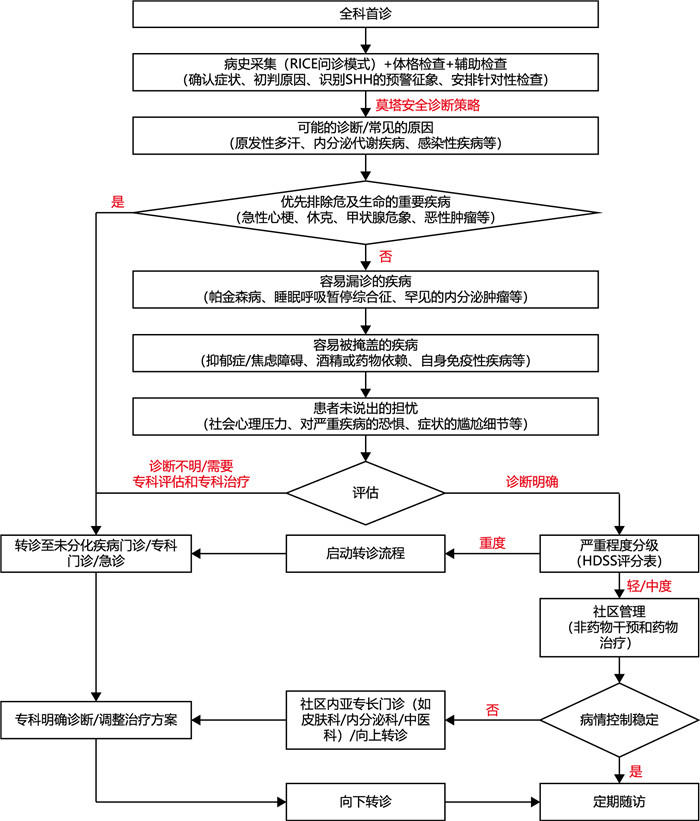
表 1 多汗严重程度量表(HDSS评分表)
评分 症状描述 分度 1分 从不明显,从不影响生活 轻度(1分) 2分 可忍受,有时影响生活 中度(2分) 3分 难以忍受,经常影响生活 重度(≥3分) 4分 无法忍受,总是影响生活 重度(≥3分)  下载: 导出CSV
表 2 多汗的常见原因
多汗分类 常见原因 生理性多汗 环境温度高或衣物厚重、体力劳动和运动等;进食辛辣食物,饮用含酒精饮品或咖啡、浓茶等;特殊气味如香水等;情绪紧张、窘迫、恐惧、发怒、兴奋和精神打击等;婴儿期、月经期、妊娠期、产褥期、围绝经期等 病理性多汗 原发性多汗 原发性全身性多汗 原发性多汗症 原发性局限性多汗 手汗症、足汗症、腋汗症、头面汗症等 继发性多汗 继发性全身性多汗 内分泌和代谢性疾病 甲状腺功能亢进、糖尿病、低血糖、垂体功能亢进、多囊卵巢综合征、维生素D缺乏、肥胖症等 神经系统疾病 帕金森病、脑血管病、痴呆、多发性神经病、不宁腿综合征、下丘脑病变等 循环系统疾病 心力衰竭、心肌梗死、休克、高血压、血管迷走性晕厥等 呼吸系统疾病 慢性阻塞性肺疾病、支气管哮喘、呼吸衰竭、睡眠呼吸暂停低通气综合征等 皮肤病 泛发性脓疱疮、脱发-多汗-舌状角膜混浊综合征(Spanlang-Tappeiner综合征)等 风湿免疫病 系统性红斑狼疮、血管炎、类风湿性关节炎、Still病等 血液系统疾病 淋巴瘤、多发性骨髓瘤、白血病、POEMS综合征、血色素沉积症等 消化系统疾病 炎症性肠病、胃食管反流病、急性胃肠炎等 肿瘤性疾病 嗜铬细胞瘤、肾上腺髓质瘤、中枢神经系统肿瘤、类癌、乳腺癌、肾癌、胆管癌等 感染性疾病 结核病、布鲁氏菌病、心内膜炎、HIV感染、疟疾等 精神心理疾病 焦虑症、抑郁症、精神分裂症、双相情感障碍、睡眠障碍等 药物 具体药物见表 3 其他 慢性酒精中毒、汞中毒,鸦片类、吗啡等麻醉品戒断等 继发性局限性多汗 神经系统疾病 带状疱疹后遗神经痛、糖尿病周围神经病变、脊髓疾病或损伤、交感神经干损伤、胸交感神经切除术后代偿性多汗、反射性交感神经萎缩、腮腺的手术或损伤如耳颞神经综合征(Frey’s综合征)、足部灼伤综合征(Gopalan综合征)、家族性自主神经失调综合征(Riley-Day综合征)、神经源性胸廓出口综合征、罗斯综合征(Ross综合征)等 皮肤病 汗腺血管瘤样错构瘤、皮肤多发性神经病变、汗腺痣、先天性厚甲症、蓝色橡胶膜痣、单侧火焰痣、大疱性表皮松解症、甲-髌骨综合征等 胸部肿瘤 肺癌、间皮瘤、脊髓瘤、骨瘤等 其他 副肿瘤综合征、胫前黏液性水肿、尿道狭窄等 注:部分继发性多汗病因存在全身性多汗和局限性多汗并存可能。
下载: 导出CSV
表 3 可致多汗的常见药物
药物类别 代表药物 神经、精神类药物 抗胆碱酯酶药物(多奈哌齐、卡巴拉汀、加兰他敏、石杉碱甲、溴吡斯的明、新斯的明等)、阿片类药(吗啡、羟考酮、芬太尼等)、选择性5-羟色胺再摄取抑制剂抗抑郁药(舍曲林、帕罗西汀、西酞普兰、艾司西酞普兰、氟西汀等)、三环类抗抑郁药(阿米替林、多塞平等)、5-羟色胺和去甲肾上腺素再摄取抑制剂抗抑郁药(文拉法辛、度洛西汀等)、单胺氧化酶抑制剂(苯乙肼等)、抗精神病药(氯氮平、奥氮平、利培酮、喹硫平等)、苯二氮类药(地西泮、阿普唑仑等) 心血管、呼吸类药物 钙通道阻滞剂(硝苯地平、氨氯地平、非洛地平等)、β-受体阻滞剂(普萘洛尔、美托洛尔等)、α-受体阻滞剂(特拉唑嗪、多沙唑嗪等)、硝酸酯类药物(硝酸甘油、单硝酸异山梨酯等)、抗心律失常药(胺碘酮等)、β-受体激动剂(异丙肾上腺素、沙丁胺醇、特布他林等) 内分泌类药物 降糖药(胰岛素、格列本脲、格列美脲、瑞格列奈等) 消化类药物 奥美拉唑、甲氧氯普胺等 激素类药物 甲状腺激素(左甲状腺素钠等)、皮质类固醇(泼尼松等)、抗雌激素类(他莫昔芬等)、抗雄激素类(比卡鲁胺、氟他胺等)、促性腺激素释放激素激动剂(亮丙瑞林、戈舍瑞林等)、芳香化酶抑制剂(阿那曲唑、来曲唑、依西美坦等) 抗生素与抗病毒药物 广谱抗生素(左氧氟沙星、环丙沙星等)、抗结核药(利福平、异烟肼等)、抗病毒药(更昔洛韦等) 非甾体类抗炎药 对乙酰氨基酚、布洛芬、萘普生、塞来昔布等 其他药物 兴奋剂(哌甲酯、安非他命等)、抗青光眼药(毛果芸香碱滴眼液等)、钙调神经磷酸酶抑制剂(环孢素、他克莫司等)、肿瘤坏死因子抑制剂(英夫利西单抗、阿达木单抗等)、伊克珠单抗、舒尼替尼、帕博利珠单抗、度普利尤单抗等
下载: 导出CSV
表 4 多汗的RICE问诊
问诊内容 提示信息 R:患者本次就诊的主要原因(Reason)是什么? 明确多汗的特点及伴随症状 I:患者认为自己出了什么问题(Idea)? 探寻多汗背后的可能原因及心理问题 C:患者的担忧(Concern)是什么? 了解患者的真实诉求 E:患者期望(Expectation)可以解决什么问题? 共同决策,了解患者对诊疗的接受程度
下载: 导出CSV
表 5 多汗的预警征及可能的严重疾病
预警征 可能的严重疾病 发热 感染性疾病等 咳嗽、呼吸困难、咯血 肺结核、支气管扩张、慢性阻塞性肺疾病等 呕血、黑便、便血 消化道出血 心悸 甲状腺功能亢进、贫血等 食欲亢进 糖尿病、甲状腺功能亢进等 体重下降 糖尿病、甲状腺功能亢进、肺结核、恶性肿瘤等 颈静脉怒张、端坐呼吸 急性心力衰竭、肺水肿等 胸痛 急性冠脉综合征、主动脉夹层等 行动迟缓、肢体抖动、活动障碍 脑卒中、脊髓损伤、帕金森病等 皮肤水疱、溃破、脱屑 真菌感染等 血压升高、头痛、面色苍白 嗜铬细胞瘤等 情绪低落、情志改变、睡眠障碍 焦虑症、抑郁症、自主神经功能紊乱等
下载: 导出CSV
表 6 高级自主神经功能测试
测试名称 类型 评估目标 方法 结果解释 备注 热调节排汗测试(TST) 定性 评估全身汗腺节前和节后通路完整性 患者全身涂上遇湿变色的指示剂粉末(如茜素红),然后进入可控温腔室,通过逐渐升高核心体温来诱发全身性出汗 通过观察颜色变化的模式和分布,判断是否存在全身性或局灶性的出汗异常,从而定位神经损伤的区域 TST和QSART结合使用,能更精确地鉴别自主神经病变的部位[21] 定量轴索反射泌汗测试(QSART) 定量 评估节后交感神经胆碱能纤维功能 通过离子导入法将乙酰胆碱导入皮肤特定部位,刺激汗腺产生轴索反射性出汗;使用汗液计测量和记录出汗量和延迟时间 定量评估汗腺功能
下载: 导出CSV
表 7 中医“汗证”辨证分型与舌脉特征
中医证型 典型舌象 典型脉象 治疗原则 肺卫不固 舌质淡,苔薄白 脉细弱或虚 益气固表 营卫不和 舌质淡红,苔薄白 脉缓或浮缓 调和营卫 阴虚火旺 舌质红或绛,少津,苔少或无苔 脉细数 滋阴降火,敛阴止汗 邪热内蕴 舌质红,苔黄燥或黄腻 脉洪大有力或滑数 清胃泻热 湿热蕴蒸 舌质红,苔黄腻 脉滑数或濡数 清热化湿,和营泄热 气阴两虚 舌质红嫩,少津,苔薄白或少苔 脉细数或虚数 益气养阴,生津止汗 气虚阳虚 舌质淡胖,边有齿痕,苔白滑或白腻 脉沉细无力或虚弱 益气温阳,固表止汗 肝郁化火 舌质红,苔黄 脉弦数 疏肝清热 脾虚湿困 舌质淡,苔白腻 脉濡缓 健脾化湿 痰浊内阻 舌质淡,苔白腻 脉滑 化痰理气
下载: 导出CSV
表 8 实用的自我监测方法
方法名称 操作步骤 结果观察 注意事项 纸巾握持试验 1.取一张洁净干纸巾对折。2.受试者使用汗液分泌显著的手部紧握纸巾,持续1~2 min。 轻度:纸巾仅轻微潮湿,无浸润感。中度:纸巾被完全浸透,但无水滴形成。重度:纸巾完全湿透,并可见汗珠形成或滴落。 1.用于评估手汗症。2.测试前尽量保持手部干燥。3.在情绪稳定的状态下进行,以获得更准确的结果。 淀粉-碘试验(家庭简易版) 1.于干燥待测皮肤区域均匀涂抹少量碘酊。2.自然风干后,均匀撒上一层薄玉米淀粉。 出汗区域的淀粉会与碘反应,呈现蓝色或紫黑色。颜色越深,说明该区域出汗越多;无颜色变化表示无汗。 对碘剂过敏者禁止使用。 称重法 1.将干燥的纱布或滤纸称重(W1)。2.放在出汗部位一定时间(如5 min)吸收汗水,再次称重(W2)。 2次称重的重量差即为出汗量(W2-W1)。 可为治疗前后的疗效对比提供客观、量化的数据支持,但操作方法较烦琐。
下载: 导出CSV
-
[1] LAKRAJ A A, MOGHIMI N, JABBARI B. Hyperhidrosis: anatomy, pathophysiology and treatment with emphasis on the role of botulinum toxins[J]. Toxins (Basel), 2013, 5(4): 821-840. doi: 10.3390/toxins5040821 [2] 李玲玲, 曲天歌, 段行武, 等. 原发性多汗症的中西医理论辨析[J]. 现代中医临床, 2019, 26(3): 45-49. [3] 黎恒, 吴松. 原发性多汗症[J]. 临床皮肤科杂志, 2025, 54(6): 374-378. [4] MONIATI F, VASSILIOU M, COSTA C, et al. Efficacy and safety of treatments for primary palmar hyperhidrosis: a systematic review assessing patient-centric outcomes[J]. Dermatol Res Pract, 2025, 2025: 8867838. DOI: 10.1155/drp/8867838. [5] 涂远荣, 刘彦国. 中国手汗症微创治疗临床指南(2021年版)[J]. 中国胸心血管外科临床杂志, 2021, 28(10): 1133-1139. [6] 孙秋宁, 房柔妤, 陈典. 多汗症及腋臭的肉毒素注射治疗专家共识[J]. 中国中西医结合皮肤性病学杂志, 2017, 16(1): 90-93. [7] GORELICK J, FRIEDMAN A. Diagnosis and management of primary hyperhidrosis: practical guidance and current therapy update[J]. J Drugs Dermatol, 2020, 19(7): 704-710. doi: 10.36849/JDD.2020.5162 [8] SOLISH N, BERTUCCI V, DANSEREAU A, et al. A comprehensive approach to the recognition, diagnosis, and severity-based treatment of focal hyperhidrosis: recommendations of the Canadian Hyperhidrosis Advisory Committee[J]. Dermatol Surg, 2007, 33(8): 908-923. [9] LIU Y, WENG W, TU Y, et al. Chinese Expert Committee on Palmar Hyperhidrosis. Chinese expert consensus on the surgical treatment of primary palmar hyperhidrosis (2021 version)[J]. Chin Med J (Engl), 2022, 135(11): 1264-1271. doi: 10.1097/CM9.0000000000002198 [10] DOOLITTLE J, WALKER P, MILLS T, et al. Hyperhidrosis: an update on prevalence and severity in the United States[J]. Arch Dermatol Res, 2016, 308(10): 743-749. doi: 10.1007/s00403-016-1697-9 [11] LIU Y, BAHAR R, KALIA S, et al. Hyperhidrosis prevalence and demographical characteristics in dermatology outpatients in Shanghai and Vancouver[J]. PLoS One, 2016, 11(4): e0153719. DOI: 10.1371/journal.pone.0153719. [12] WOHLRAB J, BECHARA F G, SCHICK C, et al. Hyperhidrosis: a central nervous dysfunction of sweat secretion[J]. Dermatol Ther (Heidelb), 2023, 13(2): 453-463. doi: 10.1007/s13555-022-00885-w [13] NASTASE F, VERENCA M C, NICULET E, et al. Primary hyperhidrosis in children-a retrospective study and a short review[J]. Life (Basel), 2024, 14(5): 645. DOI: 10.3390/life14050645. [14] MAAZI M, LEUNG A K, LAM J M. Primary hyperhidrosis: an updated review[J]. Drugs Context, 2025, 14: 2025-3-2. DOI: 10.7573/dic.2025-3-2 .[15] HASHMONAI M, CAMERON A E P, CONNERY C P, et al. The etiology of primary hyperhidrosis: a systematic review[J]. Clin Auton Res, 2017, 27(6): 379-383. doi: 10.1007/s10286-017-0456-0 [16] LIN J B, KANG M Q, HUANG L P, et al. CHRNA1 promotes the pathogenesis of primary focal hyperhidrosis[J]. Mol Cell Neurosci, 2021, 111: 103598. DOI: 10.1016/j.mcn.2021.103598. [17] LIN J B, CHEN J F, LAI F C, et al. Involvement of activin a receptor type 1 (ACVR1) in the pathogenesis of primary focal hyperhidrosis[J]. Biochem Biophys Res Commun, 2020, 528(2): 299-304. doi: 10.1016/j.bbrc.2020.05.052 [18] 国家中医药管理局. 中医病证诊断疗效标准[S]. 南京: 南京大学出版社, 1994: 32-33. [19] 李彩伟, 吴浩, 任保瑞, 等. 原发性手汗症患者社交回避及苦恼的现状分析[J]. 空军医学杂志, 2014, 30(2): 111-113. [20] 王梦真, 罗玥, 刘子玉, 等. 从肝脾论治多汗症[J]. 北京中医药大学学报, 2024, 47(4): 490-495. [21] BARATEAU L, DIAB J, THOBOIS O, et al. Systematic assessment of dysexecutive syndrome, hypersomnolence and dysautonomia in kleine-levin syndrome[J]. Eur J Neurol, 2025, 32(7): e70259. DOI: 10.1111/ene.70259. [22] 刘巍, 鲍霞, 王诗源. 手汗症中医经方辨治探讨[J]. 山东中医杂志, 2018, 37(10): 807-810. [23] 李荣慧, 雷晓明, 张国民, 等. 张崇泉"二维四向法"治疗汗证经验[J]. 中华中医药杂志, 2022, 37(7): 3932-3935. [24] 武广华, 臧益秀, 刘运祥, 等. 中国卫生管理辞典[M]. 北京: 中国科学技术出版社, 2001: 115. [25] 张培玲, 李仙, 王晶晶. 原发性多汗症患者日常生活质量及心理体验的质性研究[J]. 当代护士, 2023, 30(5): 110-114. [26] PARASHAR K, ADLAM T, POTTS G. The impact of hyperhidrosis on quality of life: a review of the literature[J]. Am J Clin Dermatol, 2023, 24(2): 187-198. doi: 10.1007/s40257-022-00743-7 [27] HENNING M A S, BOUAZZI D, JEMEC G B E. Treatment of hyperhidrosis: an update[J]. Am J Clin Dermatol, 2022, 23(5): 635-646. doi: 10.1007/s40257-022-00707-x [28] KAWAHARA K, SHIMOMURA Y, OSHIMA Y, et al. Case report: acquired generalized anhidrosis caused by brain tumor: review of the literature[J]. Front Endocrinol (Lausanne), 2022, 13: 877715. DOI: 10.3389/fendo.2022.877715. [29] BEHINAEIN P, GAVAGAN K, WAITZMAN J, et al. A review of the etiologies and key clinical features of secondary hyperhidrosis[J]. Am J Clin Dermatol, 2025, 26(1): 97-108. doi: 10.1007/s40257-024-00908-6 [30] AUBIGNAT M. Hyperhidrosis from diagnosis to management[J]. Rev Med Interne, 2021, 42(5): 338-345. doi: 10.1016/j.revmed.2020.11.002 [31] LÜTGERATH C, WEIß C, FAULHABER J, et al. Comparison of a novel aluminum lactate-based with an aluminum chloride-based antiperspirant in excessive axillary and inguinal perspiration: first randomized controlled trial[J]. J Dtsch Dermatol Ges, 2022, 20(12): 1589-1601. [32] NAWROCKI S, CHA J. The etiology, diagnosis, and management of hyperhidrosis: a comprehensive review: therapeutic options[J]. J Am Acad Dermatol, 2019, 81(3): 669-680. doi: 10.1016/j.jaad.2018.11.066 [33] PATRA S, KAUR M, SHARMA V K. Stepwise treatment of primary focal hyperhidrosis with aluminum chloride hexahydrate lotion (20%) and oral glycopyrrolate: a retrospective study from a tertiary care center[J]. Dermatol Ther, 2020, 33(6): e13914. DOI: 10.1111/dth.13914. [34] ELKHOLY B M, ALI EBRAHIM S, OTHMAN SOBH M A, et al. A comparative study of aluminum chloride, oxybutynin chloride, and botulinum toxin in the treatment of primary focal hyperhidrosis[J]. J Cutan Med Surg, 2025, 21: 12034754251336233. DOI: 10.1177/12034754251336233. [35] GLASER D A, HEBERT A A, NAST A, et al. Topical glycopyrronium tosylate for the treatment of primary axillary hyperhidrosis: results from the ATMOS-1 and ATMOS-2 phase 3 randomized controlled trials[J]. J Am Acad Dermatol, 2019, 80(1): 128-138. doi: 10.1016/j.jaad.2018.07.002 [36] YOKOZEKI H, FUJIMOTO T, WANATABE S, et al. Topical glycopyrronium tosylate in Japanese patients with primary axillary hyperhidrosis: a randomized, double-blind, vehicle-controlled study[J]. J Dermatol, 2022, 49(1): 86-94. doi: 10.1111/1346-8138.16188 [37] ARTZI O, LOIZIDES C, ZUR E, et al. Topical oxybutynin 10% gel for the treatment of primary focal hyperhidrosis: a randomized double-blind placebo-controlled split area study[J]. Acta Derm Venereol, 2017, 97(9): 1120-1124. doi: 10.2340/00015555-2731 [38] KIRSCH B, SMITH S, COHEN J, et al. Efficacy and safety of topical sofpironium bromide gel for the treatment of axillary hyperhidrosis: a phase II, randomized, controlled, double-blinded trial[J]. J Am Acad Dermatol, 2020, 82(6): 1321-1327. doi: 10.1016/j.jaad.2020.02.016 [39] SCHOLLHAMMER M, BRENAUT E, MENARD-ANDIVOT N, et al. Oxybutynin as a treatment for generalized hyperhidrosis: a randomized, placebo-controlled trial[J]. Br J Dermatol, 2015, 173(5): 1163-1168. doi: 10.1111/bjd.13973 [40] CRUDDAS L, BAKER D M. Treatment of primary hyperhidrosis with oral anticholinergic medications: a systematic review[J]. J Eur Acad Dermatol Venereol, 2017, 31(6): 952-963. doi: 10.1111/jdv.14081 [41] LIN Q, CAI B, CHEN L, et al. Contemporary algorithm for treating bromhidrosis: a review of treatment available[J]. Aesthetic Plast Surg, 2025, 49(13): 3841-3848. doi: 10.1007/s00266-024-04633-7 [42] WATANABE H, OHSHIMA Y, WATANABE D. Therapeutic Effectiveness of needle injection versus needle-free jet injector system for botulinum toxin type a in palmar hyperhidrosis[J]. J Cutan Med Surg, 2023, 27(5): 481-486. doi: 10.1177/12034754231191062 [43] LUEANGARUN S, SERMSILP C, TEMPARK T. Topical botulinum toxin type a liposomal cream for primary axillary hyperhidrosis: a double-blind, randomized, split-site, vehicle-controlled study[J]. Dermatol Surg, 2018, 44(8): 1094-1101. doi: 10.1097/DSS.0000000000001532 [44] MALEK-KHATABI A, RAD-MALEKSHAHI M, SHAFIEI M, et al. Botulinum toxin A dissolving microneedles for hyperhidrosis treatment: design, formulation and in vivo evaluation[J]. Biomater Sci, 2023, 11(24): 7784-7804. doi: 10.1039/D3BM01301D [45] 李祎铭, 李利. 腋窝多汗症诊断及A型肉毒毒素注射治疗专家共识[J]. 中国皮肤性病学杂志, 2024, 38(3): 237-242. [46] GALADARI H, GALADARI I, SMIT R, et al. Treatment approaches and outcomes associated with the use of abobotulinumtoxin A for the treatment of hyperhidrosis: a systematic review[J]. J Am Acad Dermatol, 2021, 85(5): 1121-1129. doi: 10.1016/j.jaad.2020.07.123 [47] PRODAN-BARBULESCU C, CASTIGLIONE L, BURTIC S R, et al. Longitudinal assessment of facial hyperhidrosis management: evaluating the utility and quality of life improvements following botulinum toxin injection[J]. Toxins (Basel), 2024, 16(1): 59. DOI: 10.3390/toxins16010059. [48] CAMPANATI A, DIOTALLEVI F, RADI G, et al. Efficacy and safety of botulinum toxin B in focal hyperhidrosis: a narrative review[J]. Toxins (Basel), 2023, 15(2): 147. DOI: 10.3390/toxins15020147. [49] SUN J, CHEN S, YANG T, et al. Efficacy and safety of botulinum toxin type A in primary axillary hyperhidrosis: a meta-analysis and systematic review[J]. Aesthetic Plast Surg, 2025, 49(17): 4932-4940. doi: 10.1007/s00266-025-04909-6 [50] WALLING H W. Systemic therapy for primary hyperhidrosis: a retrospective study of 59 patients treated with glycopyrrolate or clonidine[J]. J Am Acad Dermatol, 2012, 66(3): 387-392. doi: 10.1016/j.jaad.2011.01.023 [51] 张伯礼, 吴勉华. 中医内科学[M]. 北京: 中国中医院出版社, 2017: 331. [52] 李倩, 老锦雄. 《针灸大成》论治汗证探微[J]. 浙江中医杂志, 2023, 58(2): 137-138. [53] 田纪良, 胡泉. 中医药治疗多汗症的研究进展[J]. 内蒙古中医药, 2024, 43(4): 164-166. [54] 田湘平, 吴剑芳, 陈可. 黄芪建中汤加减联合五倍子散外敷神阙穴治疗小儿汗证的效果分析[J]. 医学理论与实践, 2024, 37(16): 2788-2790. [55] 夏宁俊, 顾根网, 陈艳, 等. 固表扶正止瘤汗汤联合益气敛汗散治疗气血两虚型肿瘤相关性汗证疗效观察[J]. 广西中医药大学学报, 2025, 28(4): 20-24. [56] RAHIM M, AHMED N, NAZ KHAN K, et al. Comparison of the efficacy of tap water iontophoresis versus aluminum chloride hexahydrate in the treatment of palmoplantar hyperhidrosis[J]. Cureus, 2022, 14(12): e32367. DOI: 10.7759/cureus.32367. [57] HOSSEINI S M, GHANDALI E, MOGHIMI H R, et al. A comparative evaluation of aluminum chloride hexahydrate gel iontophoresis versus tap water iontophoresis in people with primary palmar hyperhidrosis: a randomised clinical trial[J]. Indian J Dermatol Venereol Leprol, 2023, 90(1): 52-58. [58] HÖLZLE E. Tap water iontophoresis[J]. Hautarzt, 2012, 63(6): 462-468. doi: 10.1007/s00105-012-2332-0 [59] GLASER D A, COLEMAN W P, FAN L K, et al. A randomized, blinded clinical evaluation of a novel microwave device for treating axillary hyperhidrosis: the dermatologic reduction in underarm perspiration study[J]. Dermatol Surg, 2012, 38(2): 185-191. [60] GUPTA A K, VENKATARAMAN M, JOSHI L T, et al. Potential use of microwave technology in dermatology[J]. J Dermatolog Treat, 2022, 33(7): 2899-2910. doi: 10.1080/09546634.2022.2089333 [61] PISSA M, HASHEM R, SHAYESTEH A, et al. Evaluation of quality of life, anxiety, and depression in patients with primary axillary hyperhidrosis undergoing treatment with a microwave device: one-year follow-up[J]. Acta Derm Venereol, 2024, 104: adv40543. DOI: 10.2340/actadv.v104.40543. [62] JUNG J M, NA H M, KIM J H, et al. The efficacy and safety of a fractional microneedle radiofrequency device for the treatment of axillary hyperhidrosis: clinical prospective pilot study[J]. Lasers Med Sci, 2022, 37(3): 1559-1566. doi: 10.1007/s10103-021-03404-z [63] TAUDORF E H, HENNING M, OLSEN J, et al. Attempted treatment of primary axillary hyperhidrosis with one session of either neodymium YAG laser or intense pulsed light: a within patient randomized trial of treated versus untreated contralateral axilla[J]. Lasers Surg Med, 2023, 55(8): 748-757. doi: 10.1002/lsm.23697 [64] 林清财, 林剑波, 涂远荣, 等. 243例原发性手汗症患者胸腔镜下胸交感神经切断术后生活质量分析[J]. 中国胸心血管外科临床杂志, 2022, 29(3): 294-300. [65] 陈安平, 龚明, 黎兰, 等. 日间快速康复模式下胸腔镜交感神经切断术治疗手汗症的单中心回顾性队列研究[J]. 中国胸心血管外科临床杂志, 2022, 29(3): 301-305. [66] UREÑA A, GRANDO L, RODRIGUEZ-GUSSINYER L, et al. 20-year efficacy of endoscopic thoracic sympathectomy for primary hyperhidrosis: a cohort study[J]. J Clin Med, 2025, 14(14): 4831. DOI: 10.3390/jcm14144831. [67] LIMA S O, NETO J M, FONTES L M, et al. Evaluation of quality of life (QOL) of young patients with primary hyperhidrosis (PH) before and after endoscopic thoracic sympathectomy (ETS)[J]. J Am Acad Dermatol, 2023, 88(5): e197-e201. doi: 10.1016/j.jaad.2015.10.048 [68] TOOLABI K, PARSAEI R, FARID R, et al. Endoscopic thoracic sympathotomy for primary hyperhidrosis: predictors of outcome over a 10-year period[J]. Surg Endosc, 2022, 36(5): 3585-3591. doi: 10.1007/s00464-021-08684-8 [69] 陈曦, 唐旭, 甘佳伟, 等. 个人与家庭自我管理理论在护理实践中的应用及研究进展[J]. 中华现代护理杂志, 2024, 30(32): 4465-4469. [70] 吴梦雅, 王杰, 回恬静, 等. 慢性病健康管理模式的研究进展[J]. 中国健康教育, 2025, 41(9): 828-832, 843. [71] 林雪霏, 吴楠, 张海萍. 多汗症患者焦虑抑郁状态及睡眠情况研究[J]. 首都医科大学学报, 2021, 42(5): 841-846. [72] 雷旭光, 戴骊颖, 于炳洋, 等. A型肉毒毒素治疗手部多汗症的效果[J]. 中华医学美学美容杂志, 2023, 29(3): 227-230. [73] KISIELNICKA A, SZCZERKOWSKA-DOBOSZ A, PURZYCKA-BOHDAN D, et al. Hyperhidrosis: disease aetiology, classification and management in the light of modern treatment modalities[J]. Postepy Dermatol Alergol, 2022, 39(2): 251-257. doi: 10.5114/ada.2022.115887 [74] HU Y, CONVERSE C, LYONS M C, et al. Neural control of sweat secretion: a review[J]. Br J Dermatol, 2018, 178(6): 1246-1256. doi: 10.1111/bjd.15808 [75] DE MOURA JÚNIOR N B, DAS-NEVES-PEREIRA J C, DE OLIVEIRA F R, et al. Expression of acetylcholine and its receptor in human sympathetic ganglia in primary hyperhidrosis[J]. Ann Thorac Surg, 2013, 95(2): 465-470. doi: 10.1016/j.athoracsur.2012.10.068 [76] HENNING M A S, JEMEC G B E, PEDERSEN O B, et al. Cluster analysis identifies clinical phenotypes of primary hyperhidrosis[J]. Skin Pharmacol Physiol, 2024, 37(4-6): 63-69. [77] JEONG S C, KIM J J, KIM Y H, et al. Heart rate variability as a potential diagnostic tool to predict compensatory hyperhidrosis after sympathectomy in patients with primary focal hyperhidrosis[J]. J Thorac Dis, 2020, 12(11): 6789-6796. doi: 10.21037/jtd-20-2038 [78] KARACA S, KULAC M, UZ E, et al. Erythrocyte oxidant/antioxidant status in essential hyperhidrosis[J]. Mol Cell Biochem, 2006, 290(1-2): 131-135. doi: 10.1007/s11010-006-9177-8 [79] AKBAŞ A, KILINÇ F. Can thiol-disulfide balance be an indicator of oxidative stress for hyperhidrosis?[J]. J Cosmet Dermatol, 2022, 21(7): 3031-3037. doi: 10.1111/jocd.14533 [80] HENNING M A S, THORLACIUS L, IBLER K S, et al. How to diagnose and measure primary hyperhidrosis: a systematic review of the literature[J]. Clin Auton Res, 2021, 31(4): 511-528. doi: 10.1007/s10286-021-00794-6 [81] MANAV V, TVRK C B, KARA POLAT A, et al. Evaluation of the serum magnesium and vitamin D levels and the risk of anxiety in primary hyperhidrosis[J]. J Cosmet Dermatol, 2022, 21(1): 373-379. doi: 10.1111/jocd.14075 [82] GROVE G L, JACOBSEN K, MAARTENSSON N L, et al. Subclinical effects of botulinum toxin A and microwave thermolysis for axillary hyperhidrosis: a descriptive study with line-field confocal optical coherence tomography and histology[J]. Exp Dermatol, 2024, 33(6): e15110. DOI: 10.1111/exd.15110. [83] OGIEN J, TAVERNIER C, FISCHMAN S, et al. Dubois A. Line-field confocal optical coherence tomography (LC-OCT): principles and practical use[J]. Ital J Dermatol Venerol, 2023, 158(3): 171-179. [84] ZHOU Z, JIN D, HE J, et al. Digital health platform for improving the effect of the active health management of chronic diseases in the community: mixed methods exploratory study[J]. J Med Internet Res, 2024, 26: e50959. DOI: 10.2196/50959. [85] TIGHE S A, BALL K, KENSING F, et al. Toward a digital platform for the self-management of noncommunicable disease: systematic review of platform-like interventions[J]. J Med Internet Res, 2020, 22(10): e16774. DOI: 10.2196/16774. [86] GROVE G L, TOGSVERD-BO K, SCHWENSEN J F B, et al. Impact of microwave thermolysis energy levels on patient-reported outcomes for axillary hyperhidrosis and osmidrosis[J]. Lasers Surg Med, 2023, 55(1): 105-115. doi: 10.1002/lsm.23610 [87] GABES M, KNVTTEL H, APFELBACHER C J. Measurement properties of patient-reported outcome measures (PROMs) in patients with hyperhidrosis: protocol for a systematic review[J]. Syst Rev, 2021, 10(1): 163. DOI: 10.1186/s13643-021-01701-w. [88] OGAWA S, TAYAMA J, MUROTA H, et al. The reliability and validity of a developed anxiety scale specific to primary focal hyperhidrosis symptoms[J]. Biopsychosoc Med, 2024, 18(1): 14. DOI: 10.1186/s13030-024-00310-y. [89] KLEIN S Z, HULL M, GILLARD K K, et al. Treatment patterns, depression, and anxiety among US patients diagnosed with hyperhidrosis: a retrospective cohort study[J]. Dermatol Ther (Heidelb), 2020, 10(6): 1299-1314. doi: 10.1007/s13555-020-00439-y -

 点击查看大图
图(2) / 表(8)
计量
- 文章访问数: 30
- HTML全文浏览量: 11
- PDF下载量: 6
- 被引次数: 0
