



Predictive value of iSEND immunity scoring system and LIPI on the efficacy of immuno-combination chemotherapy for extensive stage small cell lung cancer treatment
-
摘要:
目的 分析iSEND免疫评分与肺免疫预后指数(LIPI)在广泛期小细胞肺癌患者免疫联合化疗治疗疗效及预后中的预测价值,以探索可指导临床治疗的新指标。 方法 回顾性分析2022年6月—2024年12月蚌埠医科大学第一附属医院收治的127例应用免疫联合化疗治疗的广泛期小细胞肺癌患者的临床资料,分别利用iSEND免疫评分及LIPI对患者进行分组,构建ROC曲线比较2种评分对疗效及预后的预测效能。利用Kaplan-Meier法、单因素和多因素Cox回归分析研究各种预后相关因素和PFS间的关系。 结果 iSEND免疫评分不良组、中等组、良好组中位无进展生存期(PFS)分别为3.50、8.50、13.17个月;LIPI不良组、中等组、良好组中位PFS分别为3.67、8.20和10.83个月,差异均有统计学意义(P<0.001)。LIPI预测疾病控制率(DCR)、客观缓解率(ORR)、PFS的AUC分别为0.731、0.725、0.751,iSEND免疫评分预测DCR、ORR、PFS的AUC分别为0.708、0.649、0.677,均小于LIPI(P<0.01)。Cox回归分析显示,LDH和dNLR在全组和各亚组中都是PFS的独立预测因素。 结论 2种评分在免疫联合化疗治疗ES-SCLC患者疗效及预后中均具有良好的预测价值,且LIPI预测能力更强。LDH和dNLR作为LIPI的评分因素在全组和各亚组中均是PFS的独立预测因素,这可能与LIPI预测能力强于iSEND免疫评分有关。 Abstract:Objective To analyze the predictive value of iSEND immune score and lung immune prognostic index (LIPI) in the prognosis and efficacy of immunotherapy combined with chemotherapy in patients with extensive-stage small cell lung cancer, and to explore novel indicators guided clinical treatment. Methods A retrospective analysis was performed on the clinical data of 127 patients with extensive-stage small cell lung cancer (ES-SCLC) treated with immunotherapy combined with chemotherapy (CIT) admitted to the First Affiliated Hospital of Bengbu Medical University from June 2022 to December 2024. Patients were stratified according to the iSEND immune score and LIPI, respectively, and receiver operating characteristic (ROC) curves were constructed to compare the predictive efficacy of the two scoring systems for treatment response and prognosis. Kaplan-Meier method, univariate and multivariate Cox regression analyses were applied to explore the association between various prognosis-related factors and progression-free survival (PFS). Results The median PFS was 3.50 months, 8.50 months, and 13.17 months in the poor, intermediate, and favorable subgroups of the iSEND immune score, respectively; while the median PFS was 3.67 months, 8.20 months, and 10.83 months in the corresponding subgroups of the LIPI, with statistically significant differences (P < 0.001). The area under the curve (AUC) values of LIPI for predicting disease control rate (DCR), objective response rate (ORR), and PFS were 0.731, 0.725, and 0.751, respectively, whereas those of the iSEND immune score were 0.708, 0.649, and 0.677, which were significantly lower than those of LIPI (P < 0.01). Cox regression analysis revealed that lactate dehydrogenase (LDH) and derived neutrophil-to-lymphocyte ratio (dNLR) were independent prognostic factors for PFS in both the entire cohort and all subgroups. Conclusion Both scoring systems exhibit favorable predictive value for the prognosis and efficacy of CIT in patients with ES-SCLC, with LIPI demonstrating superior predictive ability. LDH and dNLR, as LIPI components, are independent predictors of PFS across overall and subgroup analyses, likely attributed to LIPI's enhanced predictive capacity over the iSEND model. -

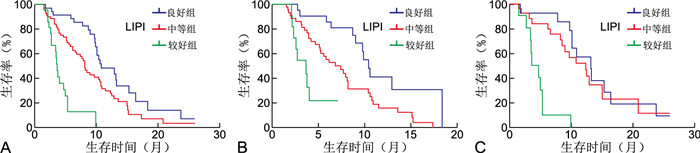
图 1 LIPI各组在全组及PD-1/PD-L1抑制剂联合化疗治疗亚组患者的生存曲线
注: A为全组(PD1+PD-L1)患者根据LIPI进行分组后各组的KM生存曲线; B为应用PD-1抑制剂治疗的患者根据LIPI进行分组后各组的KM生存曲线; C为应用PD-L1抑制剂治疗的患者根据LIPI进行分组后各组的KM生存曲线。
Figure 1. Survival curves of LIPI subgroups in the overall cohort and the PD-1/PD-L1 inhibitor combined with chemotherapy subgroup

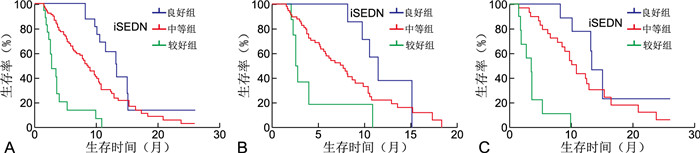
图 2 iSEND免疫评分各组在全组及PD-1/PD-L1抑制剂联合化疗治疗亚组患者的生存曲线
注: A为全组(PD1+PD-L1)患者根据iSEND进行分组后各组的KM生存曲线; B为应用PD-1抑制剂治疗的患者根据iSEND进行分组后各组的 KM生存曲线; C为应用PD-L1抑制剂治疗的患者根据iSEND进行分组后各组的KM生存曲线。
Figure 2. Survival curves of iSEND immune score subgroups in the overall cohort and the PD-1/PD-L1 inhibitor combined with chemotherapy subgroup

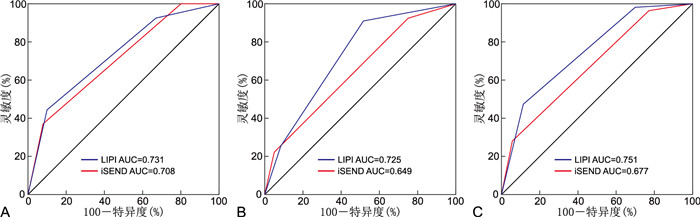
图 3 LIPI、iSEND免疫评分预测DCR、ORR、PFS的ROC曲线
注:A为LIPI和iSEND对DCR预测的ROC曲线;B为LIPI和iSEND对ORR预测的ROC曲线;C为LIPI和iSEND对PFS预测的ROC曲线。
Figure 3. ROC curves of LIPI and iSEND immune scores for predicting DCR, ORR, and PFS
表 1 127例ES-SCLC患者临床特征
Table 1. Clinical characteristics of 127 patients with ES-SCLC
项目 例数 占比(%) 性别 男性 98 77.2 女性 19 22.8 年龄 <65岁 69 54.3 ≥65岁 58 45.7 吸烟史 有 31 24.4 无 96 75.6 ECOG PS <2分 113 89.0 ≥2分 14 11.0 NLR <5 105 82.7 ≥5 22 17.3 DNLR <0 81 63.8 ≥0 46 36.2 dNLR ≤1.99 67 52.8 >1.99 60 47.2 LDH ≤250 IU/L 73 57.5 >250 IU/L 54 42.5 ICIs PD-1 75 59.1 PD-L1 52 40.9 预后 CR 3 2.4 PR 55 43.3 SD 42 33.1 PD 27 21.2 iSEND 良好组 20 15.7 中等组 89 70.1 不良组 18 14.2 LIPI 良好组 35 27.6 中等组 70 55.1 不良组 22 17.3 注:ICIs为免疫检查点抑制剂(immune checkpoint inhibitors)。  下载: 导出CSV
表 2 全组与PD-1/PD-L1抑制剂联合化疗治疗亚组患者PFS单因素与多因素Cox回归分析
Table 2. Univariate and multivariate Cox regression analyses of PFS in the overall cohort and the PD-1/PD-L1 inhibitor combined with chemotherapy subgroup
变量 全组患者 PD-1抑制剂联合化疗 PD-L1抑制剂联合化疗 单因素 多因素 单因素 多因素 单因素 多因素 性别 HR(95% CI) 1.454(0.868~2.438) 1.537(0.722~3.274) 1.259(0.607~2.610) P值 0.155 0.265 0.537 年龄 HR(95% CI) 1.135(0.748~1.721) 1.052(0.609~1.816) 1.232(0.633~2.397) P值 0.552 0.857 0.539 PS评分 HR(95% CI) 5.744(2.849~11.580) 1.771(0.842~3.726) 4.365(1.746~10.912) 1.633(0.621~4.297) 8.736(2.808~27.185) 2.369(0.710~7.903) P值 <0.001 0.132 0.002 0.320 <0.001 0.161 吸烟史 HR(95% CI) 1.531(0.696~1.748) 1.531(0.842~2.783) 0.832(0.398~1.742) P值 0.677 0.162 0.626 LDH HR(95% CI) 4.392(2.765~6.976) 5.148(2.992~8.860) 4.058(2.206~7.466) 4.564(2.343~8.887) 5.459(2.590~11.505) 5.565(2.056~15.059) P值 <0.001 <0.001 <0.001 <0.001 <0.001 0.001 dNLR HR(95% CI) 2.392(1.568~3.717) 2.965(1.817~4.838) 2.392(1.384~4.135) 2.841(1.596~5.056) 2.383(1.185~4.791) 3.219(1.310~7.909) P值 <0.001 <0.001 0.002 <0.001 0.015 0.011 NLR HR(95% CI) 2.235(1.296~3.855) 0.977(0.543~1.757) 0.002(0.566~3.135) 4.572(2.050~10.198) 1.482(0.543~4.047) P值 0.004 0.938 0.511 <0.001 0.443 DNLR HR(95% CI) 1.491(0.985~2.256) 1.060(0.619~1.817) 1.996(1.021~3.903) 2.382(1.131~5.013) P值 0.059 0.831 0.043 0.022 注:性别,男性=1,女性=0;年龄<65岁=1,≥65岁=0;PS评分<2分=1,≥2分=0;吸烟史,是=1,否=0;LDH≤250 IU/L=1, 250 IU/L=0;dNLR≤1.99=1, >1.99=0;NLR<5=1, ≥5=0;DNLR<0=1, ≥0=0。
下载: 导出CSV
-
[1] 滕熠, 张晓丹, 夏昌发, 等. 中国与全球癌症发病、死亡和患病对比及其预测分析: GLOBOCAN 2022数据解读[J]. 中华肿瘤防治杂志, 2024, 31(23): 1413-1420.TENG Y, ZHANG X D, XIA C F, et al. Comparison and predictive analysis of cancer incidence, mortality, prevalence in China and Globally: an interpretation of GLOBOCAN 2022[J]. Chinese Journal of Cancer Prevention and Treatment, 2024, 31(23): 1413-1420. [2] SIEGEL R L, MILLER K D, WAGLE N S, et al. Cancer statistics, 2023[J/OL]. CA Cancer J Clin, 2023, 73(1): 17-48. [3] KRISTIN A, CHARLES B, AMINI A, et al. American radium society appropriate use criteria on radiation therapy for extensive-stage SCLC[J]. J Thorac Oncol, 2021, 16(1): 54-65. doi: 10.1016/j.jtho.2020.09.013 [4] RUDIN C M, BRAMBILLA E, FAIVRE-FINN C, et al. Small-cell lung cancer[J]. Nat Rev Dis Primers, 2021, 7(1): 3. doi: 10.1038/s41572-020-00235-0 [5] YU H, CHEN P, CAI X, et al. Efficacy and safety of PD-L1 inhibitors versus PD-1 inhibitors in first-line treatment with chemotherapy for extensive-stage small-cell lung cancer[J]. Cancer Immunol Immunother, 2022, 71(3): 637-644. doi: 10.1007/s00262-021-03017-z [6] 张婷素, 袁春樱, 邱海江, 等. 血清特异性烯醇化酶、胃泌素释放肽前体在小细胞肺癌诊断和治疗效果评价中的作用[J]. 中华全科医学, 2019, 17(6): 959-961, 965. doi: 10.16766/j.cnki.issn.1674-4152.000835ZHANG T S, YUAN C Y, QIU H J, et al. The role of serum NSE and ProGRP in the diagnosis and treatment evaluation of small cell lung cancer[J]. Chinese Journal of General Practice, 2019, 17(6): 959-961, 965. doi: 10.16766/j.cnki.issn.1674-4152.000835 [7] PARK W, MEZQUITA L, OKABE N, et al. Association of the prognostic model iSEND with PD-1/L1 monotherapy outcome in non-small-cell lung cancer[J]. Br J Cancer, 2020, 122(3): 340-347. doi: 10.1038/s41416-019-0643-y [8] ALDEA M, BENITEZ J C, MEZQUITA L. The lung immune prognostic index (lipi) stratifies prognostic groups in advanced non-small cell lung cancer (NSCLC) patients[J]. Transl Lung Cancer Res, 2020, 9(4): 967. doi: 10.21037/tlcr.2020.04.14 [9] CARRIL-AJURIA L, LAVAUD P, DALBAN C, et al. Validation of the lung immune prognostic index (LIPI) as a prognostic biomarker in metastatic renal cell carcinoma[J]. Eur J Cancer, 2024, 204: 114048. DOI: 10.1016/j.ejca.2024.114048. [10] SANDER M S, STUKALIN I, VALLERAND I A, et al. Evaluation of the modified immune prognostic index to prognosticate outcomes in metastatic uveal melanoma patients treated with immune checkpoint inhibitors[J]. Cancer Med, 2021, 10(8): 2618. DOI: 10.1002/cam4.3784. [11] HE M, CHI X, SHI X, et al. Value of pretreatment serum lactate dehydrogenase as a prognostic and predictive factor for small-cell lung cancer patients treated with first-line platinum-containing chemotherapy[J]. Thorac Cancer, 2021, 12(23): 3101-3109. doi: 10.1111/1759-7714.13581 [12] 李莉, 郝玮, 卢元丽, 等. 广泛期小细胞肺癌免疫检查点抑制剂联合化疗治疗后无进展生存期的影响因素分析[J]. 中国医刊, 2024, 59(8): 899-902.LI L, HAO W, LU Y L, et al. Analysis of factors influencing progression-free survival in patients with extensive-stage small cell lung cancer treated with immune checkpoint inhibitors combined with chemotherapy[J]. Chinese Medical Journal, 2024, 59(8): 899-902. [13] WANG H, SHAN D, DONG Y, et al. Correlation analysis of serum cystatin C, uric acid and lactate dehydrogenase levels before chemotherapy on the prognosis of small-cell lung cancer[J]. Oncol Lett, 2021, 21(1): 73. [14] 马庆功, 邱慧, 王岩, 等. LIPI评分评估局限期小细胞肺癌患者预后的临床价值[J]. 医学研究杂志, 2022, 51(8): 150-154, 159.MA Q G, QIU H, WANG Y, et al. Clinical value of LIPI score in evaluating the prognosis of patients with limited-stage small cell lung cancer[J]. Journal of Medical Research, 2022, 51(8): 150-154, 159. [15] 罗怡颖, 王新娟, 王一博, 等. LIPI及iSEND免疫评分在晚期非小细胞肺癌免疫治疗中的预测价值分析[J]. 中国肺癌杂志, 2022, 25(11): 803-810.LUO Y Y, WANG X J, WANG Y B, et al. Predictive value of LIPI and iSEND immune scoring system in immunotherapy of advanced non-small cell lung cancer[J]. Chinese Journal of Lung Cancer, 2022, 25(11): 803-810. [16] WANG Y, MATHAI J, ALAMGEER M, et al. Real-World analysis of clinical characteristics and survival outcomes in patients with extensive-stage SCLC treated with first-line chemoimmunotherapy[J]. JTO Clin Res Rep, 2023, 4(8): 100544. DOI: 10.1016/j.jtocrr.2023.100544. [17] REBUZZI S E, SIGNORI A, BANNA G L, et al. Inflammatory indices and clinical factors in metastatic renal cell carcinoma patients treated with nivolumab: the development of a novel prognostic score (Meet-URO 15 study)[J]. Ther Adv Med Oncol, 2021, 13: 17588359211019642. DOI: 10.1177/17588359211019642. [18] GALVANO A, PERI M, GUARINI A A, et al. Analysis of systemic inflammatory biomarkers in neuroendocrine carcinomas of the lung: prognostic and predictive significance of NLR, LDH, ALI, and LIPI score[J]. Ther Adv Med Oncol, 2020, 12: 1758835920942378. DOI: 10.1177/1758835920942378. -

 点击查看大图
计量
- 文章访问数: 3
- HTML全文浏览量: 2
- PDF下载量: 0
- 被引次数: 0
