



Construction and validation of a catheter-related infection prediction model for patients undergoing continuous renal replacement therapy
-
摘要:
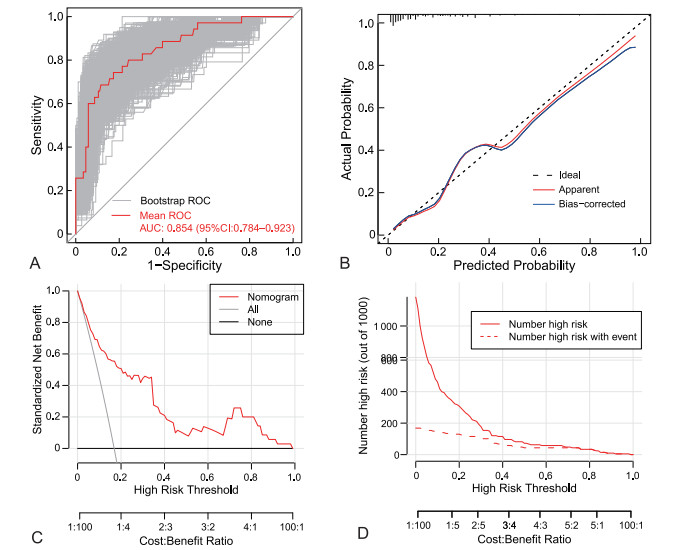
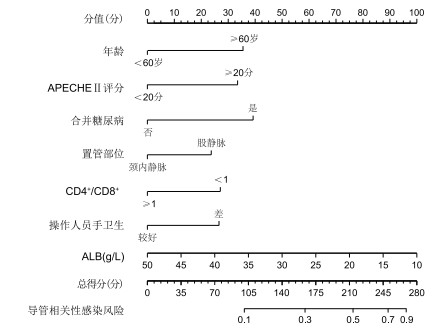
目的 探究行连续性肾脏替代治疗(CRRT)患者导管相关感染(CRI)的风险因素并构建预测模型,评估该模型的临床应用价值。 方法 回顾性收集2023年1—12月于杭州市第一人民医院ICU行CRRT治疗的208例患者临床资料。利用单因素和多因素logistic逐步回归分析筛选CRRT发生CRI的风险因素并构建预测模型。利用ROC曲线、校准曲线、决策曲线和临床影响曲线分别评估模型的区分度、校准度和临床实用性。 结果 本研究中CRRT患者CRI发生率为16.8%(35例)。多因素logistic逐步回归分析结果显示,年龄、急性生理和慢性健康评分Ⅱ(APECHE Ⅱ)、合并糖尿病、置管部位、CD4+/CD8+、白蛋白(ALB)、操作人员手卫生是CRRT发生CRI的风险因素(OR分别为3.494、3.270、4.004、2.328、0.385、0.916和0.390,均P < 0.05)。基于以上7个风险因素构建预测模型。模型ROC曲线下面积为0.854(95% CI:0.784~0.923)。校准曲线结果显示模型预测的校正曲线与理想曲线吻合度良好。决策曲线结果显示当阈概率大于15%时使用该模型作出临床决策,患者净获益均高于不干预或全部干预的极端曲线。临床影响曲线结果显示当阈概率大于30%时,模型判定为CRI高风险人群与实际发生CRI人群匹配度良好。 结论 本研究构建的CRRT患者CRI发生风险模型具有较高的预测效能及临床应用价值,有助于临床医护人员早期识别CRRT发生CRI的高危人群,进行及时干预,从而改善患者预后。 Abstract:Objective To investigate the risk factors for catheter-related infection (CRI) in patients undergoing continuous renal replacement therapy (CRRT), to construct a prediction model, and to evaluate its clinical application value. Methods The clinical data of 208 patients who underwent CRRT in Hangzhou First People ' s Hospital from January to December 2023 were collected. Univariate and multiple logistic regression analyses were used to screen the risk factors for CRI in CRRT patients, and a prediction model was constructed. Receiver operating characteristic (ROC) curve, calibration curve (CC), decision curve analysis (DCA), and clinical impact curve (CIC) were used to evaluate the discrimination, calibration, and clinical utility of the model. Results The incidence of CRI in CRRT patients was 16.8%. Multiple logistic regression analysis showed that age, acute physiology and chronic health evaluation Ⅱ, diabetes mellitus, catheterization site, CD4+/CD8+, albumin level, and operator hand hygiene (OR=3.494, 3.270, 4.004, 2.328, 0.385, 0.916, and 0.390, respectively; all P < 0.05) were associated with CRI in CRRT patients. A prediction model was constructed based on these seven risk factors. The area under the ROC curve (AUC) was 0.854 (95% CI: 0.784-0.923). The results of the CC showed that the predicted calibration curve of the model closely matched the ideal curve, indicating good agreement. The results of the DCA showed that using this model to guide clinical decisions provided higher net benefits for patients than the extreme strategies of no intervention or full intervention when the threshold probability was greater than 15%. The results of the CIC showed that the population identified as high risk for CRI by the model matched well with the actual population when the threshold probability was greater than 30%. Conclusion The risk prediction model constructed in this study demonstrates high predictive efficacy and clinical utility, which could help identify patients at high risk of CRI during CRRT at an early stage and enable timely intervention, thereby improving prognosis. -

图 1 CRRT患者CRI发生风险模型的列线图
Figure 1. Nomogram of the risk prediction model for catheter-related infections in CRRT patients

图 2 CRRT患者CRI发生风险模型评价
注:A为ROC曲线;B为校准曲线;C为决策曲线;D为临床影响曲线。
Figure 2. Evaluation of the risk prediction model for catheter-related infections in CRRT patients
表 1 CRRT患者CRI发生的单因素分析
Table 1. Univariate analysis of CRI in CRRT patients
项目 感染组(n=35) 未感染组(n=173) 统计量 P值 年龄[例(%)] 9.189a 0.002 <60岁 8(22.85) 88(50.87) ≥60岁 27(77.15) 85(49.13) 性别[例(%)] 0.243a 0.621 男性 19(54.29) 86(49.71) 女性 16(45.71) 87(50.29) BMI(x±s) 24.01±2.20 23.39±1.92 1.704b 0.089 APECHE Ⅱ评分[例(%)] 11.121a 0.001 <20分 13(37.14) 114(65.90) ≥20分 22(62.86) 59(34.10) 糖尿病[例(%)] 13.74a < 0.001 否 12(34.29) 117(67.63) 是 23(65.71) 56(32.37) 高血压[例(%)] 1.241a 0.265 否 15(42.86) 92(53.20) 是 20(57.14) 81(46.82) 贫血[例(%)] 3.483a 0.062 否 17(48.57) 113(65.32) 是 18(51.43) 60(34.68) 置管部位[例(%)] 5.214a 0.022 颈内静脉 15(42.86) 110(63.58) 股静脉 20(57.14) 63(36.42) 穿刺次数[例(%)] 3.883a 0.048 1次 28(80.00) 160(92.49) ≥2次 7(20.00) 13(7.51) 住院时间[例(%)] 2.578a 0.108 <14 d 13(37.14) 90(52.02) ≥14 d 22(62.86) 83(47.98) 置管时间[例(%)] 4.742a 0.029 <7 d 19(54.29) 126(72.83) ≥7 d 16(45.71) 47(27.17) 导管移动[例(%)] 4.314a 0.037 否 21(60.00) 133(76.88) 是 14(40.00) 40(23.12) 使用免疫抑制剂[例(%)] 1.463a 0.226 否 29(82.86) 158(91.33) 是 6(17.14) 15(8.67) 使用抗生素[例(%)] 4.166a 0.041 否 16(45.71) 111(64.16) 是 19(54.29) 62(35.84) 抗凝治疗[例(%)] 2.737a 0.098 否 22(62.86) 132(76.30) 是 13(37.14) 41(23.70) CD4+/CD8+[例(%)] 6.110a 0.013 <1 24(68.57) 79(45.66) ≥1 11(31.43) 94(54.34) IgG(x±s, g/L) 9.12±0.95 8.93±1.14 0.896b 0.371 ALB(x±s, g/L) 28.75±6.54 31.25±5.05 2.530b 0.012 操作人员相关工作年限[例(%)] 5.452a 0.019 <5年 16(45.71) 45(26.01) ≥5年 19(54.29) 128(73.99) 操作人员手卫生[例(%)] 6.155a 0.013 差 23(65.71) 74(42.77) 较好 12(34.29) 99(57.23) 注:a为χ2值,b为t值。  下载: 导出CSV
表 2 影响CRRT患者CRI发生的多因素分析
Table 2. Multivariate analysis of factors associated with CRI in CRRT patients
变量 B SE Waldχ2 P值 OR(95% CI) 年龄 1.251 0.430 8.453 0.004 3.494(1.503~8.121) APECHEⅡ评分 1.185 0.385 9.478 0.002 3.270(1.538~6.952) 糖尿病 1.387 0.391 12.563 < 0.001 4.004(1.859~8.624) 置管部位 0.845 0.376 5.042 0.025 2.328(1.113~4.868) CD4+/CD8+ -0.954 0.395 5.839 0.016 0.385(0.178~0.835) ALB -0.088 0.036 6.049 0.014 0.916(0.854~0.982) 操作人员手卫生 -0.942 0.388 5.895 0.015 0.390(0.182~0.834)
下载: 导出CSV
-
[1] 宗慧敏, 李娟, 严陈燕, 等. 连续性肾脏替代治疗老年脓毒症相关急性肾损伤的影响因素分析[J]. 浙江临床医学, 2024, 26(12): 1768-1770, 1773. [2] 付平, 张凌, 陈志文, 等. 连续性肾脏替代治疗医院感染防控专家共识[J]. 华西医学, 2023, 38(7): 961-968.FU P, ZHANG L, CHEN Z W, et al. Expert consensus on hospital infection prevention and control in continuous renal replacement therapy[J]. West China Medical Journal, 2023, 38(7): 961-968. [3] 曹燚, 赵信飞, 冯绘绘, 等. 封管液对预防导管相关血流感染的研究进展[J]. 中国感染控制杂志, 2024, 23(1): 119-125.CAO Y, ZHAO X F, FENG H H, et al. Research advances in the prevention of catheter-related bloodstream infection by locking solution[J]. Chinese Journal of Infection Control, 2024, 23(1): 119-125. [4] LUNNEMAR P, TAXBRO K, HAMMARSKJÖLD F. An analysis of central venous catheter-related bloodstream infections in patients treated in a Swedish Covid-19 intensive care unit[J]. SAGE Open Med, 2024, 12(1): 213-214. [5] STOLDICK M, VANNIER M, VERDALLE-CAZES M, et al. Short-course versus prolonged-course antimicrobial therapy in adults with catheter-related septic thrombosis: a propensity-weighted retrospective study[J]. Open Forum Infect Dis, 2023, 10(11): 530-533. doi: 10.1093/ofid/ofad530 [6] 马曦立, 刘霞, 吴鑫, 等. 慢性肾功能衰竭血液透析导管相关性血流感染病原菌耐药性及其影响因素[J]. 中华医院感染学杂志, 2021, 31(3): 385-389.MA X L, LIU X, WU X, et al. Drug resistance of pathogenic bacteria and its influencing factors in catheter- related bloodstream infection in patients with chronic renal failure hemodialysis[J]. Chinese Journal of Nosocomiology, 2021, 31(3): 385-389. [7] 王晓娜, 胡永娜, 李星岐, 等. 连续性肾脏替代治疗中心静脉导管相关血流感染的危险因素分析[J]. 齐鲁护理杂志, 2023, 29(20): 83-85.WANG X N, HU Y N, LI X Q, et al. Analysis of risk factors for central venous catheter-related bloodstream infection in continuous renal replacement therapy[J]. Journal of Qilu Nursing, 2023, 29(20): 83-85. [8] 宋晓超, 乔美珍, 丁蔚, 等. 2020-2022年苏州市区域性医院感染监测平台中央血管导管相关血流感染监测报告[J]. 中华医院感染学杂志, 2024, 34(3): 438-443.SONG X C, QIAO M Z, DING W, et al. Surveillance report of central line-associated bloodstream infection from regional nosocomial infection surveillance platform in Suzhou between 2020 to 2022[J]. Chinese Journal of Nosocomiology, 2024, 34(3): 438-443. [9] 安娜, 徐明芝, 白亚飞, 等. 老年血液透析患者导管相关感染的病原菌特征及影响因素分析[J]. 中国病原生物学杂志, 2022, 17(4): 455-458.AN N, XU M Z, BAI Y F, et al. Study on pathogenic bacteria and influencing factors of catheter-related infection in elderly hemodialysis patients[J]. Journal of Pathogen Biology, 2022, 17(4): 455-458. [10] 马云清, 张京晓, 孙宏志, 等. 连续性肾脏替代治疗相关血流感染的影响因素分析[J]. 中国急救复苏与灾害医学杂志, 2021, 16(4): 411-413.MA Y Q, ZHANG J X, SUN H Z, et al. Analysis of influential factors of continuous renal replacement therapy related bloodstream infection[J]. China Journal of Emergency Resuscitation and Disaster Medicine, 2021, 16(4): 411-413. [11] 林丽玉, 许丽春, 张鑫, 等. 血液透析患者中心静脉导管发生相关血流感染危险因素的meta分析[J]. 中华护理杂志, 2021, 56(10): 1478-1484.LIN L Y, XU L C, ZHANG X, et al. Risk factors of central venous catheter-related bloodstream infection in hemodialysis patients: a meta-analysis[J]. Chinese Journal of Nursing, 2021, 56(10): 1478-1484. [12] 唐晓娟, 刘小兰, 张敏. 1781例血液净化患者导管相关性感染情况及影响因素分析[J]. 华南预防医学, 2022, 48(3): 311-314.TANG X J, LIU X L, ZHANG M. Catheter-related infection and its influencing factors in 1 781 patients with blood purification[J]. South China Journal of Preventive Medicine, 2022, 48(3): 311-314. [13] 肖茹. ICU行连续性肾脏替代治疗患者医院感染风险预测模型的构建[D]. 山东大学, 2023.XIAO R. Construction of a risk prediction model for nosocomial infection in ICU patients undergoing continuous renal replacement therapy[D]. Jinan: Shandong University, 2023. [14] 宋秀银, 陈国庆. 重症监护室连续性血液净化治疗病人导管相关血流感染现状及其危险因素调查[J]. 全科护理, 2021, 19(10): 1425-1427.SONG X Y, CHEN G Q. Current status and risk factors of catheter-related bloodstream infection in patients undergoing continuous blood purification in intensive care unit[J]. General Practice Nursing, 2021, 19(10): 1425-1427. [15] 王晶晶. 终末期肾脏病患者发生导管相关性血流感染的危险因素分析[J]. 临床医学, 2023, 43(3): 26-29.WANG J J. Analysis of risk factors for catheter-related bloodstream infection in patients with end-stage renal disease[J]. Clinical Medicine, 2023, 43(3): 26-29. [16] 李金花, 王莉杰, 戚熠, 等. 医护人员预防中心静脉导管相关性血流感染导管置入重点措施依从性现状及影响因素分析[J]. 中国护理管理, 2022, 22(8): 1232-1237.LI J H, WANG L J, QI Y, et al. Current status and influencing factors of compliance with Catheter-Related Bloodstream Infection key prevention measures in medical staffs ' Central Venous Catheters insertion sessions[J]. Chinese Nursing Management, , 2022, 22(8): 1232-1237. [17] GUO H, ZHANG L, HE H, et al. Risk factors for catheter-associated bloodstream infection in hemodialysis patients: a meta-analysis[J]. PLoS One, 2024, 19(3): e0299715. DOI: 10.1371/journal.pone.0299715. [18] CHEN W, WANG Z, WANG G, et al. A meta-analysis of risk factors for a dacron-cuffed catheter related infection in hemodialysis[J]. BMC Nephrol, 2024, 25(1): 126-128. doi: 10.1186/s12882-024-03568-0 [19] 胡喜莲. 急性缺血性脑卒中病人下肢深静脉血栓形成预测模型的建立与分析[J]. 中西医结合心脑血管病杂志, 2020, 18(16): 2585-2589.HU X L. Establishment and analysis of deep venous thrombosis in lower limb with acute ischemic stroke: a predictive model[J]. Chinese Journal of Integrative Medicine on Cardio-Cerebrovascular Disease, 2020, 18(16): 2585-2589. [20] 程志强, 张宝珍, 夏娇云, 等. ICU转出患者应激障碍风险预测模型的构建与验证[J]. 中华护理杂志, 2023, 58(18): 2223-2229.CHENG Z Q, ZHANG Baozhen, XIA Jiaoyun, et al. Development and validation of risk prediction model for post-traumatic stress disorder in ICU transferred patients[J]. Chinese Journal of Nursing, 2023, 58(18): 2223-2229. [21] 杨菁, 刘梅, 杨蕾, 等. 老年髋部骨折患者术后谵妄发生的危险因素及预测模型构建[J]. 中华全科医学, 2024, 22(9): 1596-1600. doi: 10.16766/j.cnki.issn.1674-4152.003691YANG J, LIU M, YANG L, et al. Risk factors and predictive model construction of postoperative delirium in elderly patients with hip fracture[J]. Chinese Journal of General Practice, 2024, 22(9): 1596-1600. doi: 10.16766/j.cnki.issn.1674-4152.003691 [22] 吴树剑, 俞咏梅, 范莉芳, 等. 基于定量CT及临床危险因素列线图预测重症新型冠状病毒肺炎短期预后[J]. 中国医学计算机成像杂志, 2023, 29(5): 498-504.WU S J, YU Y, FAN L F, et al. Nomogram based on quantitative CT and clinical risk factors for predicting short-term prognosis of severe COVID-19[J]. Chinese Computed Medical Imaging, 2023, 29(5): 498-504. [23] 黎朝政, 苗玉, 吴珍, 等. ICU患者并发导管相关血流感染预测模型的构建与验证[J]. 河北医药, 2024, 46(10): 1478-1482.LI C Z, MIAO Y, WU Z, et al. Construction of a prediction model for catheter-related bloodstream infection in intensive care unit patients and its validation[J]. Hebei Medical Journal, 2024, 46(10): 1478-1482. -

 点击查看大图
计量
- 文章访问数: 2
- HTML全文浏览量: 2
- PDF下载量: 0
- 被引次数: 0
