



Effects of loneliness on sleep quality of middle-aged and older adults and the suppressive effect of depression
-
摘要:
目的 探讨孤独感对中老年人睡眠质量的影响,分析抑郁在其中的中介作用,为改善中老年人的睡眠质量提供针对性干预措施。 方法 2023年7—8月,采用整群随机抽样法选取陕西省安康市年龄≥45岁居民为研究对象,采用孤独感量表(ULS-8)、流调中心抑郁量表(CESD-10)和匹兹堡睡眠质量指数量表(PSQI)评估其孤独感水平、抑郁症状及睡眠质量。运用SPSS 25.0统计学软件进行统计描述、相关性分析、单因素和多因素分析以及SPSS Process程序进行中介检验。 结果 (1) 共纳入1 018名研究对象,男性341人(33.5%),女性677人(66.5%),年龄中位数为60岁。其中有睡眠障碍、孤独感以及抑郁症状的参与者分别占总参与者的34.1%(347/1 018)、23.5%(239/1 018)、20.8%(212/1 018)。(2)自我报告有睡眠障碍的参与者中有94.2%(327/347)表现为睡眠潜伏期障碍。(3)孤独感评分与睡眠质量评分呈正相关关系(r=0.140,P < 0.01),抑郁评分与睡眠质量评分、孤独感评分均呈正相关关系(r=0.486、0.449,均P < 0.01)。(4)孤独感与睡眠质量之间存在抑郁情绪的遮掩效应(ab=0.275,c ' =-0.113)。 结论 孤独感对中老年人睡眠质量的影响受到抑郁情绪的遮掩作用。及时发现并干预孤独感和抑郁,有助于改善中老年人睡眠质量,降低睡眠障碍发生率。 Abstract:Objective To explore the impact of loneliness on sleep quality and analyze the mediating role of depression, and to provide targeted interventions to improve the sleep quality of middle-aged and older adults. Methods During July-August 2023, the residents ≥45 years old in Ankang City, Shaanxi Province, were selected by a whole cluster random sampling method. Their loneliness level, depressive symptoms, and sleep quality were assessed by the Loneliness scale (ULS-8), the Centre for Epidemiological Studies depression scale (CESD-10), and the Pittsburgh sleep quality index scale (PSQI). The SPSS 25.0 statistical software was used for statistical descriptions, correlation analyses, univariate and multivariate analyses, and mediation tests using the SPSS Process program. Results (1) A total of 1 018 participants were enrolled, including 341 males (33.5%) and 677 females (66.5%), with a median age of 60 years. Participants who reported sleep disturbance, loneliness, and depressive symptoms accounted for 34.1% (347/1 018), 23.5% (239/1 018), and 20.8% (212/1 018) of the total, respectively. (2) Among participants who self-reported sleep disturbance, 94.2% presented with sleep latency disturbance. (3) The loneliness score was positively correlated with the sleep quality score (r=0.140, P < 0.01). The depression score was positively correlated with the sleep quality and loneliness scores (r=0.486, 0.449; both P < 0.01). (4) There was a suppressive effect of depression between loneliness and sleep quality (ab=0.275, c ' =-0.113). Conclusion The effect of loneliness on the sleep quality of middle-aged and older adults was suppressed by depressed mood. Detecting and intervening in loneliness and depression in time can help to improve the sleep quality of middle-aged and older adults and reduce the incidence of sleep disorders. -
Key words:
- Loneliness /
- Sleep quality /
- Depression /
- Middle-aged and older adults /
- Suppressing effect
-

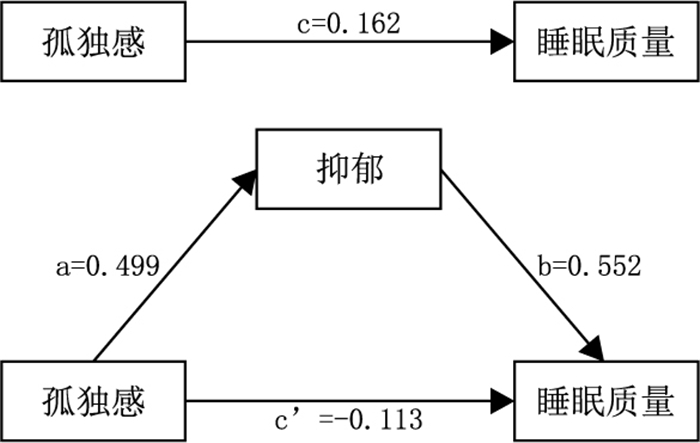
图 1 抑郁在孤独感和睡眠质量间的中介模型图
Figure 1. Mediation model of depression between loneliness and sleep quality
表 1 不同参与者一般资料发生情况比较[例(%)]
Table 1. Comparison of general characteristics of participants [cases (%)]
变量 总计(n=1 018) 睡眠障碍 χ2值 P值 否(n=671) 是(n=347) 年龄段 9.810 0.002 中年 486(47.7) 344(51.3) 142(40.9) 老年 532(52.3) 327(48.7) 205(59.1) 性别 23.003 <0.001 男性 341(33.5) 259(38.6) 82(23.6) 女性 677(66.5) 412(61.4) 265(76.4) 职业 5.982 0.014 务农 574(56.4) 360(53.7) 214(61.7) 非务农 444(43.6) 311(46.3) 133(38.3) 受教育水平 17.552 0.001 未受教育 274(26.9) 158(23.5) 116(33.4) 小学及以下 390(38.3) 255(38.0) 135(38.9) 初中 216(21.2) 152(22.7) 64(18.4) 高中及以上 138(13.6) 106(15.8) 32(9.2) 婚姻状况 10.800 0.005 已婚且同居 844(82.9) 575(85.7) 269(77.5) 丧偶 117(11.5) 65(9.7) 52(15.0) 分居/离异/未婚 57(5.6) 31(4.6) 26(7.5) 居住情况 15.395 0.002 独居 80(7.9) 44(6.6) 36(10.4) 与配偶 393(38.6) 276(41.1) 117(33.7) 与配偶及晚辈 410(40.3) 277(41.3) 133(38.3) 与晚辈 135(13.3) 74(11.0) 61(17.6) 家庭人均月收入(元) 11.106 0.025 <1 000 363(35.7) 219(32.6) 144(41.5) 1 000~2 499 319(31.3) 215(32.0) 104(30.0) 2 500~4 999 201(19.7) 148(22.1) 53(15.3) 5 000~9 999 98(9.6) 63(9.4) 35(10.1) ≥10 000 37(3.6) 26(3.9) 11(3.2) 吸烟状况 4.628 0.099 从不 779(76.5) 500(74.5) 279(80.4) 吸烟 156(15.3) 110(16.4) 46(13.3) 已戒烟 83(8.2) 61(9.1) 22(6.3) 饮酒状况 8.013 0.018 从不 573(56.3) 372(55.4) 201(57.9) 饮酒 385(37.8) 268(39.9) 117(33.7) 已戒酒 60(5.9) 31(4.6) 29(8.4) BMI 0.372 0.946 <18.5 20(2.0) 12(1.8) 8(2.3) 18.5~23.9 399(39.2) 262(39.0) 137(39.5) 24.0~27.9 443(43.5) 293(43.7) 150(43.2) ≥28.0 156(15.3) 104(15.5) 52(15.0) 久坐时长(h/d) 13.286 <0.001 <6 839(82.4) 574(85.5) 265(76.4) ≥6 179(17.6) 97(14.5) 82(23.6) 孤独感 17.133 <0.001 无 779(76.5) 540(80.5) 239(68.9) 有 239(23.5) 131(19.5) 108(31.1) 抑郁症状 114.587 <0.001 无 806(79.2) 597(89.0) 209(60.2) 有 212(20.8) 74(11.0) 138(39.8)  下载: 导出CSV
表 2 参与者睡眠质量的各维度特征
Table 2. Characteristics of each dimension of sleep quality among participants
项目 总人群(n=1018) 非睡眠障碍组(n=671) 睡眠障碍组(n=347) Z值 得分[M(P25, P75)] 得分>1分[例(%)] 得分[M(P25, P75)] 得分>1分[例(%)] 得分[M(P25, P75)] 得分>1分[例(%)] PSQI总分 6(4, 9) - 4(3, 6) - 10(9, 13) - -26.286a 主观睡眠质量 1(1, 2) 346(34.0) 1(1, 1) 99(14.8) 2(1, 2) 247(71.2) -18.360a 睡眠潜伏期 2(1, 3) 681(66.9) 2(0, 2) 354(52.8) 3(2, 3) 327(94.2) -18.398a 睡眠持续时间 0(0, 1) 176(17.3) 0(0, 0) 11(1.6) 1(0, 2) 165(47.6) -20.262a 睡眠效率 0(0, 1) 214(21.0) 0(0, 0) 22(3.3) 2(1, 3) 192(55.3) -21.924a 睡眠障碍 1(1, 1) 146(14.3) 1(0, 1) 40(6.0) 1(1, 2) 106(30.5) -11.860a 催眠药物的使用 0(0, 0) 26(2.6) 0(0, 0) 3(0.4) 0(0, 0) 23(6.6) -4.422a 日间功能障碍 1(0, 2) 304(29.9) 1(0, 1) 100(14.9) 2(1, 2) 204(58.8) -14.704a 注:aP<0.001;“-”代表无此项数据。
下载: 导出CSV
表 3 参与者睡眠障碍影响因素的logistic回归多模型
Table 3. Multiple logistic regression models for influencing factors of sleep disorders among participants
变量 模型1 模型2 模型3 模型4 OR(95% CI) P值 OR(95% CI) P值 OR(95% CI) P值 OR(95% CI) P值 孤独感 1 1 1 1 有 1.863(1.384~2.506) <0.001 1.660(1.216~2.265) 0.001 1.681(1.226~2.304) 0.001 0.989(0.689~1.419) 0.952 年龄 1 1 1 老年 1.486(1.102~2.005) 0.009 1.499(1.107~2.030) 0.009 1.436(1.048~1.967) 0.025 性别 1 1 1 女性 1.916(1.398~2.627) <0.001 2.107(1.501~2.959) <0.001 1.833(1.289~2.606) 0.001 饮酒状况 1 1 饮酒 1.092(0.802~1.487) 0.575 1.077(0.780~1.486) 0.653 已戒酒 2.642(1.456~4.792) 0.001 2.893(1.589~5.268) 0.001 久坐时长 1 1 ≥6 h/d 1.848(1.308~2.613) 0.001 1.479(1.026~2.133) 0.036 抑郁症状 1 有 4.468(3.090~6.461) <0.001 注:表格中仅保留了差异有统计学意义的变量。模型1为单因素模型,模型2调整了社会人口学变量(年龄、性别、职业、受教育水平、婚姻状况、居住情况、家庭人均月收入),模型3在模型2的基础上调整了个人史(饮酒状况、每日久坐时长),模型4在模型3的基础上加入了抑郁变量。变量中孤独感以无为参照、年龄以中年为参照、性别以男性为参照、饮酒状况以从不为参照、久坐时长以<6 h/d为参照、抑郁症状以无为参照。
下载: 导出CSV
表 4 参与者抑郁、孤独感、睡眠质量相关性分析
Table 4. Correlation analysis of depression, loneliness, and sleep quality among participants
项目(rs值) 得分[M(P25, P75)] 抑郁评分 孤独感评分 睡眠质量评分 抑郁评分 6(3, 9) 1 孤独感评分 13(10, 15) 0.449a 1 睡眠质量评分 6(4, 9) 0.486a 0.140a 1 注:aP<0.001。
下载: 导出CSV
表 5 抑郁在孤独感与睡眠质量之间的中介检验结果
Table 5. Mediation test results of depression between loneliness and sleep quality
模型 结局变量 预测变量 β SE t值 P值 模型Ⅰ 睡眠质量 孤独感 0.162 0.031 5.318 <0.001 模型Ⅱ 抑郁 孤独感 0.499 0.026 19.171 <0.001 模型Ⅲ 睡眠质量 孤独感 -0.113 0.032 -3.585 <0.001 抑郁 0.552 0.033 16.903 <0.001 注:模型Ⅰ表示孤独感预测睡眠质量;模型Ⅱ表示孤独感预测抑郁;模型Ⅲ表示孤独感和抑郁共同预测睡眠质量。将年龄(按连续性变量纳入)、性别、职业、教育水平、婚姻状况、居住情况、家庭人均月收入、饮酒状况、久坐时长(按是否≥6 h)作为协变量纳入中介模型进行调整。
下载: 导出CSV
表 6 中介模型的总、直接和间接效应结果(n=1 018)
Table 6. Total, direct, and indirect effects of the mediation model (n=1 018)
主要路径 β SE Bootstrap 95% CI P值 总路径(c) 0.162 0.031 0.103~0.222 <0.001 直接路径(c') -0.113 0.032 -0.175~-0.051 <0.001 间接路径(ab) 0.275 0.022 0.231~0.319 <0.001 注:路径c, 孤独感对睡眠质量的总效应;路径a, 孤独感与抑郁的直接关联;路径b, 抑郁与睡眠质量的关联;路径c ', 在考虑到抑郁的中介作用后,孤独感对睡眠质量的直接效应。
下载: 导出CSV
-
[1] CHEN X, GILES J, YAO Y, et al. The path to healthy ageing in China: a Peking University-Lancet Commission[J]. Lancet, 2022, 400(10367): 1967-2006. doi: 10.1016/S0140-6736(22)01546-X [2] GKOTZAMANIS V, PANAGIOTAKOS D B, YANNAKOULIA M, et al. Sleep quality and duration as determinants of healthy aging trajectories: the HELIAD study[J]. J Frailty Aging, 2023, 12(1): 16-23. doi: 10.14283/jfa.2022.37 [3] LIM D C, NAJAFI A, AFIFI L, et al. The need to promote sleep health in public health agendas across the globe[J]. Lancet Public Health, 2023, 8(10): e820-e826. doi: 10.1016/S2468-2667(23)00182-2 [4] 潘贤丽, 苏增锋. 失眠与端粒长度和衰老的相关性研究进展[J]. 中华全科医学, 2023, 21(3): 481-484. doi: 10.16766/j.cnki.issn.1674-4152.002912PAN X L, SU Z F. Correlation between insomnia and telomere length and aging[J]. Chinese Journal of General Practice, 2023, 21(3): 481-484. doi: 10.16766/j.cnki.issn.1674-4152.002912 [5] 王振杰, 赵蔓, 陈婷蔚, 等. 中国老年人睡眠障碍患病率的meta分析[J]. 中国全科医学, 2022, 25(16): 2036-2043.WANG Z J, ZHAO M, CHEN T W, et al. Sleep Disturbance Prevalence Rate among Chinese Older People: a Meta-analysis[J]. Chinese General Practice, 2022, 25(16): 2036-2043. [6] BELLUCCI G. Positive attitudes and negative expectations in lonely individuals[J]. Sci Rep, 2020, 10(1): 18595. DOI: 10.1038/s41598-020-75712-3. [7] SHANKAR A. Loneliness and sleep in older adults[J]. Soc Psychiatry Psychiatr Epidemiol, 2020, 55(2): 269-272. doi: 10.1007/s00127-019-01805-8 [8] LEE S L, PEARCE E, AJNAKINA O, et al. The association between loneliness and depressive symptoms among adults aged 50 years and older: a 12-year population-based cohort study[J]. Lancet Psychiatry, 2021, 8(1): 48-57. doi: 10.1016/S2215-0366(20)30383-7 [9] WANG Y P, LIU M, YANG F D, et al. The associations of socioeconomic status, social activities, and loneliness with depressive symptoms in adults aged 50 years and older across 24 countries: findings from five prospective cohort studies[J]. Lancet Healthy Longev, 2024, 5(9): 100618. DOI: 10.1016/j.lanhl.2024.07.001. [10] FANG H, TU S, SHENG J F, et al. Depression in sleep disturbance: a review on a bidirectional relationship, mechanisms and treatment[J]. J Cell Mol Med, 2019, 23(4): 2324-2332. doi: 10.1111/jcmm.14170 [11] 陈浩, 吴谦, 章如山, 等. 江西婺源高血压患者体重指数和腰高比与高尿酸血症的关联性研究[J]. 中华全科医学, 2023, 21(8): 1284-1286, 1378. doi: 10.16766/j.cnki.issn.1674-4152.003103CHEN H, WU Q, ZHANG R S, et al. The relationship between body mass index and waist-height ratio and hyperuricemia in patients with hypertension in Wuyuan, Jiangxi Province[J]. Chinese Journal of General Practice, 2023, 21(8): 1284-1286, 1378. doi: 10.16766/j.cnki.issn.1674-4152.003103 [12] WEGNER L, LIU S. Positive and negative experiences with the COVID-19 pandemic among lonely and non-lonely populations in Germany[J]. Front Public Health, 2023, 10: 1067038. DOI: 10.3389/fpubh.2022.1067038. [13] 杨君芳, 娄蓝天, 郑发艳, 等. 叙事护理对RSA患者负面情绪、睡眠质量及护理满意度的影响[J]. 昆明医科大学学报, 2023, 44(8): 167-171.YANG J F, LOU L T, et al. Effect of Narrative Nursing on Negative Emotions, Sleep Quality and Nursing Satisfaction of RSA Patients[J]. Journal of Kunming Medical University, 2023, 44(8): 167-171. [14] WANG W W, ZHANG C, SONG Y F, et al. Symptoms and diabetes among Chinese middle-aged and elderly adults with prediabetes: a national cohort study[J]. Am J Epidemiol, 2024, 11: kwae339. DOI: 10.1093/aje/kwae339. [15] LIU X C, XU P R, WEI R, et al. Gender-and age-specific associations of sleep duration and quality with cognitive impairment in community-dwelling older adults in Anhui Province, China[J]. Front Public Health, 2023, 11: 1047025. DOI: 10.3389/fpubh.2023.1047025. [16] 路一丹, 张林, 高萌召, 等. 2型糖尿病患者孤独感、抑郁与睡眠质量的关系[J]. 南通大学学报(医学版), 2023, 43(3): 237-241.LU Y D, ZHANG L, et al. Relationships among loneliness, depression and sleep quality in patients with type 2 diabetes mellitus[J]. Journal of Nantong University (Medical Sciences), 2023, 43(3): 237-241. [17] MUND M, FREUDING M M, MÖBIUS K, et al. The stability and change of loneliness across the life span: a meta-analysis of longitudinal studies[J]. Pers Soc Psychol Rev, 2020, 24(1): 24-52. doi: 10.1177/1088868319850738 [18] 陈惟义, 周泽文, 刘颖春, 等. 广西35~74岁壮族人群睡眠状况及其影响因素分析[J]. 现代预防医学, 2022, 49(2): 289-294.CHEN W Y, ZHOU Z W, et al. Analysis of sleep status and influencing factors of Zhuang people aged 35 to 74 in Guangxi[J]. Modern Preventive Medicine, 2022, 49(2): 289-294. [19] TANDON V R, SHARMA S, MAHAJAN A, et al. Menopause and sleep disorders[J]. J Midlife Health, 2022, 13(1): 26-33. [20] JEONG S H, JANG B N, KIM S H, et al. Association between sedentary time and sleep quality based on the Pittsburgh Sleep Quality Index among South Korean adults[J]. BMC Public Health, 2021, 21(1): 2290. DOI: 10.1186/s12889-021-12388-y. [21] KUBALA A G, BUYSSE D J, BRINDLE R C, et al. The association between physical activity and a composite measure of sleep health[J]. Sleep Breath, 2020, 24(3): 1207-1214. doi: 10.1007/s11325-019-02007-x -

 点击查看大图
计量
- 文章访问数: 3
- HTML全文浏览量: 1
- PDF下载量: 1
- 被引次数: 0
