



Influence of quality intervention based on causal analysis on disinfection effect of disinfection supply room
-
摘要:
目的 消毒供应中心医疗器械消毒效果直接影响医疗质量、患者安全及医院感染防控成效,为提高消毒供应中心灭菌质量,本研究将基于因果分析的质量干预应用于消毒供应中心,并探讨其临床价值。 方法 将2022年6—12月于中国人民解放军东部战区总医院消毒供应中心未接受基于因果分析质量干预的1 326件手术器械作为对照组,2023年1—6月接受基于因果分析质量干预的1 389件手术器械作为观察组,对照组接受常规质量干预,观察组在常规质量干预的基础上予以基于因果分析的质量干预。比较2组消毒效果。 结果 观察组消毒供应人员、监管人员及医疗器械工程师感染管理相关知识水平评分分别为(94.63±3.32)分、(93.80±2.21)分、(86.68±2.89)分,均高于对照组的(90.27±4.36)分、(87.62±2.03)分、(81.92±1.45)分(P<0.05)。观察组医疗器械回收、清洗消毒、包装灭菌、无菌检测、器械发放中规范操作比例均高于对照组(P<0.05)。对照组医疗器械清洗、灭菌不合格事件发生率为2.04%(27/1 326),高于观察组的0.94%(13/1 389,χ2=5.658,P=0.017)。 结论 基于因果分析的质量干预能提高消毒供应中心感染管理相关知识水平,提高消毒、灭菌质量。 Abstract:Objective The disinfection effect of medical devices in the central sterile supply department directly influences medical quality, patient safety, and the efficacy of hospital infection prevention and control. To improve sterilization quality in the central sterile supply department, this study applied quality intervention based on causal analysis to the central sterile supply department and explored its clinical value. Methods From June 2022 to December 2022, 1 326 surgical instruments disinfected in the Central Sterile Supply Department of Eastern Theater General Hospital, Chinese People's Liberation Army, which did not receive quality intervention based on causal analysis, were set as the control group. From January 2023 to June 2023, 1 389 surgical instruments receiving quality intervention based on causal analysis were selected as the observation group. The control group received conventional quality intervention, while the observation group was given quality intervention based on causal analysis in addition to conventional intervention. The disinfection effects between the two groups were compared. Results The scores for the knowledge level of infection management among the disinfection supply staff, supervisors, and medical device engineers in the observation group were (94.63±3.32) points, (93.80±2.21) points, and (86.68±2.89) points respectively, which were all higher than those of the control group (90.27±4.36) points, (87.62±2.03) points, and (81.92±1.45) points (P < 0.05). The proportion of standardized operations in the recovery, cleaning and disinfection, packaging sterilization, aseptic testing, and equipment distribution of the observation group was higher than that of the control group (P < 0.05). The incidence of unqualified events in the cleaning and sterilization of medical devices in the control group was 2.04% (27/1 326), which was higher than that in the observation group [0.94% (13/1 389), χ2=5.658, P=0.017]. Conclusion Quality intervention based on causal analysis can improve the knowledge level of infection management in the disinfection supply room, improve the quality of disinfection and sterilization. -

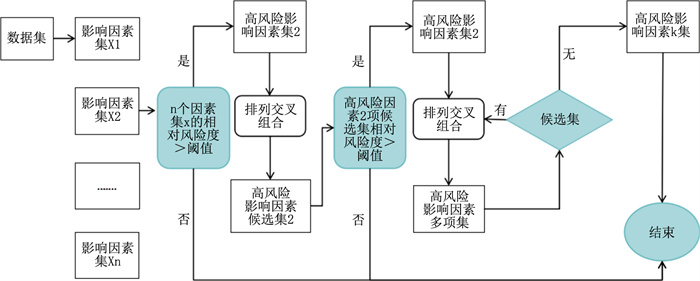
图 1 医疗器械感染高风险因素集分析流程
Figure 1. Analysis flow of high-risk factor sets for medical device infections
表 1 2组消毒供应中心工作人员感染管理相关知识水平比较(x±s)
Table 1. Comparison of infection management knowledge levels between two groups of sterile supply department staff (x±s)
人员 组别 人数 评分 t值 P值 消毒供应人员 对照组 11 90.27±4.36 2.578 0.018 观察组 11 94.63±3.32 监管人员 对照组 3 87.62±2.03 3.567 0.024 观察组 3 93.80±2.21 医疗器械工程师 对照组观察组 4 4 81.92±1.45 86.68±2.89 2.948 0.026  下载: 导出CSV
表 2 2组消毒供应中心医疗器械消毒、灭菌的日常检查规范率比较[件(%)]
Table 2. Comparison of routine inspection compliance rates for medical device disinfection and sterilization between two groups of sterile supply departments [cases (%)]
组别 件数 器械回收 清洗消毒 包装灭菌 无菌检测 器械发放 总发生 对照组 1 326 320/353(90.65) 137/146(93.84) 133/146(91.10) 224/243(92.18) 397/438(90.64) 1 211/1 326(91.33) 观察组 1 389 367/378(97.09) 146/147(99.32) 143/147(97.28) 238/246(96.75) 451/471(95.75) 1 345/1 389(96.83) χ2值 13.376 6.683 5.124 4.888 9.483 37.288 P值 <0.001 0.001 0.024 0.027 0.002 <0.001
下载: 导出CSV
表 3 2组消毒供应中心医疗器械消毒、灭菌的日常检查不合格率比较[件(%)]
Table 3. Comparison of routine inspection non-compliance rates for medical device disinfection and sterilization between two groups of sterile supply departments [cases (%)]
组别 件数 高压灭菌 环境空气 物体表面 消毒剂浓度 消毒剂染菌 无菌试验 紫外线 总发生 对照组 1 326 0/75 12/259(4.63) 1/434(0.23) 9/172(5.23) 0/172 0/119 5/95(5.26) 27/1 326(2.04) 观察组 1 389 0/86 11/326(3.37) 1/345(0.29) 1/220(0.45) 0/220 0/220 0/106 13/1 389(0.94) 注:2组日常检查不合格总发生率比较,χ2=5.658,P=0.017。
下载: 导出CSV
-
[1] 韩松花, 蒋丽迁, 余旭良, 等. 供应室在消毒管理中施行全程质控管理对医院感染防控的作用分析[J]. 中华全科医学, 2020, 18(11): 1950-1952, 1960. doi: 10.16766/j.cnki.issn.1674-4152.001661HAN S H, JIANG L Q, YU X L, et al. Analysis of the effect of the whole process quality control management in disinfection management of supply room on the prevention and control of hospital infection[J]. Chinese Journal of General Practice, 2020, 18(11): 1950-1952, 1960. doi: 10.16766/j.cnki.issn.1674-4152.001661 [2] DAI J, REN X, WU P, et al. Construction of exchange integrated information chain management model leading by information nurse for large instrument and equipment in operating room[J]. BMC Med Inform Decis Mak, 2021, 21(1): 50. DOI: 10.1186/s12911-021-01417-w. [3] XU Y, SHI C, LIU Y. Application effect of PDCA circulation on nursing quality management and risk control in digestive endoscopy room[J]. Medicine(Baltimore), 2023, 102(48): e35885. DOI: 10.1097/MD.0000000000035885. [4] SHUAI J, LIU M, HOU J, et al. Central sterile supply departament management on hospital-associated infections: a systematic review and meta-analysis[J]. Rev Inst Med Trop Sao Paulo, 2025, 67(1): e16. DOI: 10.1590/S1678-9946202567016. [5] 中华护理学会消毒供应中心专业委员会. 重复使用医疗器械包装技术专家共识[J]. 中华护理杂志, 2023, 58(5): 517-523.Expert consensus on packaging techniques of reusable medical instruments[J]. Chinese Journal of Nursing, 2023, 58(5): 517-523. [6] YU P, YANG R, CEN C. Evaluation of the prevention effect of high-quality nursing quality control in disinfection supply center on nosocomial infection[J]. Medicine (Baltimore), 2024, 103(2): e35459. DOI: 10.1097/MD.0000000000035459. [7] 宋之琰, 陈军, 彭红芬, 等. 男性酒精使用障碍者小脑亚区效应连接的格兰杰因果分析[J]. 放射学实践, 2025, 40(2): 183-190.SONG Z Y, CHEN J, PENG H F, et al. Effective connectivity of cerebellum in male patients with alcohol use disorder: a resting-state functional MRI Granger causality analysis[J]. Radiologic Practice, 2025, 40(2): 183-190. [8] 贺云霞, 杨敏利, 周婷, 等. 手术室器械感染风险评估及失效模式与影响分析评价模型研究[J]. 中国医学装备, 2023, 20(5): 158-162.HE Y X, YANG M L, ZHOU T, et al. Practice research of operating room instrument infection risk assessment system and failure mode and effects analysis evaluation model[J]. China Medical Equipment, 2023, 20(5): 158-162. [9] 中华人民共和国卫生部. 医疗机构消毒技术规范: WS/T 367-2012[S]. 2012.Ministry of Health of the People's Republic of China. Regulation of disinfection technique in healthcare institutions: WS/T 367-2012[S]. 2012. [10] JIANG S, YI L, CHEN Y, et al. Optimizing sterilization packaging through root cause analysis: an exploration into sealing defects of paper-plastic pouches[J]. Med Sci Monit, 2023, 29: e940342. DOI: 10.12659/MSM.940342. [11] 钟洁琳. 浅谈手术室卫生器械严格质量管理对医院感染控制的作用[J]. 中国感染与化疗杂志, 2023, 23(5): 670.ZHONG J L. Discussion on role of strict quality management of operating room medical instruments in nosocomial infection control[J]. Chinese Journal of Infection and Chemotherapy, 2023, 23(5): 670. [12] 陈玲, 余颖. 医院消毒供应中心工作人员消毒依从性干预效果及清洗消毒不合格影响因素[J]. 国际护理学杂志, 2024, 43(6): 984-988.CHEN L, YU Y. Intervention effect of disinfection compliance among staff in hospital sterile supply center and influencing factors of unqualified cleaning and disinfection[J]. International Journal of Nursing, 2024, 43(6): 984-988. [13] DRIESEN B, BAARTMANS M, MERTEN H, et al. Root cause analysis using the prevention and recovery information system for monitoring and analysis method in healthcare facilities: a systematic literature review[J]. J Patient Saf, 2022, 18(4): 342-350. doi: 10.1097/PTS.0000000000000925 [14] AAN ADRIANDYAH A, SETIANTO B, LUKIYONO Y T, et al. Proactive method for identification and handling of patient complaints with root cause analysis in Surabaya Islamic Hospital[J]. J Public Health Res, 2023, 12(4): 22799036231208357. DOI: 10.1177/22799036231208357. [15] 王少芹, 生小妹, 罗婷. 根本原因分析法对消毒供应室器械清洗效果的影响[J]. 国际护理学杂志, 2021, 40(18): 3307-3310.WANG S Q, SHENG X M, LUO T. Effect of root cause analysis on instrument cleaning in sterile supply center[J]. International Journal of Nursing, 2021, 40(18): 3307-3310. [16] SHARMA A E, LYSON H C, CHERIAN R, et al. A root cause analysis of barriers to timely colonoscopy in california safety-net health systems[J]. J Patient Saf, 2022, 18(1): 163-171. doi: 10.1097/PTS.0000000000000718 -

 点击查看大图
计量
- 文章访问数: 2
- HTML全文浏览量: 1
- PDF下载量: 0
- 被引次数: 0
