



Predicting in-hospital mortality in critically ill pulmonary embolism patients: development and validation of a machine learning-based model
-
摘要:
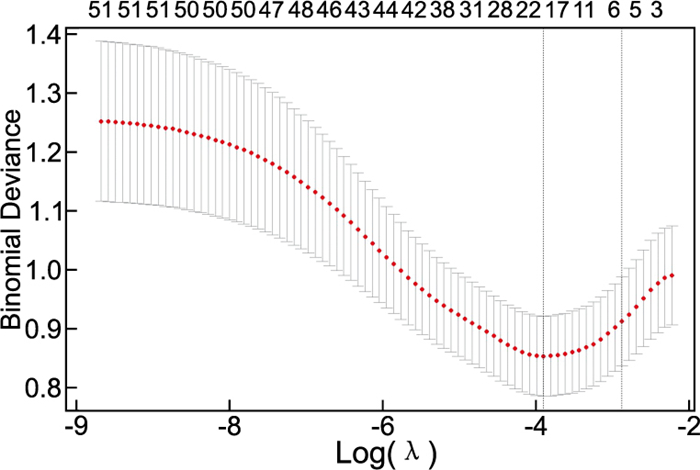
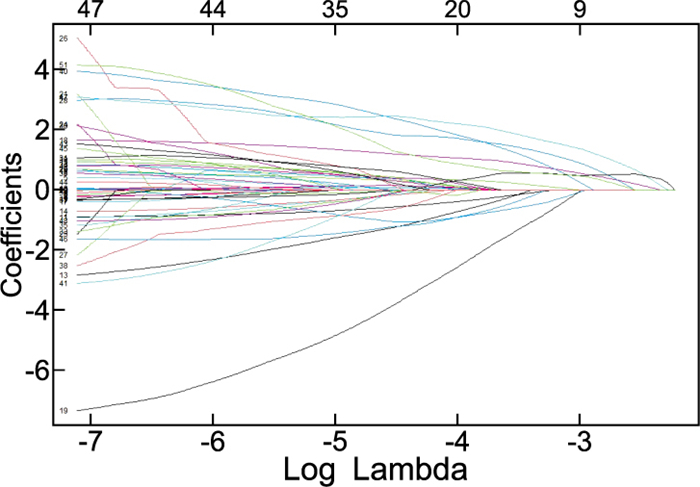
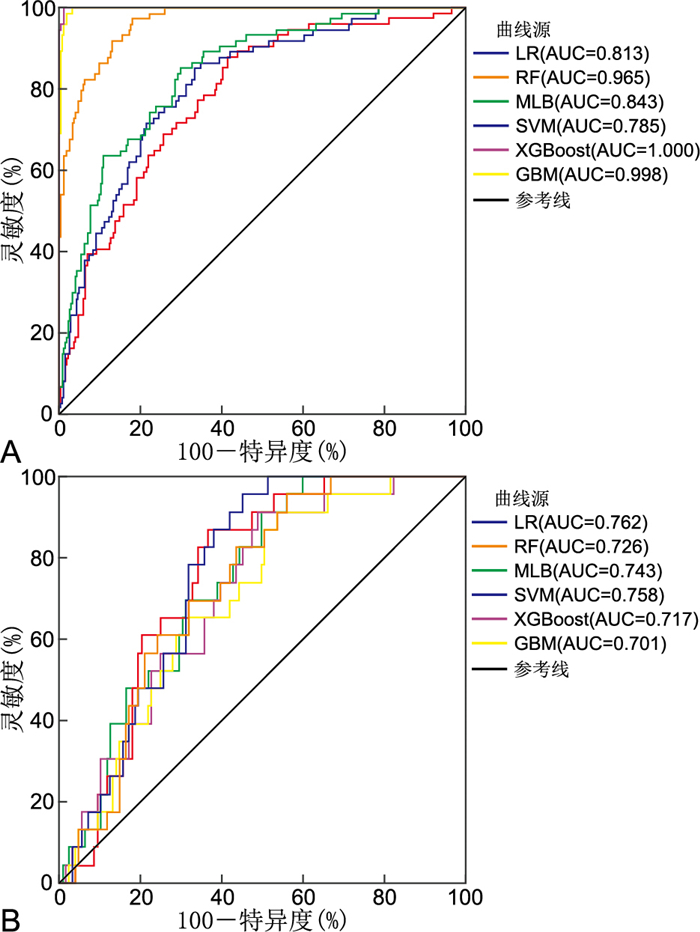
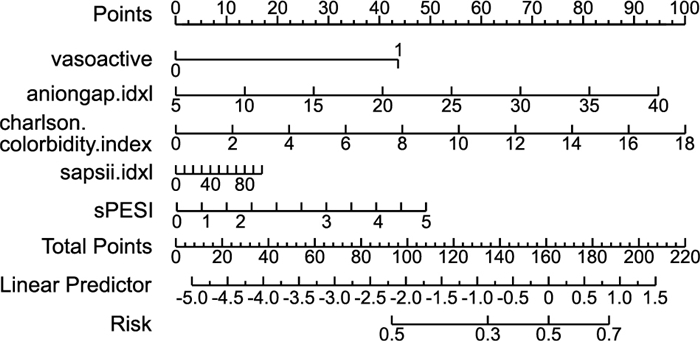
目的 本研究基于机器学习技术,利用列线图模型,探讨急性肺栓塞院内不良预后的危险因素,开发并验证一种整合多维度指标的院内死亡风险预测模型,以优化急性肺栓塞(PE)患者的风险分层。 方法 回顾性分析MIMIC-Ⅳ数据库中505例入住ICU的患者数据,按7∶3比例分为训练集(354例)和测试集(151例)。通过LASSO回归筛选出预测变量,基于逻辑回归(LR)算法构建预测肺栓塞院内死亡的列线图,通过受试者工作特征曲线(ROC)、校准曲线及决策曲线分析(DCA) 对该模型进行了验证。 结果 LASSO回归分析表明,血管活性药物使用、阴离子间隙(AG)、查尔森合并症指数(CCI)、简化急性生理评分Ⅱ(SAPSⅡ)及肺栓塞严重指数简化版本(sPESI)评分为关键预测变量。基于这些因素建立列线图预测模型并进行验证,模型在训练集的AUC为0.813(95% CI:0.759~0.863),测试集中的AUC为0.762(95% CI:0.683~0.838),显示模型对肺栓塞患者院内死亡风险具有良好的区分度,校准曲线和Hosmer-Lemeshow检验(P>0.05)表明模型在训练集和测试集中的拟合度良好,决策曲线分析(DCA)显示在较大范围的阈值概率下,模型均可获得收益。 结论 基于血管活性药物使用、AG、CCI、SAPSⅡ及sPESI评分构建列线图能有效预测PE患者的院内死亡风险,为临床决策提供量化工具。 Abstract:Objective This study aimed to develop and validate a multidimensional risk prediction model for in-hospital mortality in critically ill patients with acute pulmonary embolism (PE) using machine learning-based nomogram techniques, and to identify key risk factors associated with adverse outcomes for improved risk stratification. Methods A retrospective analysis was conducted on 505 ICU patients with acute PE from the MIMIC-Ⅳ database. Patients were randomly divided into a training set (n=354) and a testing set (n=151) at a ratio of 7∶3. LASSO regression was employed to screen predictive variables, followed by logistic regression (LR) to construct the nomogram model. Model performance was validated using ROC curves, calibration curves, and decision curve analysis (DCA). Results LASSO regression identified vasopressor use, anion gap (AG), Charlson comorbidity index (CCI), simplified acute physiology score Ⅱ (SAPS Ⅱ), and simplified pulmonary embolism severity index (sPESI) as critical predictors. The nomogram demonstrated good discriminative performance, with AUCs of 0.813 (95% CI: 0.759-0.863) in the training set and 0.762 (95% CI: 0.683-0.838) in the testing set. Calibration curves and Hosmer-Lemeshow tests (P>0.05) indicated good agreement between predicted and observed outcomes, while DCA indicated favorable clinical utility across a wide range of threshold probabilities. Conclusion The nomogram integrating vasopressor use, AG, CCI, SAPS Ⅱ, and sPESI effectively predicts the risk of in-hospital mortality in critically ill patients with PE, offering a quantitative tool for clinical decision-making and risk stratification. -
Key words:
- Pulmonary embolism /
- Nomograms /
- Predictive model /
- Hospital mortality /
- Intensive care unit
-

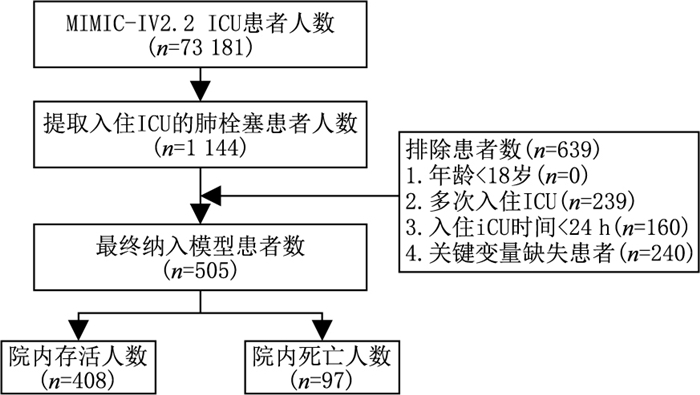
图 1 肺栓塞患者纳入与排除流程图
注:ICU为重症监护病房。
Figure 1. Flowchart for inclusion and exclusion of patients with pulmonary embolism

图 4 训练集和测试集ROC曲线
注:A为训练集,B为测试集。
Figure 4. ROC curve of the training set and the test set

图 5 PE不良预后的预测模型列线图
Figure 5. Nomogram for predicting adverse outcomes in pulmonary embolism

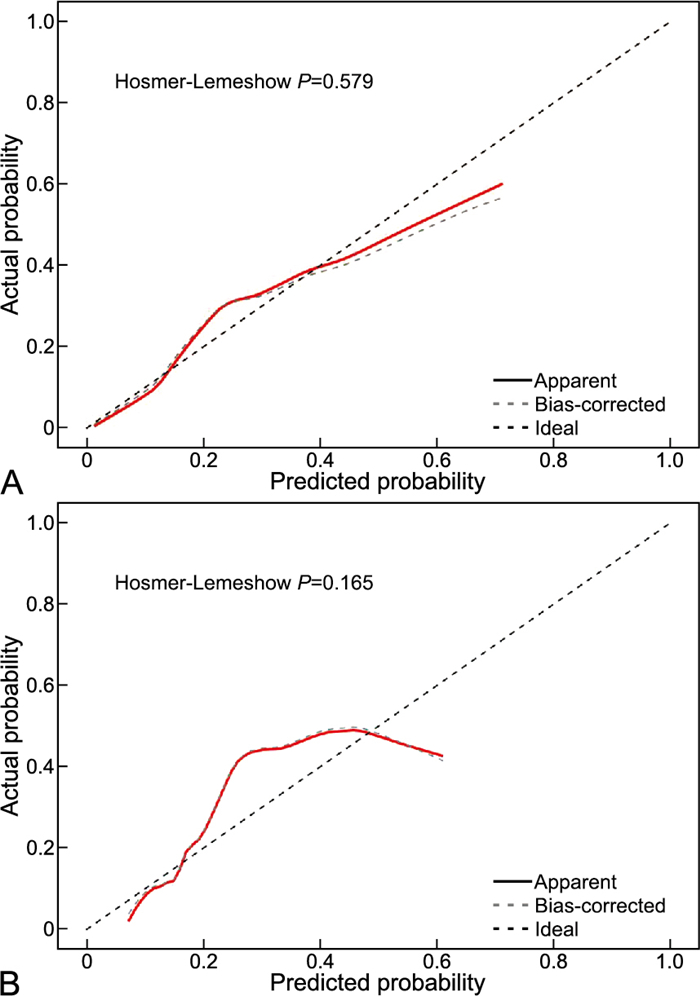
图 6 训练集和测试集校准曲线
注:A为训练集,B为测试集。
Figure 6. Calibration curve of the training set and the test set

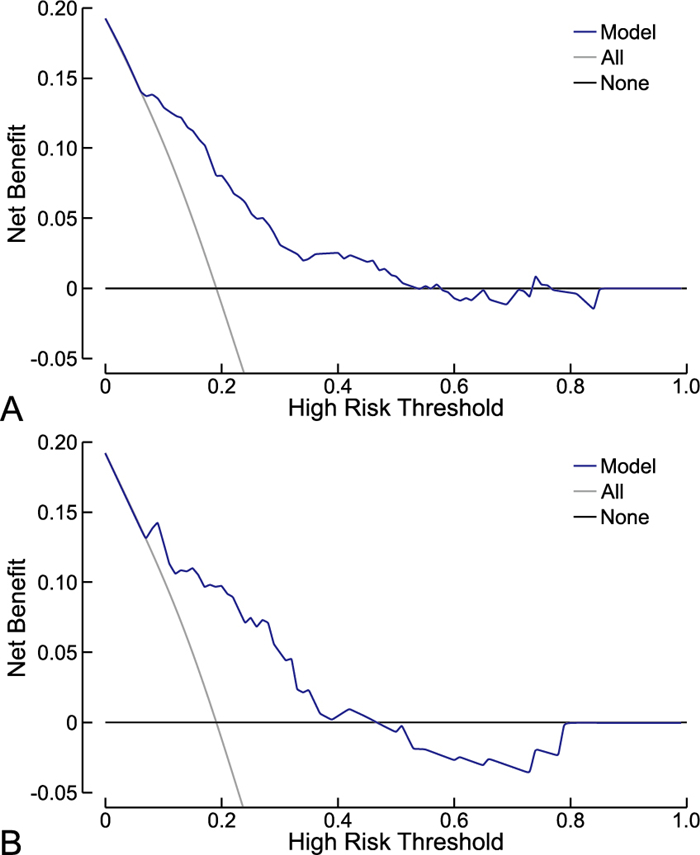
图 7 训练集和测试集决策曲线
注:A为训练集,B为测试集。
Figure 7. Decision curve of the training set and the test set
表 1 存活组与死亡组肺栓塞患者一般资料比较
Table 1. Comparison of general data between patients with pulmonary embolism in the survival group and the death group
项目 总体(n=505) 存活(n=408) 死亡(n=97) 统计量 P值 性别[例(%)] 1.831a 0.177 女性 250(49.5) 196(48.0) 54(55.7) 男性 255(50.5) 212(52.0) 43(44.3) 种族[例(%)] 0.242a 0.626 其他 187(37.0) 149(36.5) 38(39.2) 白色人种 318(63.0) 259(63.5) 59(60.8) 有创辅助通气[例(%)] 10.245a 0.001 否 235(46.5) 204(50.0) 31(32.0) 是 270(53.5) 204(50.0) 66(68.0) 脓毒血症[例(%)] 9.304a 0.002 否 159(31.5) 141(34.6) 18(18.6) 是 346(68.5) 267(65.4) 79(81.4) 高血压[例(%)] 5.336a 0.021 否 214(42.4) 183(44.9) 31(32.0) 是 291(57.6) 225(55.1) 66(68.0) 慢性肾脏病[例(%)] 11.344a < 0.001 否 434(85.9) 361(88.5) 73(75.3) 是 71(14.1) 47(11.5) 24(24.7) 急性心肌梗死[例(%)] 11.902a < 0.001 否 435(86.1) 362(88.7) 73(75.3) 是 70(13.9) 46(11.3) 24(24.7) 充血性心力衰竭[例(%)] 3.638a 0.056 否 343(67.9) 285(69.9) 58(59.8) 是 162(32.1) 123(30.1) 39(40.2) 脑血管疾病[例(%)] 5.808a 0.016 否 430(85.1) 355(87.0) 75(77.3) 是 75(14.9) 53(13.0) 22(22.7) 慢性肺部疾病[例(%)] 0.402a 0.529 否 372(73.7) 303(74.3) 69(71.1) 是 133(26.3) 105(25.7) 28(28.9) 糖尿病[例(%)] 10.218a 0.001 否 381(75.4) 320(78.4) 61(62.9) 是 124(24.6) 88(21.6) 36(37.1) 恶性肿瘤[例(%)] 7.304a 0.007 否 395(78.2) 329(80.6) 66(68.0) 是 110(21.8) 79(19.4) 31(32.0) 血管活性药物使用[例(%)] 36.217a < 0.001 否 248(49.1) 227(55.6) 21(21.6) 是 257(50.9) 181(44.4) 76(78.4) 年龄(x±s,岁) 62.0±17.3 60.5±17.8 68.1±13.7 -4.625b < 0.001 心率(x±s,次/min) 99.2±22.7 98.8±22.9 100.8±21.9 -0.766b 0.443 收缩压(x±s,mmHg) 122.5±24.9 122.6±24.5 122.0±26.9 0.223b 0.825 住院时间[M(P25, P75), d] 15.5(9.1, 24.9) 15.9(10.3, 25.8) 11.6(5.9, 20.5) -3.775c < 0.001 阴离子间隙(x±s,mmol/L) 15.4±4.9 15.0±4.5 17.2±5.8 -3.477b < 0.001 SOFA评分[M(P25, P75), 分] 1.0(0.0, 3.0) 1.0(0.0, 3.0) 2.0(0.0, 4.0) -2.681c 0.007 格拉斯哥昏迷评分[M(P25, P75), 分] 15.0(15.0, 15.0) 15.0(15.0, 15.0) 15.0(15.0, 15.0) -0.349c 0.729 血氧饱和度[M(P25, P75), %] 97.0(94.0, 100.0) 97.0(94.0, 100.0) 97.0(94.0, 100.0) -1.102c 0.269 查尔森合并症指数[M(P25, P75), 分] 5.0(2.0, 7.0) 4.0(2.0, 7.0) 7.0(5.0, 9.0) -6.167c < 0.001 SAPSⅡ评分[M(P25, P75), 分] 38.0(29.0, 49.0) 36.0(27.0, 46.0) 46.0(38.0, 57.0) -6.331c < 0.001 sPESI评分[M(P25, P75), 分] 2.0(1.0, 3.0) 2.0(1.0, 2.0) 2.0(2.0, 3.0) -5.082c < 0.001 注:a为χ2值,b为t值,c为Z值; 1 mmHg=0.133 kPa。  下载: 导出CSV
表 2 训练集与测试集肺栓塞患者一般资料比较
Table 2. Comparison of general information of pulmonary embolism patients in the training set and the test set
项目 总数据集(n=505) 训练集(n=354) 测试集(n=151) 统计量 P值 院内死亡[例(%)] 0.004a 0.999 否 408(80.8) 286(80.8) 122(80.8) 是 97(19.2) 68(19.2) 29(19.2) 性别[例(%)] 1.245a 0.263 女性 250(49.5) 181(51.1) 69(45.7) 男性 255(50.5) 173(48.9) 82(54.3) 种族[例(%)] 0.029a 0.854 其他 187(37.0) 132(37.3) 55(36.4) 白色人种 318(63.0) 222(62.7) 96(63.6) 有创辅助通气[例(%)] 0.202a 0.659 否 235(46.5) 167(47.2) 68(45.0) 是 270(53.5) 187(52.8) 83(55.0) 脓毒血症[例(%)] 0.546a 0.458 否 159(31.5) 115(32.5) 44(29.1) 是 346(68.5) 239(67.5) 107(70.9) 高血压[例(%)] 0.002a 0.998 否 214(42.4) 150(42.4) 64(42.4) 是 291(57.6) 204(57.6) 87(57.6) 慢性肾脏病[例(%)] 0.117a 0.731 否 434(85.9) 303(85.6) 131(86.8) 是 71(14.1) 51(14.4) 20(13.2) 急性心肌梗死[例(%)] 0.288a 0.587 否 435(86.1) 303(85.6) 132(87.4) 是 70(13.9) 51(14.4) 19(12.6) 充血性心力衰竭[例(%)] 0.546a 0.458 否 343(67.9) 244(68.9) 99(65.6) 是 162(32.1) 110(31.1) 52(34.4) 脑血管疾病[例(%)] 0.945a 0.329 否 430(85.1) 305(86.2) 125(82.8) 是 75(14.9) 49(13.8) 26(17.2) 慢性肺部疾病[例(%)] 0.154a 0.696 否 372(73.7) 259(73.2) 113(74.8) 是 133(26.3) 95(26.8) 38(25.2) 糖尿病[例(%)] 0.441a 0.509 否 381(75.4) 270(76.3) 111(73.5) 是 124(24.6) 84(23.7) 40(26.5) 恶性肿瘤[例(%)] 0.245a 0.619 否 395(78.2) 279(78.8) 116(76.8) 是 110(21.8) 75(21.2) 35(23.2) 血管活性药物使用[例(%)] 0.177a 0.675 否 248(49.1) 176(49.7) 72(47.7) 是 257(50.9) 178(50.3) 79(52.3) 年龄(x±s,岁) 62.0±17.3 62.0±17.2 61.9±17.6 0.021b 0.983 住院时间[M(P25, P75), d] 15.5(9.1, 24.9) 15.9(9.8, 26.4) 14.2(8.5, 21.3) -1.703c 0.089 心率(x±s,次/min) 99.2±22.7 99.4±22.8 98.6±22.5 0.335b 0.736 收缩压(x±s,mmHg) 122.5±24.9 123.5±26.1 120.1±21.9 1.409b 0.161 阴离子间隙(x±s,mmol/L) 15.4±4.9 15.5±4.7 15.3±5.2 0.503b 0.619 查尔森合并症指数[M(P25, P75), 分] 5.0(2.0, 7.0) 5.0(2.0, 7.0) 4.0(3.0, 7.0) 0.152c 0.772 SAPSⅡ评分[M(P25, P75), 分] 38.0(29.0, 49.0) 38.0(29.0, 49.0) 39.0(29.0, 49.0) -0.703c 0.364 sPESI评分[M(P25, P75), 分] 2.0(1.0, 3.0) 2.0(1.0, 3.0) 2.0(1.0, 3.0) 0.542c 0.519 SOFA评分[M(P25, P75), 分] 1.0(0.0, 3.0) 1.0(0.0, 3.0) 1.0(0.0, 3.0) -1.478c 0.140 格拉斯哥昏迷评分[M(P25, P75), 分] 15.0(15.0, 15.0) 15.0(15.0, 15.0) 15.0(15.0, 15.0) -0.235c 0.810 注:a为χ2值,b为t值,c为Z值。
下载: 导出CSV
-
[1] 王杭, 许启霞, 李小晴, 等. 急性肺栓塞患者的长期预后因素分析[J]. 中华全科医学, 2023, 21(9): 1466-1469, 1502. doi: 10.16766/j.cnki.issn.1674-4152.003147Wang H, Xu Q X, Li X Q, et al. Analysis of long-term prognostic factors in patients with acute pulmonary embolism[J]. Chin J Gen Pract, 2023, 21(9): 1466-1469, 1502. doi: 10.16766/j.cnki.issn.1674-4152.003147 [2] 庞颖颖, 刘海涛. 生物标志物与急性肺栓塞危险分层及预后的关联性研究[J]. 中华全科医学, 2022, 20(2): 199-201, 281. doi: 10.16766/j.cnki.issn.1674-4152.002311Pang Y Y, Liu H T. Association study of biomarkers with risk stratification and prognosis in acute pulmonary embolism[J]. Chin J Gen Pract, 2022, 20(2): 199-201, 281. doi: 10.16766/j.cnki.issn.1674-4152.002311 [3] SUROV A, AKRITIDOU M, BACH A G, et al. A new index for the prediction of 30-day mortality in patients with pulmonary embolism: the pulmonary embolism mortality score (PEMS)[J]. Angiology, 2021, 72(8): 787-793. doi: 10.1177/0003319721993346 [4] SUROV A, THORMANN M, BÄR C, et al. Validation of clinical-radiological scores for prognosis of mortality in acute pulmonary embolism[J]. Respir Res, 2023, 24(1): 195. DOI: 10.1186/s12931-023-02489-0. [5] JOHNSON A E W, BULGARELLI L, SHEN L, et al. MIMIC-Ⅳ, a freely accessible electronic health record dataset[J]. Sci Data, 2023, 10(1): 1. DOI: 10.1038/s41597-022-01899-x. [6] MCGUIRE W C, SULLIVAN L, ODISH M F, et al. Management strategies for acute pulmonary embolism in the ICU[J]. Chest, 2024, 166(6): 1532-1545. doi: 10.1016/j.chest.2024.04.032 [7] EBNER M, SENTLER C, HARJOLA V P, et al. Outcome of patients with different clinical presentations of high-risk pulmonary embolism[J]. Eur Heart J Acute Cardiovasc Care, 2021, 10(7): 787-796. [8] RYLL M J, ZODL A, WEINGARTEN T N, et al. Predicting hospital survival in patients admitted to ICU with pulmonary embolism[J]. J Intensive Care Med, 2024, 39(5): 455-464. doi: 10.1177/08850666231212875 [9] ALTER D N, ZHA L. The anion gap as a predictive tool for morbidity and mortality[J]. Crit Rev Clin Lab Sci, 2025, 62(8): 568-584. doi: 10.1080/10408363.2025.2526346 [10] ZHANG T T, WANG J, LI X Y. Association between anion gap and mortality in critically ill patients with cardiogenic shock[J]. Int J Gen Med, 2021, 14: 4765-4773. doi: 10.2147/IJGM.S329150 [11] TANG Y Y, LIN W C, ZHA L H, et al. Serum anion gap is associated with all-cause mortality among critically ill patients with congestive heart failure[J]. Dis Markers, 2020, 2020: 8833637. DOI: 10.1155/2020/8833637. [12] GAO Y J, HONG Z L, SHEN R N, et al. Association between anion gap and mortality of aortic aneurysm in intensive care unit after open surgery[J]. BMC Cardiovasc Disord, 2021, 21(1): 458. DOI: 10.1186/s12872-021-02263-4. [13] PENG Y B, CHEN Z, LUO Z K, et al. Identifying prognostic factors for pulmonary embolism patients with hemodynamic decompensation admitted to the intensive care unit[J]. Medicine, 2024, 103(3): e36392. DOI: 10.1097/MD.0000000000036392. [14] LI R H, JIN X T, REN J J, et al. Relationship of admission serum anion gap and prognosis of critically ill patients: a large multicenter cohort study[J]. Dis Markers, 2022, 2022: 5926049. DOI: 10.1155/2022/5926049. [15] QU J M, TANG X H, CHENG Y, et al. Association between albumin corrected anion gap and 28-day all-cause mortality in patients with acute respiratory failure in ICU: a retrospective study based on the MIMIC-Ⅳ database[J]. Clin Respir J, 2025, 19(7): e70100. DOI: 10.1111/crj.70100. [16] HUANG Z L, WANG S J, YANG S. Association between serum anion gap and risk of in-hospital mortality in patients with acute heart failure[J]. Sci Rep, 2024, 14: 4858. DOI: 10.1038/s41598-024-55658-6. [17] HO T A, LIO K U, PATEL P, et al. Comorbidity profiles and pulmonary embolism risk assessment: leveraging the Charlson cmorbidity index for improved prognostication in a national data set[J]. Pulm Circ, 2024, 14(4): e70010. DOI: 10.1002/pul2.70010. [18] POLO FRIZ H, ORENTI A, GELFI E, et al. Predictors of medium- and long-term mortality in elderly patients with acute pulmonary embolism[J]. Heliyon, 2020, 6(9): e04857. DOI: 10.1016/j.heliyon.2020.e04857. [19] O'HARA A, POZIN J, ABOURAHMA M, et al. Charlson and elixhauser comorbidity indices for prediction of mortality and hospital readmission in patients with acute pulmonary embolism[J]. Clin Appl Thromb Hemost, 2024, 30: 10760296241253844. DOI: 10.1177/10760296241253844. [20] LIU P, REN Y K. Prognostic value of SAPS Ⅱ score for 28-day mortality in ICU patients with acute pulmonary embolism[J]. Int J Cardiol, 2025, 430: 133201. DOI: 10.1016/j.ijcard.2025.133201. [21] ZHANG Y, CHEN Y N, CHEN H, et al. Performance of the simplified pulmonary embolism severity index in predicting 30-day mortality after acute pulmonary embolism: validation from a large-scale cohort[J]. Eur J Intern Med, 2024, 124: 46-53. doi: 10.1016/j.ejim.2024.01.037 [22] YAMAN M, ORAK M, DURGUN H M, et al. The prognostic value of HALP score and sPESI in predicting in-hospital mortality in patients with pulmonary thromboembolism[J]. Postgrad Med J, 2024, 101(1191): 60-65. doi: 10.1093/postmj/qgae124
 点击查看大图
计量
- 文章访问数: 6
- HTML全文浏览量: 2
- PDF下载量: 1
- 被引次数: 0
