



Effect of alirocumab combined with statin therapy on short-term major adverse cardiovascular events in patients with acute myocardial infarction after percutaneous coronary intervention
-
摘要:
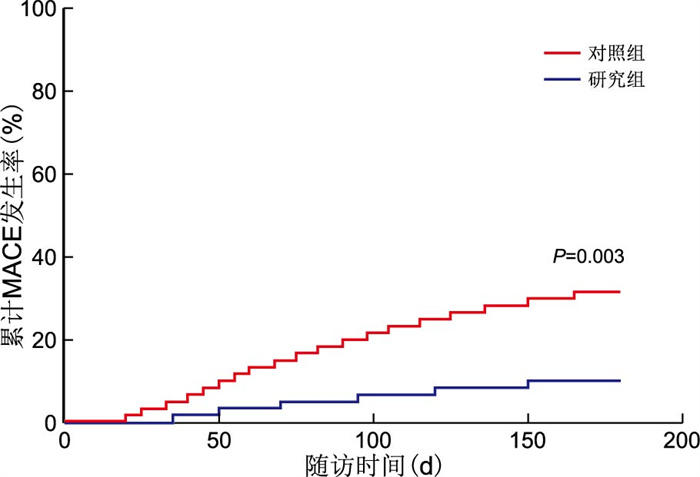
目的 探讨阿利西尤单抗联合他汀类药物治疗对急性心肌梗死(AMI)经皮冠状动脉介入治疗(PCI)术后患者短期预后的影响,并分析主要不良心血管事件(MACE)的独立影响因素。 方法 回顾性纳入2022年1月—2023年12月在蚌埠市第三人民医院接受PCI治疗的AMI患者120例,根据是否联合应用阿利西尤单抗分为研究组和对照组,各60例。对照组给予常规二级预防治疗,研究组在此基础上加用阿利西尤单抗。比较2组治疗前及治疗14 d后血脂、肾功能及CRP水平变化,随访6个月记录MACE发生情况。采用Kaplan-Meier法比较累积事件率,并采用Cox比例风险模型分析MACE的独立影响因素。 结果 与对照组相比,研究组治疗14 d后TC、TG、低密度脂蛋白胆固醇(LDL-C)及CRP水平均显著降低,高密度脂蛋白胆固醇(HDL-C)显著升高(P<0.05),血清肌酐(SCr)及BUN水平均显著下降(P<0.05),ALT、AST组间差异均无统计学意义(P>0.05)。6个月随访中,研究组MACE发生率显著低于对照组[10.0%(6/60)vs. 31.7%(19/60),P<0.05]。Cox分析显示,联合应用阿利西尤单抗为MACE的独立保护因素(HR=0.451,95% CI:0.271~0.762,P=0.029),而基线LDL-C、CRP及SCr水平升高均为独立危险因素(P<0.05)。 结论 在常规抗血小板及他汀治疗基础上联合应用阿利西尤单抗,可进一步改善AMI患者PCI术后血脂谱、减轻炎症反应、改善肾功能并降低短期MACE发生风险。 -
关键词:
- 急性心肌梗死 /
- 经皮冠状动脉介入治疗 /
- 阿利西尤单抗 /
- P2Y12受体抑制剂 /
- 他汀类药物
Abstract:Objective To investigate the effect of alirocumab combined with statin therapy on the short-term prognosis of patients with acute myocardial infarction (AMI) after percutaneous coronary intervention (PCI), and to identify independent predictors of major adverse cardiovascular events (MACE). Methods A total of 120 AMI patients who underwent PCI between January 2022 and December 2023 were retrospectively enrolled and divided into an alirocumab group and a control group (n=60 each). The control group received standard secondary prevention therapy, whereas the alirocumab group received additional alirocumab treatment. Lipid profiles, renal function parameters, and CRP levels were assessed at baseline and 14 days after treatment. Patients were followed up for 6 months to record occurrence of MACE. Kaplan-Meier analysis was used to compare cumulative event rates, and Cox proportional hazards regression models were applied to identify independent predictors of MACE. Results Compared with the control group, the alirocumab group showed significantly lower levels of TC, TG, low density lipoprotein cholesterol (LDL-C), and CRP, as well as significantly higher levels of high-density lipoprotein cholesterol (HDL-C) levels at 14 days after treatment (P < 0.05). Serum creatinine and blood urea nitrogen levels were also significantly reduced (P < 0.05), while ALT and AST levels showed no significant differences between the two groups (P>0.05). During the 6-month follow-up period, the incidence of MACE was significantly lower in the alirocumab group [10.0% (6/60) vs. 31.7% (19/60), P < 0.05]. Cox regression analysis identified alirocumab use as an independent protective factor for MACE (HR=0.451, 95% CI: 0.271-0.762, P=0.029), whereas elevated baseline LDL-C, CRP, and serum creatinine levels were independent risk factors (P < 0.05). Conclusion The addition of alirocumab to standard antiplatelet and statin therapy can further improve lipid profiles, reduce inflammation, preserve renal function, and decrease the risk of short-term MACE in patients with AMI after PCI. -

图 1 2组AMI患者6个月内MACE累积发生率的Kaplan-Meier曲线
Figure 1. Kaplan-Meier curves for cumulative incidence of MACE within 6 months in patients with AMI
表 1 2组AMI患者一般资料比较
Table 1. Comparison of baseline characteristics between the two groups of patients with AMI
项目 对照组(n=60) 研究组(n=60) 统计量 P值 性别(男性/女性, 例) 41/19 40/20 0.038a 0.845 年龄(x±s, 岁) 59.17±12.74 61.13±11.97 0.872b 0.385 BMI(x±s) 23.04±1.13 23.08±1.16 0.191b 0.849 高血压[例(%)] 22(36.67) 24(40.00) 0.141a 0.707 糖尿病[例(%)] 12(20.00) 16(26.67) 0.745a 0.388 吸烟[例(%)] 36(60.00) 39(65.00) 0.320a 0.572 饮酒[例(%)] 44(73.33) 42(70.00) 0.164a 0.685 梗死类型[例(%)] 0.173a 0.678 STEMI 44(73.33) 46(76.67) NSTEMI 16(26.67) 14(23.33) 梗死罪犯血管[例(%)] 0.292a 0.864 左前降支 32(53.33) 30(50.00) 左回旋支 10(16.67) 12(20.00) 右冠状动脉 18(30.00) 18(30.00) 病变支数[例(%)] 0.214a 0.899 单支 40(66.67) 38(63.33) 双支 14(23.33) 16(26.67) 多支 6(10.00) 6(10.00) 发病至血管开通时间[M(P25, P75), h] 6.3(5.2, 7.5) 6.3(5.1, 7.4) 0.100c 0.921 注:a为χ2值,b为t值,c为Z值。发病至血管开通时间指自症状起始至梗死相关血管首次恢复血流的时间。  下载: 导出CSV
表 2 2组AMI患者治疗前后血脂及CRP水平比较(x±s)
Table 2. Comparison of blood lipid and CRP levels before and after treatment in patients with AMI between the two groups (x±s)
组别 例数 TC(mmol/L) TG(mmol/L) LDL-C(mmol/L) HDL-C(mmol/L) CRP(mg/L) 治疗前 治疗后 治疗前 治疗后 治疗前 治疗后 治疗前 治疗后 治疗前 治疗后 对照组 60 5.46±0.78 4.33±0.71b 1.82±0.51 1.45±0.44b 3.02±0.63 2.21±0.56b 0.98±0.19 1.05±0.22b 8.50±0.95 5.88±0.66b 研究组 60 5.38±0.81 3.52±0.66b 1.85±0.48 1.26±0.38b 3.10±0.65 1.72±0.49b 0.96±0.21 1.26±0.27b 8.47±0.92 5.13±0.40b 统计量 0.116a 3.145c 0.285a 2.118c 0.271a 6.214c 0.245a 2.226c 0.176a 5.528c P值 0.760 <0.001 0.878 0.014 0.652 <0.001 0.740 0.041 0.861 <0.001 注:a为t值,c为F值。与同组治疗前比较,bP<0.05。
下载: 导出CSV
表 3 2组AMI患者治疗前后肝肾功能比较(x±s)
Table 3. Comparison of liver and renal function before and after treatment in patients with AMI between the two groups (x±s)
组别 例数 ALT(U/L) AST(U/L) SCr(μmol/L) BUN(mmol/L) 治疗前 治疗后 治疗前 治疗后 治疗前 治疗后 治疗前 治疗后 对照组 60 23.87±5.39 24.94±6.14 22.59±4.45 23.39±4.68 94.14±10.05 91.02±9.41c 6.79±1.54 5.87±1.45c 研究组 60 23.78±4.39 25.25±6.21 22.60±4.34 23.80±4.75 93.43±10.14 86.13±8.70c 6.71±1.50 5.01±1.21c 统计量 0.100a 0.185b 0.012a 0.506b 0.385a 4.256b 0.288a 7.951b P值 0.920 0.664 0.990 0.425 0.701 0.042 0.774 <0.001 注:a为t值,b为F值。与同组治疗前比较,cP<0.05。
下载: 导出CSV
表 4 2组AMI患者PCI术后随访期间实验室及心功能相关指标比较
Table 4. Comparison of laboratory and cardiac function parameters during follow-up after PCI in patients with AMI between the two groups
项目 组别 例数 1个月 3个月 6个月 组别效应 时间效应 交互效应 统计量 P值 统计量 P值 统计量 P值 LDL-C(x±s, mmol/L) 对照组 60 2.23±0.55 2.20±0.58 1.91±0.60 11.390a 0.001 7.114a <0.001 6.381a 0.002 研究组 60 1.63±0.45 1.58±0.42 1.55±0.40 CRP(x±s, mg/L) 对照组 60 4.20±0.90 3.90±0.85 3.70±0.80 1.469a 0.228 2.936a 0.055 1.631a 0.198 研究组 60 3.60±0.80 3.35±0.75 3.20±0.70 SCr(x±s, μmol/L) 对照组 60 90.0±9.5 91.5±9.8 92.0±10.0 3.037a 0.084 2.918a 0.056 2.399a 0.093 研究组 60 86.5±8.8 86.8±9.0 87.0±9.2 BUN(x±s, mmol/L) 对照组 60 5.70±1.40 5.85±1.45 5.95±1.50 3.249a 0.074 3.014a 0.051 2.719a 0.068 研究组 60 5.01±1.20 5.00±1.18 5.02±1.20 NT-proBNP[M(P25, P75), pg/mL] 对照组 60 320(180, 560) 260(150, 450) 210(120, 380) 1.993b 0.158 3.311b 0.191 3.580b 0.167 研究组 60 260(150, 470) 200(120, 360) 160(95, 290) 心律失常[例(%)] 对照组 60 8(13.3) 7(11.7) 6(10.0) 0.436b 0.509 1.221b 0.543 1.339b 0.512 研究组 60 6(10.0) 5(8.3) 4(6.7) 注:a为F值, b为Waldχ2值。
下载: 导出CSV
表 5 心肌梗死患者PCI术后MACE发生的Cox回归分析
Table 5. Cox regression analyses of factors associated with MACE after PCI in patients with myocardial infarction
变量 单因素分析 多因素分析 HR(95% CI) P值 HR(95% CI) P值 年龄(>60岁) 1.693(1.090~2.867) 0.040 1.200(0.765~1.883) 0.428 性别(男性) 1.300(0.751~2.251) 0.349 高血压 1.100(0.611~1.980) 0.753 糖尿病 1.200(0.707~2.037) 0.504 吸烟 1.500(0.937~2.401) 0.091 心肌梗死类型(STEMI) 1.600(0.943~2.716) 0.081 病变支数(多支) 1.405(0.841~2.336) 0.198 饮酒 1.200(0.712~2.023) 0.048 发病至血管开通>6 h 1.350(0.820~2.225) 0.232 ALT>40 U/L 1.002(0.555~1.800) 0.101 AST>45 U/L 1.509(0.861~2.580) 0.148 SCr>59 μmol/L 2.400(1.303~4.322) 0.004 1.947(1.058~3.420) 0.032 CRP>5 mg/L 1.930(1.098~3.267) 0.022 1.451(1.002~1.951) 0.047 TC(>5.70 mmol/L) 1.521(0.853~2.648) 0.162 TG(>2.25 mmol/L) 1.301(0.766~2.208) 0.331 LDL-C(>4.21 mmol/L) 1.811(1.104~2.916) 0.019 1.604(1.045~2.464) 0.031 HDL-C(>1.55 mmol/L) 0.702(0.428~1.141) 0.154 联合阿利西尤单抗 0.324(0.189~0.559) <0.001 0.451(0.271~0.762) 0.029 注:各变量赋值如下,PCI术后6个月内未发生MACE=0,发生=1;年龄≤60岁=0,>60岁=1;女性=0,男性=1;无高血压=0,有高血压=1;无糖尿病=0,有糖尿病=1;不吸烟=0,吸烟=1;不饮酒=0,饮酒=1;NSTEMI=0,STEMI=1;病变支数,非多支=0,多支=1;发病至血管开通时间≤6 h=0,>6 h=1;ALT≤40 U/L=0,>40 U/L=1;AST≤45 U/L=0,>45 U/L=1;SCr≤59 μmol/L=0,>59 μmol/L=1;CRP≤5 mg/L=0,>5 mg/L=1;TC≤5.70 mmol/L=0,>5.70 mmol/L=1;TG≤2.25 mmol/L=0,>2.25 mmol/L=1;LDL-C≤4.21 mmol/L=0,>4.21 mmol/L=1;HDL-C≤1.55 mmol/L=0,>1.55 mmol/L=1;未联合阿利西尤单抗=0,联合阿利西尤单抗=1。
下载: 导出CSV
-
[1] BISCAGLIA S, GUIDUCCI V, ESCANED J, et al. Complete or culprit-only PCI in older patients with myocardial infarction[J]. N Engl J Med, 2023, 389(10): 889-898. doi: 10.1056/NEJMoa2300468 [2] BÖHM F, MOGENSEN B, ENGSTRØM T, et al. FFR-guided complete or culprit-only PCI in patients with myocardial infarction[J]. N Engl J Med, 2024, 390(16): 1481-1492. doi: 10.1056/NEJMoa2314149 [3] OZAKI Y, TOBE A, ONUMA Y, et al. CVIT expert consensus document on primary percutaneous coronary intervention (PCI) for acute coronary syndromes (ACS) in 2026[J]. Cardiovasc Interv Ther, 2026, 41(2): 209-255. doi: 10.1007/s12928-025-01229-z [4] ELGENDY I Y, MAHTTA D, PANIAGUA D. Multivessel PCI for acute myocardial infarction: where do we stand after the COMPLETE trial[J]. Curr Cardiol Rep, 2020, 22(9): 97. DOI: 10.1007/s11886-020-01340-y. [5] WARNER E D, ULLAH W, FARBER J, et al. PCI for acute myocardial infarction in patients with a pre-existing LVAD, does it improve survival[J]. Artif Organs, 2023, 47(4): 761-769. doi: 10.1111/aor.14444 [6] LIBBY P. Mechanisms of acute coronary syndromes and their implications for therapy[J]. N Engl J Med, 2013, 368(21): 2004-2013. doi: 10.1056/NEJMra1216063 [7] 黄光华, 张金子, 张权宇, 等. 急性心肌梗死患者围术期急诊经皮冠状动脉介入治疗联合糖蛋白Ⅱb/Ⅲa抑制剂后应用P2Y12受体拮抗剂有效性与安全性分析[J]. 临床军医杂志, 2021, 49(5): 514-516.Huang G H, Zhang J Z, Zhang Q Y, et al. Analysis of the efficacy and safety of P2Y12 receptor antagonists after perioperative emergency percutaneous coronary intervention combined with glycoprotein Ⅱb/Ⅲa inhibitors in patients with acute myocardial infarction[J]. Clinical Journal of Medical Officers, 2021, 49(5): 514-516. [8] 管晶晶, 时鹏, 李保伍, 等. 颈动脉粥样硬化斑块超声联合血脂指标对心血管疾病的预测价值评估[J]. 中华全科医学, 2022, 20(8): 1376-1379. doi: 10.16766/j.cnki.issn.1674-4152.002601Guan J J, Shi P, Li B W, et al. Predictive value of carotid atherosclerotic plaque ultrasound combined with blood lipid indicators for cardiovascular diseases[J]. Chinese Journal of General Practice, 2022, 20(8): 1376-1379. doi: 10.16766/j.cnki.issn.1674-4152.002601 [9] 侯丽君, 刘世杰. ApoE基因多态性对阿利西尤单抗调脂疗效影响的分析[J]. 中国临床药理学杂志, 2024, 40(13): 1851-1854.Hou L J, Liu S J. Influence of ApoE gene polymorphism on the lipid-lowering efficacy of alirocumab[J]. The Chinese Journal of Clinical Pharmacology, 2024, 40(13): 1851-1854. [10] 张卫丰, 马海龙, 张金玲. PCSK9抑制剂对ST段抬高型急性心肌梗死PCI后炎症水平和心室重构的影响[J]. 实用医学杂志, 2024, 40(15): 2142-2147.Zhang W F, Ma H L, Zhang J L. Effects of PCSK9 inhibitors on inflammatory levels and ventricular remodeling after PCI in patients with ST-segment elevation myocardial infarction[J]. The Journal of Practical Medicine, 2024, 40(15): 2142-2147. [11] 陈仁亮. 急诊PCI术后早期应用PCSK9抑制剂对心脏保护作用的临床研究[D]. 呼和浩特: 内蒙古医科大学, 2024.Chen R L. Clinical study on the cardioprotective effect of early application of PCSK9 inhibitors after emergency PCI[D]. Hohhot: Inner Mongolia Medical University, 2024. [12] OESTERLE A, LAUFS U, LIAO J K. Pleiotropic effects of statins on the cardiovascular system[J]. Circ Res, 2017, 120(1): 229-243. doi: 10.1161/CIRCRESAHA.116.308537 [13] VIOLI F, CALVIERI C, FERRO D, et al. Statins as antithrombotic drugs[J]. Circulation, 2013, 127(2): 251-257. doi: 10.1161/CIRCULATIONAHA.112.145334 [14] JIANG Y, ZHONG Q, LI W, et al. Efficacy and safety of PCSK9 inhibitors, potent statins and their combination in hyperlipidemia: a systematic review and meta-analysis[J]. Front Pharmacol, 2024, 15: 1366893. DOI: 10.3389/fphar.2024.1366893. [15] THYGESEN K, ALPERT J S, JAFFE A S, et al. Fourth universal definition of myocardial infarction (2018)[J]. J Am Coll Cardiol, 2018, 72(18): 2231-2264. doi: 10.1016/j.jacc.2018.08.1038 [16] 张玲姬, 吴培颖, 赵薇. 匹伐他汀与阿托伐他汀对PCI术后急性心肌梗死患者血脂、血管内皮功能、炎性因子的影响[J]. 河北医药, 2023, 45(20): 3085-3089.Zhang L J, Wu P Y, Zhao W. Effects of pitavastatin and atorvastatin on blood lipid levels, vascular endothelial function and inflammatory factors in patients with acute myocardial infarction after PCI[J]. Hebei Medical Journal, 2023, 45(20): 3085-3089. [17] 曲曼青, 张喜军, 苏轶楣, 等. 匹伐他汀联合心肺康复训练对老年心肌梗死患者PCI术后疗效及血脂水平的影响[J]. 中国老年学杂志, 2023, 43(14): 3338-3342.Qu M Q, Zhang X J, Su Y M, et al. Effects of pitavastatin combined with cardiopulmonary rehabilitation training on clinical efficacy and blood lipid levels in elderly patients with myocardial infarction after PCI[J]. Chinese Journal of Gerontology, 2023, 43(14): 3338-3342. [18] SCHWARTZ G G, STEG P G, SZAREK M, et al. Alirocumab and cardiovascular outcomes after acute coronary syndrome[J]. N Engl J Med, 2018, 379(22): 2097-2107. doi: 10.1056/NEJMoa1801174 [19] NICHOLLS S J, PURI R S, ANDERSON T, et al. Effect of evolocumab on coronary plaque composition[J]. J Am Coll Cardiol, 2018, 72(17): 2012-2021. doi: 10.1016/j.jacc.2018.06.078 [20] TOMMASINO A, D'ASCENZO F, GILI S, et al. Evolving role of P2Y12 inhibitors in ST-segment elevation myocardial infarction: focus on thrombus burden and microvascular obstruction[J]. Rev Cardiovasc Med, 2024, 25(4): 106. [21] 陈伟, 周静. 前列腺素E1预防急性心肌梗死患者PCI术后肾功能损伤的价值[J]. 医学临床研究, 2022, 39(9): 1318-1321.Chen W, Zhou J. Value of prostaglandin E1 in preventing renal function injury after PCI in patients with acute myocardial infarction[J]. Journal of Clinical Research, 2022, 39(9): 1318-1321. [22] 周海涛, 毕剑波, 陈艳霞. 持续肾替代治疗改善急性心肌梗死合并心肾功能不全患者PCI术后心肾功能和预后的作用[J]. 中国急救复苏与灾害医学杂志, 2020, 15(11): 1244-1248.Zhou H T, Bi J B, Chen Y X. Effect of continuous renal replacement therapy on cardiac and renal function and prognosis in patients with acute myocardial infarction complicated with cardiorenal insufficiency after PCI[J]. Chinese Journal of Emergency Resuscitation and Disaster Medicine, 2020, 15(11): 1244-1248. [23] 樊小雨, 张柳, 许志萍. 急性心肌梗死患者PCI术后血清BNP、CRP的表达及对预后的影响[J]. 中国循证心血管医学杂志, 2024, 16(2): 224-226.Fan X Y, Zhang L, Xu Z P. Expression of serum BNP and CRP and their influence on prognosis in patients with acute myocardial infarction after PCI[J]. Chinese Journal of Evidence-Based Cardiovascular Medicine, 2024, 16(2): 224-226. [24] 刘喜雷, 侯雨岩, 王志方, 等. CRP/ApoA1预测老年急性心肌梗死病人PCI术预后的临床价值[J]. 中西医结合心脑血管病杂志, 2024, 22(15): 2816-2819.Liu X L, Hou Y Y, Wang Z F, et al. Clinical value of CRP/ApoA1 in predicting the prognosis of elderly patients with acute myocardial infarction after PCI[J]. Chinese Journal of Integrative Medicine on Cardio-Cerebrovascular Disease, 2024, 22(15): 2816-2819. [25] 于中玉, 贺文帅. 急性心肌梗死患者经皮冠状动脉介入术后血脂达标率、影响因素及预后分析[J]. 心脑血管病防治, 2024, 24(8): 54-56.Yu Z Y, He W S. Analysis of lipid goal attainment rate, influencing factors and prognosis in patients with acute myocardial infarction after percutaneous coronary intervention[J]. Prevention and Treatment of Cardio-Cerebral-Vascular Disease, 2024, 24(8): 54-56. [26] RIDKER P M, LIBBY P, MACFADYEN J G, et al. Modulation of the interleukin-6 signalling pathway and incidence rates of atherosclerotic events and all-cause mortality: analyses from the Canakinumab Anti-Inflammatory Thrombosis Outcomes Study (CANTOS)[J]. Eur Heart J, 2018, 39(38): 3499-3507. doi: 10.1093/eurheartj/ehy310
 点击查看大图
计量
- 文章访问数: 8
- HTML全文浏览量: 2
- PDF下载量: 1
- 被引次数: 0
