



Latent profile analysis and factors influencing fear of childbirth in late-pregnancy women
-
摘要:
目的 基于潜在剖面分析(latent profile analysis,LPA)探讨妊娠晚期妇女分娩恐惧的潜在类别并进行相关影响因素分析,以期为分娩恐惧管理及实施个体化的心理干预提供理论依据。 方法 采用便利抽样法选取2024年12月—2025年3月在萧县人民医院就诊的妊娠晚期妇女,采用一般资料调查表、分娩恐惧量表、心盛量表及家庭复原力量表调查其一般资料、分娩恐惧、心盛及家庭复原力水平。应用Mplus软件对分娩恐惧进行剖面分析并选取最佳潜在剖面类别,应用多元logistic回归分析探讨不同潜在类别分娩恐惧的影响因素。 结果 妊娠晚期妇女分娩恐惧可分为3个潜在类别,分别为重度分娩恐惧组(77例,38.3%)、中度分娩恐惧组(86例,42.8%)和分娩恐惧不显著组(38例,18.9%)。3组家庭月收入、妊娠课程参加、孕期知识了解度、新生儿照护帮扶、心盛水平及家庭复原力差异均有统计学意义(P < 0.05)。其中,孕期知识了解程度是中度分娩恐惧组的独立影响因素;心盛水平、家庭复原力、家庭月收入是重度分娩恐惧组的独立影响因素。 结论 妊娠晚期妇女分娩恐惧可分为3个潜在剖面类别,医护人员可根据不同人群特征预测分组并制定干预策略,以改善分娩恐惧。 Abstract:Objective Employing latent profile analysis (LPA), this study investigated the latent subpopulations of childbirth fear among women in late pregnancy and examined their associated determinants, with the objective of furnishing a theoretical foundation for targeted fear management and the delivery of personalized psychological interventions. Methods A convenience sample of late-pregnancy women attending Xiaoxian People's Hospital in Suzhou, Anhui Province, from December 2024 to March 2025 was recruited. Data were collected using a general information questionnaire, the fear of childbirth scale, the flourishing scale, and the family resilience scale to assess demographics, childbirth fear, flourishing, and family resilience levels. Mplus software was used to perform LPA on childbirth fear scores and select the best-fitting latent profile model. Multivariate logistic regression analysis was employed to explore the factors influencing childbirth fear across the identified subgroups. Results Childbirth fear among late-pregnancy women was classified into three distinct latent profiles: the severe childbirth fear group (77, 38.3%), the moderate childbirth fear group (86, 42.8%), and the insignificant childbirth fear group (38, 18.9%). Significant differences were observed among the three profiles with respect to monthly family income, participation in prenatal classes, level of prenatal knowledge, availability of newborn care support, flourishing level, and family resilience (P < 0.05). Level of prenatal knowledge was independently associated with the moderate childbirth fear group. Flourishing level, family resilience, and monthly family income were independently associated with the severe childbirth fear group. Conclusion Childbirth fear in late-pregnancy women can be categorized into three latent profiles. Healthcare professionals can utilize population characteristics to predict group membership and develop tailored intervention strategies to mitigate childbirth fear. -

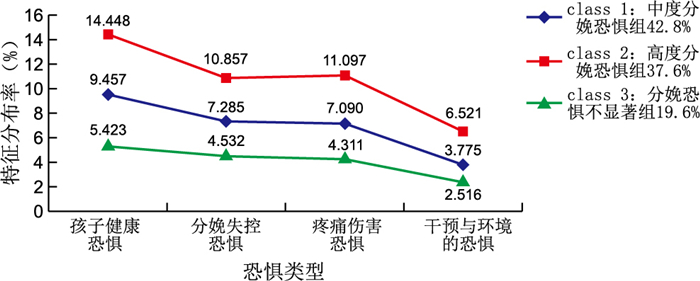
图 1 妊娠晚期妇女分娩恐惧3个潜在剖面的特征分布
Figure 1. Characteristics distribution across three latent profiles of childbirth fear in third-trimester pregnant women
表 1 妊娠晚期妇女分娩恐惧潜在剖面类别命名及特点
Table 1. Nomenclature and characteristics of latent profile classes for childbirth fear among third-trimester pregnant women
class AIC BIC aBIC Entropy LMR(P) BLRT(P) 类别概率(%) class 1 3 954.256 3 980.683 3 955.337 class 2 3 427.598 3 470.541 3 429.355 0.948 <0.001 <0.001 0.587/0.413 class 3 3 284.171 3 343.631 3 286.604 0.905 0.002 <0.001 0.428/0.376/0.196 class 4 3 172.859 3 248.835 3 175.967 0.918 0.217 <0.001 0.169/0.423/0.274/0.134  下载: 导出CSV
表 2 不同分娩恐惧潜在剖面类别妊娠晚期妇女一般资料单因素分析
Table 2. Single-factor analysis of general data of pregnant women with different latent profiles of fear of childbirth in the late stage of pregnancy
项目 例数 中度分娩恐惧组(n=86) 重度分娩恐惧组(n=77) 分娩恐惧不显著组(n=38) 统计量 P值 年龄 6.967a 0.138 <20岁 6(3.0) 3(1.5) 3(1.5) 0 20~25岁 38(18.9) 15(7.5) 15(7.5) 8(4.9) >25~30岁 78(38.8) 30(14.9) 33(16.4) 15(7.5) >30~35岁 63(31.3) 27(13.4) 21(10.4) 15(7.5) >35岁 16(8.0) 11(5.5) 5(2.5) 0 孕前检查 3.481b 0.175 有 142(70.6) 56(27.9) 55(27.4) 31(15.4) 无 59(29.4) 30(14.9) 22(10.9) 7(3.5) 孕检胎儿异常 1.153b 0.562 是 124(61.7) 50(24.9) 51(25.4) 23(11.4) 否 77(38.3) 36(17.9) 26(12.9) 15(7.5) 既往疾病史 2.819b 0.244 是 18(9.0) 7(3.54) 5(2.5) 6(3.0) 否 183(91.0) 79(39.3) 72(35.8) 32(15.9) 流产次数 0.864a 0.649 无 124(61.7) 52(25.9) 56(27.9) 16(8.0) 1次 49(24.4) 22(10.9) 13(6.5) 14(7.0) ≥2次 28(13.9) 12(6.0) 8(4.0) 8(4.0) 家庭月收入满意 6.947b 0.031 是 161(80.1) 68(33.8) 57(28.4) 36(17.9) 否 40(19.9) 18(9.0) 20(10.0) 2(1.0) 妊娠课程参加 6.254b 0.044 是 36(17.9) 14(7.0) 10(5.0) 12(6.0) 否 165(82.1) 72(35.8) 67(33.3) 26(12.9) 孕期知识了解度 7.219a 0.027 非常了解 28(13.9) 8(4.0) 8(4.0) 12(6.0) 部分了解 167(83.1) 75(37.3) 67(33.3) 25(12.4) 不了解 6(3.0) 3(1.5) 2(1.0) 1(0.5) 新生儿照护帮扶 8.070b 0.018 是 178(88.6) 81(40.3) 62(30.8) 35(17.4) 否 23(11.4) 5(2.5) 15(7.5) 3(1.5) 不良妊娠接触史 0.419b 0.811 是 21(10.4) 8(4.0) 8(4.0) 5(2.5) 否 180(89.6) 78(38.8) 69(34.3) 33(16.4) 教育程度 3.509a 0.320 小学 5(2.5) 1(0.5) 2(1.0) 2(1.0) 初高中 114(56.7) 48(23.9) 41(20.4) 25(12.4) 大学 81(40.3) 36(17.9) 34(16.9) 11(5.5) 研究生及以上 1(0.5) 1(0.5) 0 0 居住地 1.129b 0.569 农村 121(60.2) 53(26.4) 48(23.9) 20(10.0) 城市 80(39.8) 33(16.4) 29(14.4) 18(9.0) 心盛(x±s, 分) 201(100.0) 45.35±9.25 42.81±10.44 49.18±10.75 5.213c 0.006 家庭复原力(x±s, 分) 201(100.0) 157.60±35.17 169.26±31.68 173.71±53.77 3.056c 0.045 注:a为H值,b为χ2值,c为F值。其余计数资料均以[例(%)]表示。
下载: 导出CSV
表 3 自变量赋值情况
Table 3. Definition and coding of independent variables
变量 赋值方法 分娩恐惧LPA分级 中度分娩恐惧组=1,重度分娩恐惧组=2,分娩恐惧不显著组=3 家庭月收入满意 否=0,是=1 参加妊娠课程 否=0,是=1 孕期知识了解 不了解=1,部分了解=2,非常了解=3 新生儿照护帮扶 否=0,是=1 心盛 以实际值赋值 家庭复原力 以实际值赋值
下载: 导出CSV
表 4 妊娠晚期妇女分娩恐惧潜在剖面类别影响因素的多元logistic回归模型
Table 4. Multivariate logistic regression model for the influencing factors of potential fear of childbirth in pregnant women during the late stage of pregnancy
项目 中度分娩恐惧组 重度分娩恐惧组 B OR(95% CI) P值 B OR(95% CI) P值 心盛 -0.019 0.981(0.927~1.039) 0.516 -0.091 0.913(0.856~0.977) 0.007 家庭复原力 -0.007 0.993(0.981~1.005) 0.230 -0.019 1.019(1.003~1.035) 0.023 不满意家庭月收入 1.326 3.766(0.777~18.259) 0.100 1.611 5.008(1.015~24.708) 0.048 不参加妊娠课程 0.420 1.522(0.567~4.088) 0.405 0.845 2.327(0.795~6.809) 0.123 无新生儿照护帮扶 -1.054 0.349(0.071~1.721) 0.196 0.487 1.628(0.376~7.040) 0.514 孕期知识了解程度 不了解 1.278 3.588(0.270~47.735) 0.333 1.051 2.859(0.177~46.134) 0.459 部分了解 1.356 3.880(1.295~11.630) 0.015 0.866 2.377(0.778~7.261) 0.129 注:孕期知识了解程度以非常了解孕期知识为参照组。
下载: 导出CSV
-
[1] 孙佳蓉, 董丽媛, 王娇, 等. 分娩恐惧初产妇分娩方式影响因素的质性研究[J]. 护理研究, 2023, 37(11): 2033-2037.Sun J R, Dong L Y, Wang J, et al. Factors influencing delivery mode in primiparas with childbirth fear: a qualitative study[J]. Chin J Nurs Res, 2023, 37(11): 2033-2037. [2] 赵金龙, 陆慧, 肖凌燕, 等. 妊娠中晚期心理健康现状及其影响因素的研究[J]. 中华全科医学, 2024, 22(4): 629-632. doi: 10.16766/j.cnki.issn.1674-4152.003467Zhao J L, Lu H, Xiao L Y, et al. Factors influencing mental health status in mid-to-late pregnancy: a cross-sectional study[J]. Chin J Gen Pract, 2024, 22(4): 629-632. doi: 10.16766/j.cnki.issn.1674-4152.003467 [3] 白雪, 张广意, 马嫔, 等. 阴道分娩产妇分娩期全流程护理方案的构建及应用研究[J]. 中华护理杂志, 2025, 60(1): 10-17.Bai X, Zhang G Y, Ma P, et al. Development and application of a whole-process nursing protocol for vaginal delivery during labor[J]. Chin J Nurs, 2025, 60(1): 10-17. [4] 陈欢, 郑慧, 许燕. 高龄经阴道分娩初产妇分娩恐惧现状及影响因素分析[J]. 当代护士(上旬刊), 2023, 30(11): 106-110.Chen H, Zheng H, Xu Y. Childbirth fear and influencing factors in elderly primiparas undergoing vaginal delivery[J]. Mod Nurse, 2023, 30(11): 106-110. [5] HUANG J, HUANG J, LI Y, et al. The prevalence and predictors of fear of childbirth among pregnant Chinese women: a hierarchical regression analysis[J]. BMC Pregnancy Childbirth, 2021, 21(1): 643. DOI: 10.1186/s12884-021-04123-7. [6] 张艳芳, 丁京, 于园园, 等. 基于潜在剖面分析的乳腺癌术后化疗患者应对方式分型及其影响因素分析[J]. 中华全科医学, 2024, 22(2): 326-330. doi: 10.16766/j.cnki.issn.1674-4152.003395Zhang Y F, Ding J, Yu Y Y, et al. Latent profile analysis of coping styles and influencing factors in breast cancer patients receiving postoperative chemotherapy[J]. Chin J Gen Pract, 2024, 22(2): 326-330. doi: 10.16766/j.cnki.issn.1674-4152.003395 [7] 倪平, 陈京立, 刘娜. 护理研究中量性研究的样本量估计[J]. 中华护理杂志, 2010, 45(4): 378-380.Ni P, Chen J L, Liu N. Sample size estimation in quantitative nursing research[J]. Chin J Nurs, 2010, 45(4): 378-380. [8] 危娟, 刘洁英, 张莉芳, 等. 分娩恐惧量表的汉化及信效度检测[J]. 护理学杂志, 2016, 31(2): 81-83.Wei J, Liu J Y, Zhang L F, et al. Translation and cultural adaptation of the Childbirth Fear Questionnaire with validation of its reliability and validity[J]. J Nurs Sci, 2016, 31(2): 81-83. [9] 赖巧珍. 大学生心盛状况及其在心理健康双因素模型中的应用研究[D]. 广州: 南方医科大学, 2018.Lai Q Z. Psychological flourishing status of college students and its application in the dual-factor model of mental health[D]. Guangzhou: Southern Medical University, 2018. [10] 董超群, 高晨晨, 赵海峰. 家庭复原力评估量表汉化及用于慢性病患儿家庭的信效度分析[J]. 护理学杂志, 2018, 33(2): 93-97.Dong C Q, Gao C C, Zhao H F. Chinese translation and validation of the Family Resilience Assessment Scale for families with chronically ill children[J]. J Nurs Sci, 2018, 33(10): 93-97. [11] WANG J, BI X, WANG J, et al. Chinese parents' caregiving ability for children with haematologicalmalignancies: a latent class analysis[J]. Nurs Open, 2022, 9(4): 2073-2083. doi: 10.1002/nop2.1218 [12] 朱行澜, 刘颖, 黄乐琴. 分娩情景云预览在初产妇产前分娩恐惧和分娩结局中的应用及效果评价[J]. 重庆医学, 2024, 53(11): 1752-1756.Zhu X L, Liu Y, Huang L Q. Cloud-based childbirth scenario preview for childbirth fear and delivery outcomes in primiparas: application and efficacy evaluation[J]. Chongqing Med, 2024, 53(11): 1752-1756. [13] 郭亚琼, 阳晓丽, 陈丽琴, 等. 心理弹性在孕晚期妇女妊娠相关焦虑与母胎依恋间的中介效应[J]. 中国健康心理学杂志, 2024, 32(11): 369-375.Guo Y Q, Yang X L, Chen L Q, et al. Resilience as a mediator between pregnancy-related anxiety and maternal-fetal attachment in third-trimester women[J]. Chin J Health Psychol, 2024, 32(3): 369-375. [14] 刘美英, 章敏, 袁桂香. 初产妇分娩恐惧现状及影响因素分析[J]. 当代护士(中旬刊), 2024, 31(3): 127-131.Liu M Y, Zhang M, Yuan G X. Childbirth fear and associated factors in primiparas[J]. Mod Nurse, 2024, 31(3): 127-131. [15] 郑敏珠, 陈红, 陈伶奕, 等. 基于虚拟产房的产前分娩体验对初产妇心理和妊娠结局的影响研究[J]. 浙江医学, 2023, 45(21): 2329-2331.Zheng M Z, Chen H, Chen L Y, et al. Impact of virtual delivery room-based prenatal experience on psychological status and pregnancy outcomes in primiparas[J]. Zhejiang Med J, 2023, 45(21): 2329-2331. [16] 王璊玺. 不同妊娠期妇女主观幸福感、妊娠压力与社会支持相关性的探讨[D]. 哈尔滨: 黑龙江中医药大学, 2021.Wang M X. Correlations among subjective well-being, pregnancy stress and social support in women at different gestational stages[D]. Harbin: Heilongjiang Univ Chin Med, 2021. [17] 燕美琴, 闫高慧, 任永莲, 等. 积极心理干预对孕妇分娩恐惧和总体幸福感的影响[J]. 中华护理杂志, 2022, 57(24): 2957-2963.Yan M Q, Yan G H, Ren Y L, et al. Effects of positive psychological intervention on childbirth fear and general well-being in pregnant women[J]. Chin J Nurs, 2022, 57(24): 2957-2963. [18] SILVERMAN H D, GRUNAUER M. The clinician's role in promoting resiliency for individuals and families with growth anomalies[J]. Growth Horm IGF Res, 2020, 51: 34-37. doi: 10.1016/j.ghir.2020.01.004 [19] ÖCALAN S, ÜZAR-ÖZÇETIN Y S. The relationship between rumination, fatigue and psychological resilience among cancer survivors[J]. J Clin Nurs, 2022, 31(23-24): 3595-3604. doi: 10.1111/jocn.16187 [20] 牛衍芝, 李媛, 黄孝玲. 癌症幸存者家庭复原力的研究进展[J]. 医学与哲学, 2022, 43(19): 55-58.Niu Y Z, Li Y, Huang X L. Research progress on family resilience in cancer survivors[J]. Med Philos, 2022, 43(19): 55-58.
 点击查看大图
计量
- 文章访问数: 3
- HTML全文浏览量: 1
- PDF下载量: 0
- 被引次数: 0
