



Current status and influencing factors of sedentary behavior during treatment intervals in lung cancer patients
-
摘要:
目的 了解肺癌患者治疗间歇期静态行为现状及影响因素,为今后制定针对性干预方案提供参考。 方法 便利抽取2024年4—7月在浙江大学医学院附属第一医院就诊的310例肺癌患者,运用一般资料调查表、中国成人静态行为问卷、日常生活活动能力Barthel指数、疼痛数字评定量表、呼吸困难改良量表、医院焦虑抑郁量表、领悟社会支持量表、Tilburg衰弱量表进行问卷调查。采用二元logistic回归分析研究肺癌患者治疗间歇期静态行为的影响因素。 结果 共回收有效问卷308份。调查结果显示,肺癌患者治疗间歇期静态行为时间为6.25(4.50, 7.50)h。二元logistic回归分析结果显示, 肺癌类型(OR=2.408,95% CI:1.251~4.695,P=0.009)、日常生活活动能力(OR=0.961,95% CI:0.937~0.984,P=0.001)、焦虑抑郁(OR=1.033,95% CI:1.004~1.065,P=0.028)、领悟社会支持(OR=0.971,95% CI:0.948~0.993,P=0.011)与衰弱(OR=3.225,95% CI:1.891~ 5.605,P < 0.001)均是肺癌患者治疗间歇期静态行为的影响因素。 结论 肺癌患者治疗间歇期静态行为时间较长,未来可根据影响因素制定干预方案,改善患者静态行为。 Abstract:Objective To investigate the current status and influencing factors of sedentary behavior during the treatment intermission in lung cancer patients, providing a reference for the development of targeted intervention strategies in the future. Methods A convenient sampling method was employed to select 310 lung cancer patients who visited the First Affiliated Hospital of Zhejiang University School of Medicine from April to July 2024. Data were collected through a series of questionnaires, including a general information questionnaire, the Chinese version of the adult sedentary behavior questionnaire, the Barthel Index for activities of daily living, numerical rating scale for pain, modified Medical Research Council scale, hospital anxiety and depression scale, perceived social support scale, and the Tilburg frailty indicator. Binary logistic regression was used to identify the factors influencing sedentary behavior during the treatment intermission in lung cancer patients. Results A total of 308 valid questionnaires were collected. The survey results revealed that the time spent on sedentary behavior during the treatment intermission was 6.25 (4.50, 7.50) hours. Binary logistic regression analysis identified lung cancer type (OR=2.408, 95% CI: 1.251-4.695, P=0.009), activities of daily living (OR=0.961, 95% CI: 0.937-0.984, P=0.001), anxiety and depression (OR=1.033, 95% CI: 1.004-1.065, P=0.028), perceived social support (OR=0.971, 95% CI: 0.948-0.993, P=0.011), and frailty (OR=3.225, 95% CI: 1.891-5.605, P < 0.001) as significant factors influencing sedentary behavior during the treatment intermission in lung cancer patients. Conclusion Lung cancer patients exhibit prolonged sedentary behavior during the treatment intermission. Based on these influencing factors, future intervention strategies can be designed to address and improve sedentary behavior in this patient population. -
Key words:
- Lung cancer /
- Sedentary behavior /
- Influencing factors
-

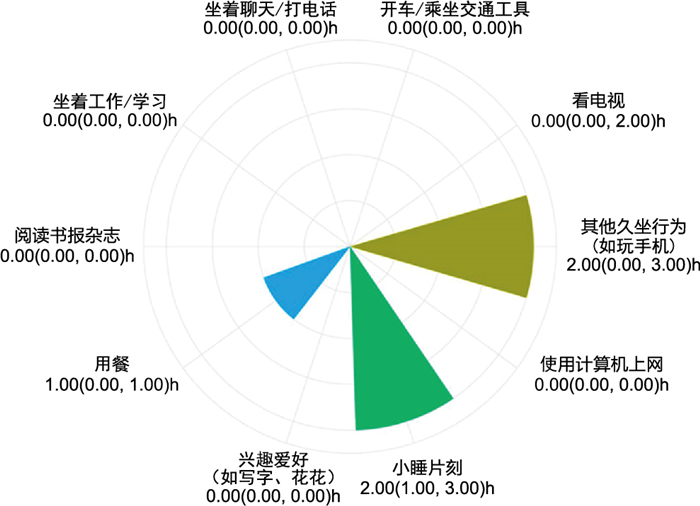
图 1 肺癌患者治疗间歇期SBQ时间
Figure 1. The SBQ time for lung cancer patients during the treatment interval
表 1 肺癌患者治疗间歇期静态行为的单因素分析
Table 1. Univariate analysis of sedentary behavior in patients with lung cancer during the treatment interval
项目 静态行为组(n=192) 非静态行为组(n=116) 统计量 P值 性别[例(%)] 0.849a 0.358 男性 151(78.65) 97(83.62) 女性 41(21.35) 19(16.38) 年龄[M(P25, P75), 岁] 67.00(61.00, 72.00) 64.50(57.75, 68.25) 3.755b <0.001 婚姻状况[例(%)] 0.394a 0.530 已婚 181(94.27) 112(96.55) 单身 11(5.73) 4(3.45) 文化程度[例(%)] 1.709b 0.087 文盲 40(20.83) 14(12.07) 小学 96(50.00) 61(52.59) 初中 44(22.92) 34(29.31) 高中 8(4.17) 4(3.45) 专科 3(1.56) 2(1.72) 本科及以上 1(0.52) 1(0.86) 居住地[例(%)] 0.030a 0.863 农村 101(52.60) 63(54.31) 城镇 91(47.40) 53(45.69) 居住方式[例(%)] 7.405a 0.025 独居 32(16.67) 7(6.03) 与配偶居住 112(58.33) 77(66.38) 与配偶子女居住 48(25.00) 32(27.59) BMI[M(P25, P75)] 21.64(19.89, 24.14) 22.61(20.05, 24.93) 1.300b 0.194 肺癌类型[例(%)] 8.117a 0.004 小细胞肺癌 29(15.1) 34(29.31) 非小细胞肺癌 163(84.9) 82(70.69) 肺癌分期[例(%)] 1.427b 0.154 Ⅰ期 10(5.21) 11(9.48) Ⅱ期 39 (20.13) 29(25.00) Ⅲ期 67 (34.90) 35(30.17) Ⅳ期 76 (39.58) 41(35.34) 病程[例(%)] 0.482b 0.629 ≤1年 81(42.19) 50(43.10) >1~3年 78(40.62) 50(43.10) >3~5年 12(6.25) 8(6.90) >5~10年 11(5.73) 4(3.45) >10年 10(5.21) 4(3.45) 继发胸腔积液[例(%)] 46(23.96) 19(16.38) 2.060a 0.151 继发心包积液[例(%)] 18(23.96) 7(6.03) 0.680a 0.409 继发脑转移[例(%)] 51(26.56) 25(21.55) 0.726a 0.394 继发静脉血栓栓塞症[例(%)] 28(14.58) 14(12.07) 0.204a 0.652 继发骨转移[例(%)] 43(22.4) 18(15.52) 1.743a 0.187 继发周围神经病[例(%)] 35(18.23) 26(22.41) 0.556a 0.456 合并心血管疾病[例(%)] 65(33.85) 48(41.38) 1.454a 0.228 BI评分[M(P25, P75), 分] 72.50(55.00, 85.00) 85.00(75.00, 90.00) 6.217b <0.001 NRS评分[M(P25, P75), 分] 1.00(0.00, 2.00) 0.00(0.00, 2.00) 1.948b 0.051 mMRC评分[M(P25, P75), 分] 2.00(2.00, 3.00) 2.00(2.00, 2.00) 4.784b <0.001 HADS评分[M(P25, P75), 分] 20.50(12.75, 27.00) 15.00(7.00, 23.00) 3.325b <0.001 PSSS评分[M(P25, P75), 分] 42.00(34.00, 54.00) 49.00(42.00, 58.00) 4.484b <0.001 TFI评分[M(P25, P75), 分] 3.00(2.00, 3.00) 2.00(2.00, 3.00) 5.739b <0.001 注:a为χ2值,b为Z值。  下载: 导出CSV
表 2 肺癌患者静态行为的单因素和多因素分析
Table 2. Univariate and multivariate analysis of sedentary behavior in patients with lung cancer
变量 单因素 多因素 OR(95% CI) P值 OR(95% CI) P值 年龄 1.055(1.025~1.086) <0.001 1.030(0.994~1.068) 0.104 肺癌类型 2.331(1.331~4.110) 0.003 2.408(1.251~4.695) 0.009 BI评分 0.950(0.933~0.966) <0.001 0.961(0.937~0.984) 0.001 NRS评分 1.272(1.017~1.603) 0.038 1.099(0.812~1.494) 0.543 mMRC评分 2.087(1.530~2.909) <0.001 0.936(0.603~1.457) 0.766 HADS评分 1.040(1.015~1.066) 0.002 1.033(1.004~1.065) 0.028 PSSS评分 0.956(0.938~0.974) <0.001 0.971(0.948~0.993) 0.011 TFI评分 3.877(2.442~6.259) <0.001 3.225(1.891~5.605) <0.001 注:单因素分析仅列出差异有统计学意义的变量。
下载: 导出CSV
-
[1] BRAY F, LAVERSANNE M, SUNG H, et al. Global cancer statistics 2022: GLOBOCAN estimates of incidence and mortality worldwide for 36 cancers in 185 countries[J]. CA Cancer J Clin, 2024, 74(3): 229-263. [2] XIA C, DONG X, LI H, et al. Cancer statistics in China and United States, 2022: profiles, trends, and determinants[J]. Chin Med J(Engl), 2022, 135(5): 584-590. [3] 陈思晴, 杨丽黎, 杨宇婷, 等. 移动健康干预在老年人静态行为中应用的研究进展[J]. 中国护理管理, 2023, 23(12): 1878-1882.Chen S Q, Yang L L, Yang Y T, et al. Research progress on mobile health intervention of sedentary behavior in older adults[J]. Chinese Nursing Management, 2023, 23(12): 1878-1882. [4] MARKOZANNES G, BECERRA-TOMÁS N, CARIOLOU M, et al. Post-diagnosis physical activity and sedentary behaviour and colorectal cancer prognosis: a global cancer update programme (CUP Global) systematic literature review and meta-analysis[J]. Int J Cancer, 2024, 155(3): 426-444. doi: 10.1002/ijc.34903 [5] 李佳欣, 刘子薇, 尚娅萌, 等. 癌症患者久坐行为的研究进展[J]. 护理学报, 2022, 29(23): 22-27.Li J X, Liu Z W, Shang Y M, et al. Research progress on sedentary behavior in cancer patients[J]. Journal of Nursing(China), 2022, 29(23): 22-27. [6] BULL F C, AL-ANSARI S S, BIDDLE S, et al. World health organization 2020 guidelines on physical activity and sedentary behaviour[J]. Br J Sports Med, 2020, 54(24): 1451-1462. doi: 10.1136/bjsports-2020-102955 [7] ROCK C L, THOMSON C A, SULLIVAN K R, et al. American cancer society nutrition and physical activity guideline for cancer survivors[J]. CA Cancer J Clin, 2022, 72(3): 230-262. [8] CH'NG S N, MCVEIGH J A, MANNERS D, et al. Sedentary behaviour, physical activity, and their associations with health outcomes at the time of diagnosis in people with inoperable lung cancer[J]. J Clin Med, 2022, 11(19): 5870. doi: 10.3390/jcm11195870 [9] D'SILVA A, BEBB G, BOYLE T, et al. Demographic and clinical correlates of accelerometer assessed physical activity and sedentary time in lung cancer survivors[J]. Psychooncology, 2018, 27(3): 1042-1049. doi: 10.1002/pon.4608 [10] 付忠荣, 张振香, 林蓓蕾, 等. 社区脑卒中患者久坐行为现状及影响因素研究[J]. 中国全科医学, 2022, 25(7): 846-850.Fu Z R, Zhang Z X, Lin B L, et al. Prevalence and influencing factors of sedentary behavior in community stroke patients[J]. Chinese General Practice, 2022, 25(7): 846-850. [11] 周丹丹, 钮美娥, 韩燕霞, 等. 慢性阻塞性肺疾病患者久坐行为改变阻碍因素的质性研究[J]. 护士进修杂志, 2021, 36(22): 2085-2089.Zhou D D, Niu M E, Han Y X, et al. A qualitative study of barriers to changing sedentary behavior among patients with chronic obstructive pulmonary disease[J]. Journal of Nurses Training, 2021, 36(22): 2085-2089. [12] 许静, 张会, 仲蕾, 等. 稳定期慢性心力衰竭患者久坐行为现状及影响因素分析[J]. 中华全科医学, 2024, 22(8): 1305-1309. doi: 10.16766/j.cnki.issn.1674-4152.003622Xu J, Zhang H, Zhong L, et al. Current status and influencing factors of sedentary behavior in patients with stable chronic heart failure[J]. Chinese Journal of General Practice, 2024, 22(8): 1305-1309. doi: 10.16766/j.cnki.issn.1674-4152.003622 [13] 逯莹, 甘红艳, 杨玉金, 等. 下肢动脉硬化闭塞症患者静态行为现状及其影响因素研究[J]. 中华护理杂志, 2023, 58(6): 714-720.Lu Y, Gan H Y, Yang Y J, et al. Study on sedentary behavior and its influencing factors in patients with arteriosclerosis obliterans[J]. Chinese Journal of Nursing, 2023, 58(6): 714-720. [14] CHEN L Y, FANG T J, LIN Y C, et al. Exploring the mediating effects of cognitive function, social support, activities of daily living and depression in the relationship between age and frailty among community-dwelling elderly[J]. Int J Environ Res Public Health, 2021, 18(23): 12543. DOI: 10.3390/ijerph182312543. [15] 缪小浪, 钮美娥, 韩燕霞, 等. 慢性阻塞性肺疾病患者呼吸困难恐惧影响因素及路径分析[J]. 护理学杂志, 2024, 39(18): 37-41, 47.Miao X L, Niu M E, Han Y X, et al. Influencing factors and pathway analysis of dyspnea-related fear in patients with chronic obstructive pulmonary disease[J]. Journal of Nursing Science, 39(18): 37-41, 47. [16] 崔玉, 赵秋平, 康俊贤, 等. 中高龄罹患慢性病老年人衰弱与抑郁的关系研究[J]. 护士进修杂志, 2024, 39(3): 236-240.Cui Y, Zhao Q P, Kang J X, et al. Study on the relationship between frailty and depression in middle-aged and elderly people with chronic diseases[J]. Journal of Nurses Training, 2024, 39(3): 236-240. [17] 朱纯静, 陈鸟鸟, 汪少艳, 等. 结直肠癌患者久坐行为现状及影响因素研究[J]. 中华全科医学, 2023, 21(9): 1478-1481. doi: 10.16766/j.cnki.issn.1674-4152.003150Zhu C J, Chen N N, Wang S Y, et al. Sedentary behavior and its influencing factors among patients with colorectal cancer[J]. Chinese Journal of General Practice, 2023, 21(9): 1478-1481. doi: 10.16766/j.cnki.issn.1674-4152.003150 [18] 王光, 郭震. 国外静态行为问卷测量工具的研究进展述评[J]. 体育学刊, 2017, 24(6): 67-71.Wang G, Guo Z. Static behavior questionnaire measurement tool research developments overseas and inspirations therefrom[J]. Journal of Physical Education, 2017, 24(6): 67-71. [19] WHIPPLE M O, REGENSTEINER J G, BERGOUIGNAN A. Is being physically active enough to be metabolically healthy?The key role of sedentary behavior[J]. Diabetes Care, 2021, 44(1): 17-19. doi: 10.2337/dci20-0064 [20] 汪燃, 黄菲. 中老年肺癌患者胸部放疗期间症状群的调查及护理对策[J]. 中华护理杂志, 2023, 58(13): 1596-1602.Wang R, Huang F. Longitudinal study on symptom groups of middle-aged and elderly lung cancer patients during chest radiotherapy[J]. Chinese Journal of Nursing, 2023, 58(13): 1596-1602. [21] 叶艳欣, 秦岚, 骆佳慧, 等. 肺癌患者化疗相关症状群的发生现状及影响因素分析[J]. 中华护理杂志, 2023, 58(18): 2230-2238.Ye Y X, Qin L, Luo J H, et al. Study on status and influencing factors of chemotherapy related symptom cluster among lung cancer patients[J]. Chinese Journal of Nursing, 2023, 58(18): 2230-2238. [22] 江小艳, 张华, 侯黎莉. 肺癌幸存者体力活动的研究进展[J]. 临床与病理杂志, 2020, 40(2): 464-469.Jiang X Y, Zhang H. Research progress on physical activity in lung cancer survivors[J]. Journal of Clinical and Pathological Research, 2020, 40(2): 464-469. [23] PINTO B, KINDRED M, DUNSIGER S, et al. Sedentary behavior among breast cancer survivors: a longitudinal study using ecological momentary assessments[J]. J Cancer Surviv, 2021, 15(4): 546-553. doi: 10.1007/s11764-020-00948-x [24] KINDRED M M, PINTO B M, DUNSIGER S I. Predictors of sedentary behavior among colorectal survivors[J]. Support Care Cancer, 2019, 27(6): 2049-2056. [25] 吴杏尧, 曹慧娇. 老年肺癌患者术前衰弱风险列线图预测模型构建与评估[J]. 中国老年学杂志, 2022, 42(12): 3098-3102.Wu X Y, Cao H J. Development and evaluation of a nomogram prediction model for preoperative frailty risk in elderly patients with lung cancer[J]. Chinese Journal of Gerontology, 42(12): 3098-3102. [26] 粟榆茜, 阎文军. 肺癌患者合并衰弱的研究进展[J]. 中华老年多器官疾病杂志, 2023, 22(9): 704-707.Su Y Q, Yan W J. Research progress in complicated frailty in lung cancer patients[J]. Chinese Journal of Multiple Organ Diseases in the Elderly, 2023, 22(9): 704-707.
 点击查看大图
图(1) / 表(2)
计量
- 文章访问数: 7
- HTML全文浏览量: 2
- PDF下载量: 0
- 被引次数: 0
