



A case study on community-based sarcopenia management by general practitioners based on expert consensus
-
摘要: 本文报道1例肌少症患者在社区进行筛查及干预的全过程,将病例与专家共识相结合,为全科医生筛查肌少症患者并进行干预提供思路和借鉴。病例为1例老年女性,在常规骨质疏松症专病门诊就诊过程中,因长期乏力、消瘦,被全科医生留意到是否患有肌少症,进一步检查发现患者握力17.6 kg,四肢骨骼肌质量3.98 kg/m2(生物电阻分析BIA法),明确诊断为肌少症。由上级医院老年科联合我中心全科医生、康复师、营养师共同制定干预方案,包括制定个体化营养干预计划及运动干预处方,对患者进行肌少症社区干预。经过26周干预,患者肌力、肌量、5次起坐试验、6米步速均有提高。目前少数综合医院尝试开展肌少症门诊,基层医院鲜有,本文针对如何能有效地把肌少症防治落实到社区,将肌少症防治窗口前移进行探讨,全科医生可借鉴此案例,帮助有效地开展肌少症筛查、防治工作。Abstract: This article describes the complete process of screening and intervention for a patient with sarcopenia in a community setting. By integrating a real-world case with expert consensus, it provides practical insights for general practitioners into the screening and management of sarcopenia. The patient was an elderly female identified during a routine osteoporosis clinic visit who presented with persistent fatigue and unintentional weight loss. Further evaluation revealed a grip strength of 17.6 kg and an appendicular skeletal muscle mass index of 3.98 kg/m2, measured via bioelectrical impedance analysis (BIA), confirming a diagnosis of sarcopenia. An interdisciplinary team comprising geriatric specialists from a tertiary hospital, general practitioners, rehabilitation therapists, and nutritionists from our center collaboratively designed an intervention plan that incorporated individualized nutrition and exercise programs for community-based sarcopenia management. After 26 weeks of intervention, improvements were observed in muscle strength, muscle mass, 5-times sit-to-stand test, and 6-meter walking speed. Although some comprehensive hospitals have established sarcopenia clinics, such initiatives remain limited in primary care settings. This article explores feasible strategies for the prevention and management of sarcopenia within communities, emphasizing on early identification and intervention. This findings from this case may assist general practitioners in improving sarcopenia screening, prevention, and treatment practices in community healthcare.
-

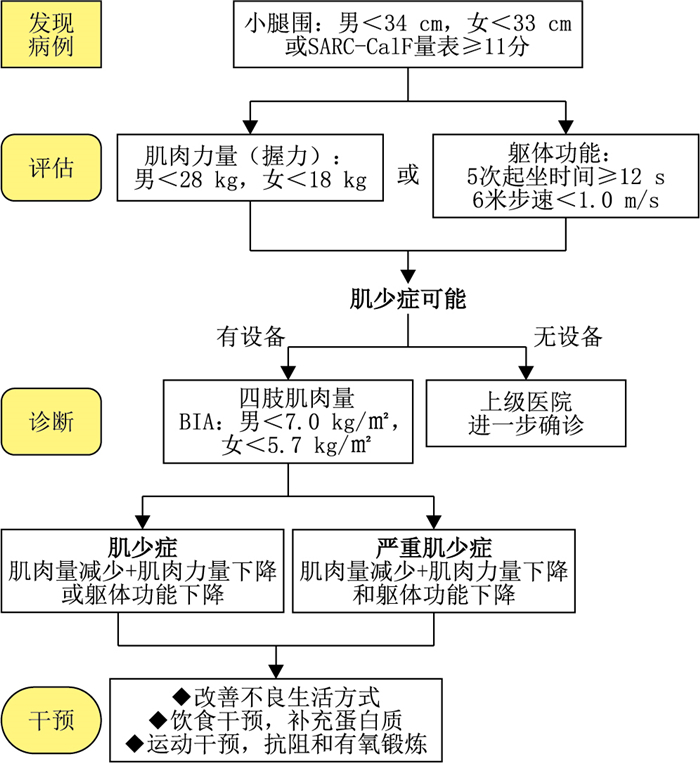
图 1 社区肌少症诊疗流程
Figure 1. Diagnosis and treatment pathway for sarcopenia in community healthcare settings
表 1 该例患者肌少症评估情况
Table 1. Evaluation of sarcopenia for the patient
项目 肌力(最大握力) 肌量(四肢骨骼肌质量ASMI) 5次起坐试验 SPPB 6米步速 诊断切点 男性<28 kg,女性<18 kg ①男性≤7.0 kg/m2,女性≤5.7 kg/m2(生物电阻抗分析BIA法);
②或男性≤7.0kg/m2,女性≤5.4kg/m2(双能X线吸光仪DXA法)≥12 s ≤9分 最大歩速<1.0 m/s 患者情况 17.6 kg 3.98 kg/m2(生物电阻分析BIA法) 8.2 s 12分 0.95 m/s  下载: 导出CSV
表 2 该患者个性化运动干预处方
Table 2. Individualized exercise prescription for the patient
阶段 热身 正式运动 恢复整理 第1个月 拉伸运动5 min 双桥运动10 min,上肢举哑铃运动10 min,下肢弹力带抗阻训练(髋屈曲、外展、后伸)10 min 温和拉伸5 min 第2~4个月 拉伸运动5 min 双桥运动5 min,侧桥运动5 min,空蹬自行车训练5 min,上肢举哑铃训练10 min,下肢弹力带抗阻训练(膝伸展、髋屈曲、外展、后伸)10 min 温和拉伸5 min 第5~6个月 拉伸运动5 min 双桥运动5 min,侧桥运动5 min,空蹬自行车训练5 min,直腿抬高训练5 min,上肢举哑铃训练10 min,下肢弹力带抗阻训练(膝伸展、髋屈曲、外展、后伸)10 min 温和拉伸5 min
下载: 导出CSV
表 3 该患者干预前后体格检查和辅助检查情况
Table 3. Physical and auxiliary examinations before and after intervention for the patient
时间 体重(kg) BMI 臂中围(cm) 小腿围(cm) 白蛋白(g/L) 血清25羟-维生素D(ng/mL) 基线 45 16.7 21 30 41.1 17.89 26周后 48 18.1 22 30 44.0 13.99
下载: 导出CSV
表 4 该患者干预前后肌少症相关指标情况
Table 4. Sarcopenia-related parameters before and after intervention for the patient
时间 肌力(最大握力) 肌量(四肢骨骼肌质量ASMI) 5次起坐试验 SPPB 6米步速 MNA Fried衰弱表型 基线 17.6 kg 3.98 kg/m2 8.2 s 12分 0.95 m/s 19.5分 衰弱前期 26周后 18.3 kg 4.34 kg/m2 7.6 s 12分 1.05 m/s 20.0分 无衰弱
下载: 导出CSV
-
[1] DELMONICO M J, HARRIS T B, LEE J S, et al. Alternative definitions of sarcopenia, lower extremity performance, and functional impairment with aging in older men and women[J]. J Am Geriatr Soc, 2007, 55: 769-774. doi: 10.1111/j.1532-5415.2007.01140.x [2] GOODPASTER B H, PARK S W, HARRIS T B, et al. The loss of skeletal muscle strength, mass, and quality in older adults: the health, aging and body composition study[J]. J Gerontol A Biol Sci Med Sci, 2006, 61: 1059-1064. doi: 10.1093/gerona/61.10.1059 [3] 周璇, 陈文英, 张珊, 等. 社区老年人不同程度肌少症与跌倒风险的关系研究[J]. 中华全科医学, 2021, 19(5): 821-824, 845. doi: 10.16766/j.cnki.issn.1674-4152.001926Zhou X, Chen W Y, Zhang S, et al. Study on the relationship between different degrees of sarcopenia and the risk of falls in the elderly in the community[J]. Chinese Journal of General Practice, 2021, 19(5): 821-824, 845. doi: 10.16766/j.cnki.issn.1674-4152.001926 [4] 刘娟, 丁清清, 周白瑜, 等. 中国老年人肌少症诊疗专家共识(2021)[J]. 中华老年医学杂志, 2021, 40(8): 943-952.Liu J, Ding Q Q, Zhou B Y, et al. Chinese expert consensus on diagnosis and treatment for elderly with sarcopenia (2021)[J]. Chinese Journal of Geriatrics, 2021, 40(8): 943-952. [5] ROBERTS S, COLLINS P, RATTRAY M. Identifying and managing malnutrition, frailty and sarcopenia in the community: a narrative review[J]. Nutrients, 2021, 13(7): 2316. DOI: 10.3390/nu13072316. [6] 陈丽娟, 黄欢欢, 唐娇, 等. 社区老年人肌少症非药物管理的最佳证据总结[J]. 重庆医学, 2024, 53(23): 3625-3632.Chen L J, Huang H H, Tang J, et al. Summary of best evidences on non-pharmacological management of sarcopenia in community-dwelling older adults[J]. Chongqing Medicine, 2024, 53(23): 3625-3632. [7] 崔华, 王朝晖, 吴剑卿, 等. 老年人肌少症防控干预中国专家共识(2023)[J]. 中华老年医学杂志, 2023, 42(2): 144-153.Cui H, Wang Z H, Wu J Q, et al. Chinese expert consensus on prevention and intervention for elderly with sarcopenia (2023)[J]. Chinese Journal of Geriatrics, 2023, 42(2): 144-153. [8] 黄宏兴, 史晓林, 李盛华, 等. 肌少-骨质疏松症专家共识[J]. 中国骨质疏松杂志, 2022, 28(11): 1561-1570.Huang H X, Shi X L, Li S H, et al. Sarcopenia-osteoporosis expert consensus[J]. Chinese Journal of Osteoporosis, 2022, 28(11): 1561-1570. [9] 于普林, 高超, 周白瑜, 等. 预防老年人肌少症核心信息中国专家共识(2021)[J]. 中华老年医学杂志, 2021, 40(8): 953-954.Yu P L, Gao C, Zhou B Y, et al. Chinese expert consensus on core information for sarcopenia prevention in the elderly (2021)[J]. Chinese Journal of Geriatrics, 2021, 40(8): 953-954. [10] CHEN L K, ARAI H, ASSANTACHAI P, et al. Roles of nutrition in muscle health of community-dwelling older adults: evidence-based expert consensus from Asian Working Group for Sarcopenia[J]. J Cachexia Sarcopenia Muscle, 2022, 13(3): 1653-1672. doi: 10.1002/jcsm.12981 [11] 张片红, 郭惠兰. 老年患者营养诊疗专家共识[J]. 浙江医学, 2023, 45(2): 113-120.Zhang P H, Guo H L. Expert consensus on nutritional diagnosis and treatment for elderly patients[J]. Zhejiang Medical Journal, 2023, 45(2): 113-120. [12] YE L, LIANG R, LIU X L, et al. Frailty and sarcopenia: a bibliometric analysis of their association and potential targets for intervention[J]. Ageing Res Rev, 2023, 92: 102111. DOI: 10.1016/j.arr.2023.102111. [13] 赵莹楚, 王小蕊, 葛政卿. 阶段性功能锻炼与抗阻运动对老年肌少症患者躯体功能和日常生活能力影响的对比[J]. 中国老年学杂志, 2022, 42(8): 1875-1878.Zhao Y C, Wang X R, Ge Z Q. Comparison of the effects of phased functional exercise versus resistance exercise on physical function and activities of daily living in elderly patients with sarcopenia[J]. Chinese Journal of Gerontology, 2022, 42(8): 1875-1878. [14] 沈家琪, 柯美英, 王海琴, 等. 衰弱指数和Fried衰弱表型在社区老年人衰弱评估中的比较研究[J]. 中国初级卫生保健, 2023, 37(9): 12-15.Shen J Q, Ke M Y, Wang H Q, et al. Comparison of frailty index and Fried frailty phenotype in evaluating frailty among community-dwelling elderly[J]. Chinese Primary Health Care, 2023, 37(9): 12-15. [15] MELLEN R H, GIROTTO O S, MARQUES E B, et al. Insights into pathogenesis, nutritional and drug approach in sarcopenia: a systematic review[J]. Biomedicines, 2023, 11(1): 136. DOI: 10.3390/biomedicines11010136. [16] 陈作兵, 窦祖林, 何成奇, 等. 中国老年人肌少症临床康复治疗指南[J]. 加速康复外科杂志, 2022, 5(1): 1-7.Chen Z B, Dou Z L, He C Q, et al. Clinical rehabilitation guidelines for sarcopenia in elderly Chinese patients[J]. Enhanced Recovery After Surgery, 2022, 5(1): 1-7. [17] 王颖, 颜轶隽, 刘蕾, 等. 抗阻力运动联合营养干预对老年2型糖尿病合并肌少症患者血糖稳定性影响的临床研究[J]. 中国全科医学, 2025, 28(21): 2604-2610.Wang Y, Yan Y J, Liu L, et al. Effects of resistance exercise combined with nutritional intervention on blood glucose stability in elderly patients with type 2 diabetes mellitus with Sarcopenia[J]. Chinese General Practice, 2025, 28(21): 2604-2610. [18] 张勤, 康琳, 王建业, 等. 老年人肌少症门诊管理规范中国专家共识(2024)[J]. 中华老年医学杂志, 2024, 43(12): 1511-1517.Zhang Q, Kang L, Wang J Y, et al. Chinese expert consensus on standardized outpatient management of sarcopenia in the elderly (2024 edition)[J]. Chinese Journal of Geriatrics, 2024, 43(12): 1511-1517. [19] 毕江涵, 康琳, 洪婷婷. 衰弱-肌少症门诊患者现况与干预效果分析[J]. 中国临床保健杂志, 2023, 26(1): 17-21.Bi J H, Kang L, Hong T T, et al. An analysis of outpatient diagnosis and treatment of frailty and sarcopenia[J]. Chinese Journal of Clinical Healthcare, 2023, 26(1): 17-21.
 点击查看大图
计量
- 文章访问数: 8
- HTML全文浏览量: 3
- PDF下载量: 0
- 被引次数: 0
